Category Archives: Editorial

The end of the Ross debate

INTRODUCTION

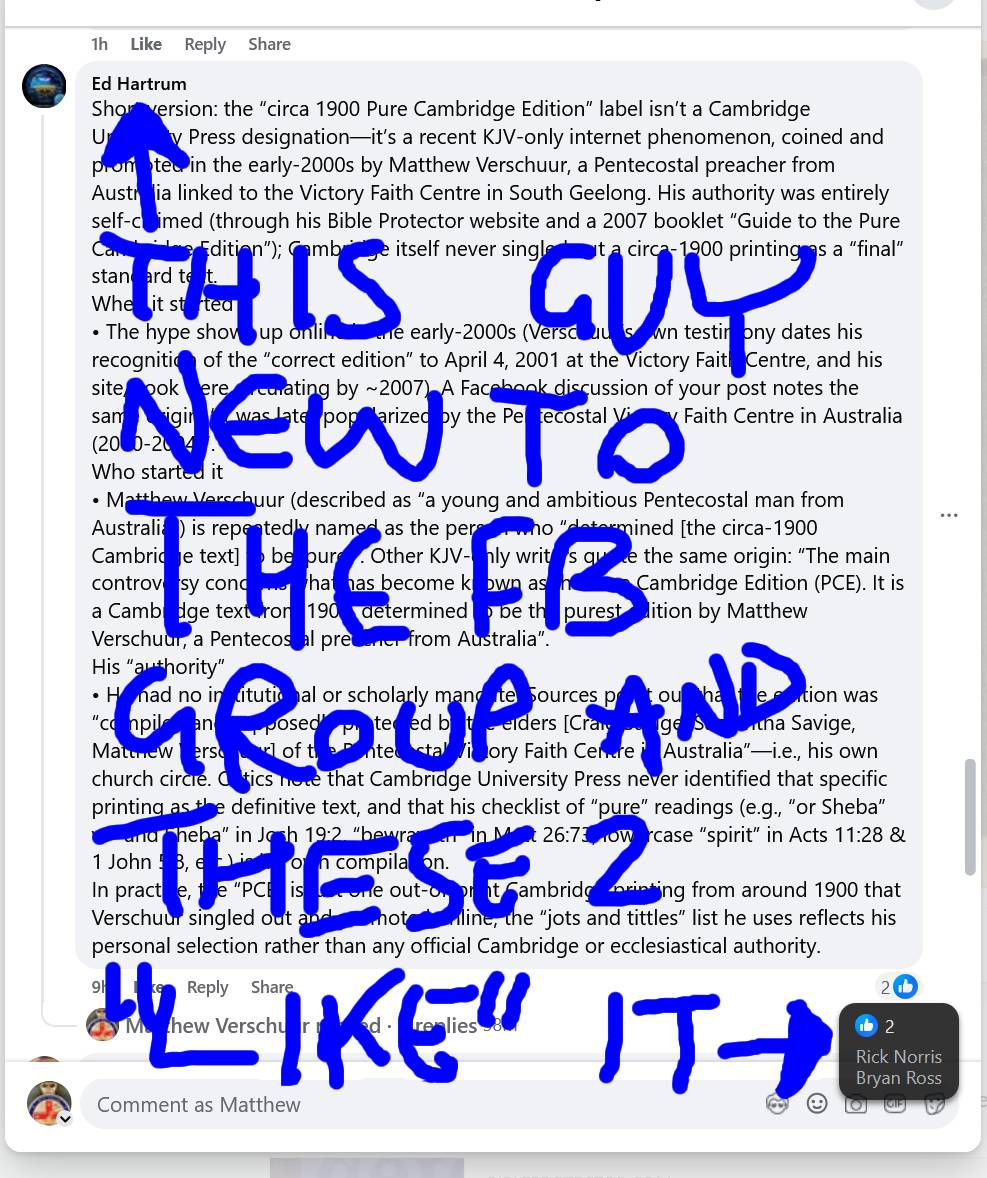
Bryan Ross has put out his Lesson 283 video, which puts his concluding case against what he calls the PCE position. In it he conflates the Pure Cambridge Edition (PCE) of the King James Bible (KJB) itself with the teachings of Matthew Verschuur (Bible Protector). There is an objective reality of the PCE, an Edition made by Cambridge in the early 20th century, and printed in many editions throughout, including from Collins. This of course has led to people accepting that the PCE is a standard (by virtue of having an accurate electronic file copy) or at least is a normal Edition to use. On the other hand, from 2007, through the Bible Protector website, there have been teachings on King James Bible Only, Church Restitution, Bible prophecy and Pentecostal-related matters. While the PCE is related to the Word and Spirit movement on the website, obviously the PCE is openly being used by all kinds of people.

It is clear that Bryan Ross seeks to attack the gamut of teachings from Bible Protector because it conflicts with his own. While this blog has outlined a conflict over Pentecostalism and Historicism, the conflict seems also very sharply about King James Bible Only.

Essentially, Ross should be challenged on how much he actually believes that the King James Bible is perfect, precisely exact and right, because it seems that behind his public preference for the KJB and that he thinks it to be the best, he certainly does not view the King James Bible as the very stringent dimensions of written perfection.

REVELATION

The word “revelation” has two relevant meanings, but Ross has not understood this or deliberately tried to fog the distinction in which this word is used.

“Revelation” can be used by cessationists, Reformed people and others as a dirty word, meaning people claiming to be Pentecostals giving prophecies, words in tongues and having visions and dreams and so on.

I very strongly oppose the mistaken or deliberate accusation that is being made that it is by this sort of “revelation” that I came to understand or confirm the Pure Cambridge Edition.

The other use of “revelation” relevant here means to understand something spiritual. For example, when a person understands they need to be born again, this is a revelation. So to discover something spiritual by natural, academic or scholarly study is a revelation.

This second use ties to the usual cessationist and Reformed use of that word where they speak of Scripture being God’s revelation to man. In such a way, to understand the Scripture is itself “revelation”. Again, cessationist and Reformed people will say that it is possible to understand the acts of God in history and broad events (providence), and the existence and nature of God in looking at creation and maybe also even in what people do in their own life and their sense of calling (e.g. becoming a Presbyterian elder or something).

I think Bryan Ross is very remiss to wrongly connect that people understand about the King James Bible and the PCE as though this must be like Pentecostal experiences rather than an act of intellect received from God so to speak.

GLISTERING TRUTHS

Bryan Ross was probably one of these KJBO types that believed the 1611 was right and that this is what we have today with some typos fixed and spellings standardised. He then read David Norton’s book, and not only did he see that there had been proper editing in the KJB (something which he mocked me for when I said that it was morally right for Blayney to have done his work), but then I think seeds of doubt began in Ross’ heart about the specialness of the KJB, and he began to look at it more and more naturalistically.

So because Ross began to doubt the specialness of God’s words in the KJB specifically, he began down a path of just saying that the KJB was good and best and that the word of God can’t be tied to specificity of lettering. (Even though that is the very definition of what “Scripture” means.)

He constructed a view called “verbal equivalency” and began to allow parameters on what is or could be the Word of God without having a specific anchor. It has I think opened him to enter into a kind of middle realm between holding the King James Bible but sort of interface with the modernistic view of modern version/translation ideology.

Ross therefore was especially reactionary against my major concept, i.e. my monograph Glistering Truths, that began to show that the very words and letters of the KJB, specifically in the PCE, are necessary for the very finesse of conceptual accuracy. He has not liked the idea of such rigidly specific perfection of scripture setting connecting to conceptual perfection of ideas. He has broad brushed his idea of general equivalence (to what standard or authority?) in opposition to accuracy to the nuance.

While rightly reacting against the idea that God’s words have been perfectly in one standard copy to the jot and tittle of correctness passed down from 1611 to today, he has gone far into his own reactive view which seems to build upon the modernistic loyalty to the originals.

As such, he has balked and reacted against the idea that God’s words are perfect in Heaven and have, by promises and through providential mechanisms, manifested in an answer to the heavenly sanctuary on Earth. In fact, besides his anti-Pentecostalism and so on, it is probably this idea of having an exact standard, perfect, specific set of lettering of Scripture that has been most offensive to him, and been his primary motivator.

I challenge him as to why, in his heart, he does not wish to conform to an exact expression of God’s law but seeks rather the freedom to have acceptable (to him) variations to God’s message.

ROSS GIVES HIMSELF OVER TO HIS ERRORS

Ross says, “No single historical PCE exists. Early–mid 20th‑century Cambridge/Collins Bibles show family resemblance, not a documented, fixed, final edition. ‘PCE’ is a retrofit label invented by Verschuur himself in the early 2000s, not a contemporaneously attested artifact”.

Ross now blatantly tries to make out that many of the Cambridge and Collins editions through the twentieth century were not the same Edition.

He will say they are not the Pure Cambridge Edition because he might find one letter different, which is Ross being super hypocritical since he claims to be for “verbal equivalency” and against “verbatim identicality” yet he is saying that one print character difference is essentially a major factor.

Even more bizarrely, Ross argues that because people didn’t specifically document about the PCE or about the specificities of setting in recognising the conformity of Cambridge Bibles through the 20th century, that somehow this invalidates reality and history.

Ross goes even further in his foolishness, trying to make out that “The modern ‘PCE’ is an editorial synthesis, not a historically settled edition. What is marketed or circulated today as ‘the PCE’ is a post‑hoc, harmonized profile assembled from multiple non‑identical ‘vintage’ printings. There is no single, contemporaneously published volume that functions as the authoritative standard; the modern PCE derives its uniformity from recent collation and normalization, not from a historically fixed print tradition.”

Such a statement is now utter hypocrisy from a person who is hung up about jots and tittles (a verse, Matthew 5:18, that he has sought to reinterpret to not mean jots and tittles but just the gist), and yet he is saying that the many different printings from Cambridge, even if they differ perhaps in a hyphen or two or something, that these are not the same Edition, even though manifestly they are.

I THINK ROSS REJECTS KING JAMES BIBLE ONLY

Ross attacks the concepts of King James Bible Onlyism by disconnecting exactness of wording from divine preservation. He specifically denies that God could get publishers to have an exactly correct printing of the Bible.

While he knows that King James Bible Onlyists use and uphold Cambridge printing, Ross is unwilling to recognise or allow that God would have worked through history with the Cambridge University Press to bring about accuracy of printing and editing.

Ross rightly sees historical preservation as continuity and sufficiency, but he refuses to recognise there could be any end or conclusion as far as having a world standard copy of Scripture. In other words, Ross is going towards the error of uniformitarianism, which says, what we have seen in the past must continue into the future.

In 2 Peter 3:4, 5 it warns that in fact there are interventions of God in history, there is an “end”. Therefore, it follows there is also an “end” of the “slackness” in which Scripture has been transmitted, and we come to sharpness and certainty.

Proverbs 22:20, 21:

20 Have not I written to thee excellent things in counsels and knowledge,

21 That I might make thee know the certainty of the words of truth; that thou mightest answer the words of truth to them that send unto thee?

Remember, God’s work is perfect (Deut. 32:4) and that God is not just allowing the looseness of naturalistic phenomena to act on His Word so it just drifts on and on with editorial or even version/translation variation without it actually being made known exactly to the world in precision.

Ross is therefore drifting towards compromise with the anti-KJBO and pro-modernist deistic position when he says, “Scripture and history align when preservation is understood as God’s faithful maintenance of His Word in the Church, not a quest for a last, flawless English edition. That framing grounds confidence without manufacturing edition‑finality.”

Already many KJBOs understood that we were more than just 1611 KJB users by accepting that the great work of 1769 has come to us. But as we have understood that each of the publishers have gone a little further from 1769, it is a matter of knowing what is right. The accurate and accepted Cambridge tradition has been established by KJBO leaders. The validity of the PCE to be central there is what is provided as a gift to all, so that God’s words can be known, as it says:

“Ye shall not add unto the word which I command you, neither shall ye diminish ought from it, that ye may keep the commandments of the LORD your God which I command you.” (Deut. 4:2).

“What thing soever I command you, observe to do it: thou shalt not add thereto, nor diminish from it.” (Deut. 12:32).

Editions studies and lists

This is a brief overview for charted lists of edition differences in the King James Bible.

When I began studying the area of edition differences of the KJB in 2000 there weren’t a lot of resources available. The internet was in its infancy, and letters rather than emails were still regularly sent.

My (Matthew Verschuur) website and materials provide lists of differences between editions, such as comparing 1611 to today, and differences between 20th century editions. It’s something I continue to discuss, study and interact with people about.

The earliest example of this, though I didn’t ever see it until later, was a list of spelling differences of words in contemporary editions in William Savage’s Dictionary of the Art of Printing (1839). This list mainly looked at spelling and whether words were hyphenated, joined or separate. You can find this on the main page of bibleprotector.com

The general foundations in edition studies (as we might term it), was the book by Scrivener, called The Authorized Edition. This book was quite obscure at the time, and has been an important source of information. Scrivener wrote this book in line with also making a highly edited edition of the KJB called the Cambridge Paragraph Bible. I obtained a physical copy of Scrivener’s guide from D. A. Waite, but the book is now easily available on archive.org

The next main source was D. A. Waite’s attempt at reading out a 1611 and comparing to a tape recording, and reading along with Cambridge Bible, and listening differences he heard. It wasn’t fully thorough, but it was enough to indicate that Scrivener’s information wasn’t wrong, and that there really were differences between 1611 and today. This document was being sold in the 1990s and early 2000s. My church bought a copy of his booklet.

In response to Waite’s work, was the far more pedantic and comprehensive investigations into editions by Rick Norris. Rick Norris has been a fairly prolific poster online, and has self-published a number of books, listing variations in many edition of the KJB. Norris published his materials after my website went up, and he first mentioned my website online in April 2007, which led me to get involved with the KJB bulletin boards/forums of those days.

When I was first examining the editions issue, one early website was from Touchet Baptist, which had a list of edition differences, including Joshua 19:2, Job 33:4, Jeremiah 34:16, Ezekiel 11:24, Nahum 3:16, Matthew 4:1, Matthew 26:39. It had a major section called “Capital ‘S’ left off the word Spirit affecting the deity of Christ”. I have a print off of this.

Another source document which was published on the Touchet Baptist 1611 website was Peter Ruckman’s Differences in King James Version editions, online in six parts, but originally written in perhaps the 1980s. I have a print off of this. He mentioned variant words in editions.

There was also a web page, which is still online, about being aware of counterfeit KJBs by Nic Kizzah, which listed differences been the Concord Cambridge and other editions.

Also, at that time, Sam Gipp’s Answer Book was around, which used a pamphlet by David Reagan which wrote about the changes in editions of the King James Bible.

Then Prof. David Norton’s book came out called A textual history of the King James Bible, which I bought. This book was designed to give information about Norton’s work to revise Scrivener’s Paragraph Bible, by making a New Cambridge Paragraph Bible. There are actually two editions of the Norton highly altered edition of the KJB.

Because of my website I’ve had interaction with different people looking at editions of the KJB over the years.

Gail Riplinger published a booklet in 2011 called Settings of the KJB, which goes through edition differences, and also mentions the Pure Cambridge Edition.

Laurence M. Vance has written a book in 2025 called The Text of the King James Bible, which has some very good tables of differences between editions. Bryan Ross and his circle of friends have been in interaction with Vance and been looking at editions over the years as well, including the Pure Cambridge Edition. So has Christopher Yetzer, a missionary and facebook user.

Brandon Peterson, author and youtuber, has made a chart comparing various editions and discussed the topic.

There are ongoing discussions of people looking at and listing differences in editions.

What is interesting is that many of the names listed above prefer Cambridge (in one form or another).

Further, in relation to comparing editions, a list was generated at MIT as recorded in an email exchange:

From: <mafetter@ATHENA.MIT.EDU>
Date: Sat, 5 Aug 89 04:42:39 EDT
To: tytso@ATHENA.MIT.EDU
Subject: diffs

…

This email from 1989 (I have a copy) showed a machine output of differences between two online texts they were comparing, one of which was a PCE text from the old Oxford Text Archive from the 1980s (that text is still available on several websites, was worked on by Robert A. Kraft).

Spelling matters

Someone asked me about the Cambridge, Oxford and London, and older and newer spelling difference of “rasor” versus “razor”. The question is, does it really matter?

If you are going to really believe that every word of God is pure and that jots and tittles really matter, then you will want precision.

So is it really important to have “rasor” and why should we consider the Cambridge spelling to be correct? The answer could be, even if it doesn’t matter (I personally can’t see a doctrine hanging on the spelling of the word), the point that the rest of the Edition that has that spelling is right, we go right along and accept rasor as well.

But for the argument of etymology and propriety. In Middle English, the French influence, it was rasour, so the z spelling is more recent.

Now, if we go one way, we will find really big differences which are important, like between “intreat” and “entreat”.

FORMSENSEDIRECTION
intreatask, pleasetoward will/favour
entreat treat, deal with toward person/condition

But in the other direction, in something which ordinarily wouldn’t matter, we ought to side with the Pure Cambridge Edition of the King James Bible.

By the way, the spelling “ought” not “aught” is not in the Pure Cambridge Edition. The mid-20th century London Edition used the spelling “aught”. If it is all the same one way or the other way, that’s one thing. But the spelling convention in the Bible (coming from 1611) has been “ought”.

“Ye shall not add unto the word which I command you, neither shall ye diminish ought from it, that ye may keep the commandments of the LORD your God which I command you.” (Deut. 4:2).

See that word in bold in that statement.


Not again…

THE BIG PICTURE

Bryan Ross and I have been having some remote back and forth.

I want to cut through Bryan Ross’ merry-go-round and directly address a major issue, specifically, that he has barely looked at the Pure Cambridge Edition itself, which was made by Cambridge in the early 20th century, but instead talked about what I have said about the PCE.

So, he claims to be talking about the printed history of the Bible, but instead has got hung up going through my materials, not talking about the PCE itself. It seems that he doesn’t like my views because they differ to his, so he has tried to put them under a microscope.

In doing this, it seems like from the outset he has had an agenda, and little knowledge of what I actually believe. It also seems he has not understood directly what the PCE is.

SOME EXAMPLES

In looking at his notes for his lesson 282 there are problems which come through. He claims to be going through a kind of review of one of my books Vintage Bibles.

On page 2, he mentions how I talk about 1335 day-years from Daniel, but he doesn’t mention Islam.

Another example is where Ross then says, “the PCE’s authority within Verschuur’s system does not arise from the actual printed history”. This is wrong, because the PCE is itself an authoritative Edition as based on the print history and information directly about that.

He continues, “which showed no single, continuous Cambridge textual line”. This too is false. The whole of the foundational study on the PCE has been totally on the Cambridge textual line.

What Ross is trying to do is conflate the information on the PCE with separate other topics on Pentecostalism and Historicism. My approach is the printed history, and then to look at other matters, from a certain theological and Bible prophecy interpretation perspective.

Here are more examples of Ross not actually presenting what is in my book. On pages 3 and 4 Ross presents a different view on Revelation 10 in relation to the sixth trumpet, where his summary doesn’t bear any real resemblance to what I wrote on pages 166 and 167 of my book Vintage Bibles.

Likewise his explanation of the two witnesses contains information not in my book, and differs distinctly to my views while purporting to present them.

On page 9, it seems he is missing the entire context of the Word and Spirit movement, the Church Restitution and so on. He in fact makes out a Postmillennial interpretation which is not what I believe, he says with no explanation, “as the seventh trumpet ushers in the global acknowledgment of Christ’s reign”.

Ross then says that “the PCE position cannot cohere without Historicism”, but in fact the PCE exists objectively. What he is doing now is labelling the Word and Spirit position, with all its theology, as “the PCE position”, which is disingenuous. He doesn’t actually explain or properly understand the Word and Spirit view, and misrepresents aspects in his explanation, because he has the motive of miscasting things to make them look as bad as possible. (The fact that he also casts doubt in ways on the historical objective reality of the PCE is also telling.)

Ross wrongly conflates my positions about theology which I have articulated between 2007 to the present with the PCE itself and the beginning of adhering to it in the early 2000s. Around the years 2000 and 2001 I was basically a Dispensationalist who believed that things were generally getting worse before the Rapture.

This framing by Bryan Ross to make the PCE and my doctrine as identical doesn’t even make sense, seeing that the PCE existed 100 years before the books he has looked at (dated 2013, 2024 and 2025).

Why has Ross avoided other content on my website from 2006, 2014, etc.?

He has clearly just set up his own interpretation, the laboratory creation of a chimera, as a kind of Frankenstein bogeyman that he can set up. That’s why he has invented this idea of “pillars” of my theological view. It’s the creation of a monstrous wickerman woven from straw.

In fact, if he were to read my books, he would find constantly two “pillars”: Word (Puritan-Bible tradition) and Spirit (Holiness-Spirit tradition), and entwined as the Word and Spirit view. Things like creationism, providentialism, historicism and fundamentalism belong to the “Word” tradition.

Further he misunderstands the “heavenly prototype → PCE” is an overarching structure to the “historical process → PCE”, meaning both are concurrently true in one divine oeconomy. But Ross tries to make false dilemmas, like if one then not the other.

BIBLE PROPHECY

We can see that also in how Ross misunderstands the structured multiple fulfilments of Bible prophecy. For example, I believe in Historicism and Futurism, whereas Ross is Futurism against Historicism. He uses his model to view mine, which is not how to fairly present the other person’s view, though can be a valid way for assessing/critiquing.

This leads Ross to misunderstanding the difference between Idealism (Word and Spirit Idealism, also known as Symbolic Word, and based upon the oldest method extant, being the commentary of Victorinus of Pettau) and Historicism. As a proponent of multiple fulfilments of Bible prophecy, I do not, as some may wrongly accuse, think that a prophecy can mean just anything or what the interpreter wishes it to mean.

Ross wrongly calls my using the Idealist method in one place as “incompatible” with the use of Historicism in another.

(In fact, mistakes can happen if one makes an eclectic view and mixes together two modes. Also we are always learning, which is a good thing.)

However, in this case Ross has wrongly understood the situation, there are four ways in which to interpret Revelation 10. They are the late Preterist, the successive repetitions Historicist, the historic premillennialist pre-tribulation rapture Futurism and the Word and Spirit Idealism.

So Ross is wrong to accuse of “a theologically significant contradiction”. Has he not heard of sensus plenior, of dual fulfilment and of multiple fulfilments? These are all positions well known in theological circles, and are found in a vast range of works, e.g. Raymond E. Brown, Desmond Ford, Henry Kett, Halley’s Bible Handbook, Arthur Pink, Augustine of Hippo, Gregory the Great, Gleason Archer, John F. Walvoord, Charles C. Ryrie, G. K. Beale, etc.

Ross goes on to try to define Historicism, but is very vague, in that there are several different frameworks on how the book of Revelation is viewed to be structured. Ross tries to compare my view as “idiosyncratic”, when my view is consistent with Historicism. As to be expected, I have refined it in light of history. But Ross is starting from probably not even understanding the Wikipedia article (with its Seventh Day Adventist biased explanation on the subject), so his assessment is of very little value.

Ross wrongly goes to sources which belittle Historicism, and charges it with one of the major theological crimes of Futurism, namely the self-referential tendency to read things to one’s own day.

Ross seems to imply, quite wrongly, that I am making up the “1967” year date for personal preference reasons, when this date is consistent with the prevailing view of the current evangelical adherents of Historicism.

Ross goes so far to try to make out that my Historicism is “bespoke”, when it is obvious his frame of reference must be the teachings of Seventh Day Adventism. If he used Steve Gregg’s “Four Views” book, he must understand that this book is fairly scant as it is only providing an overview. And if he looked anywhere, he might find Oral Collins’ book. Collins is a modernist who follows the work of E. P. Cachemaille, whereas Gregg’s book looks more at Robert Caringola’s work which follows more A. J. Ferris (and somewhat H. Grattan Guinness) but ultimately E. B. Elliott. I am very familiar with this field of study, whether the recent writings of Joe Haynes or the writings of Joseph Mede. My view is built on the shoulders of giants.

As the KJB translators understood, latter thoughts are greater than the former. Again, as Lord Verulam (Francis Bacon) rightly knew, speaking as a spiritual husbandman, that knowledge is increasing, and we can observe a springing of fulfilments from germinant prophecies.

ANSWERING ROSS’ RANTINGS

I don’t know how many times I’ve shown Ross is wrong in how he manufactures an interpretation.

Like previous times he says that I am one who “adjudicates half of his hallmark PCE ‘tests’ by Pentecostal pneumatology (e.g., ‘Spirit/spirit’ in Matt 4:1; Mark 1:12; Acts 11:12, 28; 1 John 5:8), showing that doctrinal categories—not neutral editorial history—decide the ‘pure’ reading”.

As I have said many times, the tests came before I treated them in doctrinal depth. The tests were not in themselves some places so theologically significant in the differences between KJB readings, but are clearly with some significance. The tests were for identifying an Edition, not for specific study as such. It was therefore several years later, after having a diagnostic framework (a series of test passages to test whether any Bible of any sort is a PCE) that I decided to analyse them theologically, logically, hermeneutically, etc.

Ross is therefore wrong to imply that Pentecostalism led to choosing instances regarding the word(s) “Spirit/spirit” in the tests, when in fact these were things being mentioned by Baptists in their lists of edition differences.

I know Ross wants to doubt my word for it, but indeed there was an amount of material online in the KJBO corners of the internet in 2000/2001.

Ross also wrongly says, “he links the timing and authorization of the PCE to Pentecostal revival”. I did mention twice over the years that it was interesting or even providential that the PCE came about when Pentecostalism was rising. But Ross has blown this out of all proportion.

Ross then says, “That is why his recent denials—‘providentialist not Pentecostalist’—are out of alignment with both his earlier and more recent testimony, where he seeks to deny the impact of Pentecostalism on his framework.”

What Ross is doing now is going “all in” on his false narrative, when I have repeatedly said that:

  1. The PCE came from Cambridge which was not Pentecostal
  2. The PCE came about many decades before I was born
  3. My own identification of the PCE came through textual study, the normal scientific, scholarly method
  4. The tests to identify the PCE were not Pentecostal-centric, but were mostly drawn from or in line with Baptist sources
  5. The knowledge that the PCE was right was from a KJBO not Pentecostal perspective
  6. My comments about Pentecostalism existing or Pentecostal theology in thinking about hermeneutical and editorial-textual-critical method of looking at the rightness of edition readings came later

Ross should ask his friends to instruct him on:

1. Straw Man Fallacy

2. Hasty Generalization

3. Mind Reading / Motive Fallacy

4. Cherry Picking

5. Overinterpretation / Overreading

Ross repeats his now blatant error, saying, “Verschuur’s own framework makes Faith-Pentecostalism a pillar of the position and even uses Pentecostal pneumatology to decide hallmark PCE ‘tests’ (e.g., the capitalization of Spirit/spirit in Matt 4:1; Mark 1:12; Acts 11:12, 28; 1 Jn 5:8), so the edition’s ‘purity’ rests on Pentecostal presuppositions rather than neutral textual criteria.”

Ross should stop bearing false witness.

If pneumatology was a factor, it was a factor common to Baptists who were mentioning the capitalisation of the word(s) “Spirit/spirit”. That discussing was not happening with Pentecostals at all, but Fundamentalist KJBOs.

The purity of the PCE rests on arguments drawn directly from non-Pentecostal KJBOs, TROs and even the modernist desire for consistency.

The desire for editorial purity in KJB editions is a concept going back centuries, for example, see this: https://www.bibleprotector.com/blog/?p=1163

COUNTERING ROSS’ REPEATED ERROR

In Appendix A of his lesson 282 notes, he tries to counter me yet again.

He says, “In reality, I explicitly acknowledged that the twelve items function as identification markers, not doctrinal propositions.”

Well, I have quotes just back where twice the very opposite false witness was given, and now this directly contradicts those lies. Is this a true statement?

But then, Ross writes, “it is beyond dispute that your rationale for half of the twelve PCE diagnostics are grounded in explicitly Pentecostal categories.”

All those theological reasonings I give are later than the making of the tests.

Also, logically, a person who begins studying something, as I did regarding editions in 2000, is starting from very low knowledge, a young internet and relative youth in age. I can expressly say that I was not thinking there is something more vitally Pentecostal about Matthew 4:1 or Mark 1:12 as such, for example.

It is also easy to see, What would a Baptist think? I am sure about 100% of born again Baptists who know anything will understand that the Holy Ghost led Jesus into the wilderness.

How is there anything more exclusively Pentecostal about this Bible story? Were the editors making changes at Cambridge (and maybe Oxford) in regards to Matthew and Mark there Pentecostal?

ROSS GOES FULL RICK NORRIS

Laughably, Ross will not acknowledge that a set of editions from Cambridge represented an Edition, which is now called the Pure Cambridge Edition. He will say that those editions “come close” to the electronic text I published on my website in 2007 (made in 2006). But if my text is harmonising previous editions which are sometimes only varying in one letter in one place, besides the “LORD’s” formatting, then how can it be implied that there is not one Edition which was made in the early 1900s?

Ross, like Norris, wants to make a pedantic point about all the different editions when in fact they clearly conform together, from a common origin, meaning that there is indeed one Edition.

ROSS WRONG ON BIBLE PROPHECY INTERPRETATION

Ross mentions the “Historicist scaffold” and then my mentioning of the angel’s clothes “linen → India paper” which he calls “leaps”. First, this is not a Historicist interpretation. Second, I made it clear it was a tertiary view. And third, the fact remains that India paper was made from flax. Ross’ questioning doesn’t therefore deal with the information as I have presented it. This goes to his willingness to try to make as bad a case as he can, rather than actually do an analysis. As a reviewer he may question things, but now his review is shoddy because it doesn’t even represent my view.

ROSS DOES THE USUAL SCHOLARLY TRICK

Instead of taking the wider view where I have mentioned what Professor Norton said, Ross does the trick of saying that there is “no quotation, no citation, no date, and no context for what Norton supposedly ‘mentioned,’ making the claim entirely hearsay.”

This is what Ross wants to do: he wants to invoke the academic snobbery that I must properly bibliography something in order for it to be admitted as evidence. But because I didn’t, apparently then it can be doubted what I said.

I can only imagine Ross demanding me to produce photo ID to prove whether there really be a Professor Norton at all.

Apparently Ross wants to refuse reading Norton’s book (the very book that converted him towards his new doctrine of “verbal equivalency” as though God speaks as a hydra from many mouths) which in places gives information on the Pure Cambridge Edition.

Also, I know Ross wants to refuse my testimony on correspondence from Professor Norton on the pretended grounds of empiricism, which says, “unless I see the imprint on a sheet, I will not believe”.

He says, “I noted that Norton’s published work does not define or recognize any Cambridge ‘Pure Cambridge Edition’ category (if they did Verschuur would cite them).”

How deceptive. Ross knows that Norton did not use the term “Pure Cambridge Edition” to describe it. That’s like saying that Erasmus did not produce the Textus Receptus because that term came into use a hundred years later.

And as for “citations”, the quotes and info is there in my Guide, Century and Vintage Bibles.

Again, Ross produces his exacting definitions for “copy-editing” but refuses to acknowledge that many editions can represent an Edition. The differences in editions of the Edition are but of that copy-editorial level. Even the formatting of “LORD’s” fits within that.

Again, I explain how the various tests, criticism and differences between various Editions was discussed and listed by Baptists and Fundamentalists in the past. Is this not an objective, investigable fact by engaging the wondrous contraption of analogue use of keyboard typing into a search engine or use of deep thinking AI?

Ross wants to close his eyes, saying my commentary “provides no verifiable evidence—no names, no dates, no sources, and no bibliographic documentation. He merely asserts that ‘Baptists’ made comparison tables, yet none of those alleged materials have ever been produced or shown to contain the exact twelve readings he later canonized as a diagnostic set.”

How Rick Norris of him to throw the words “asserts”, “alleged” and “he later canonized” about.

He says, “no Baptist writer prior to Verschuur ever treated these readings as a unified list, as distinctive, or as edition-defining.”

I assume he means “these sorts of editorial readings”. And Ross would be wrong.

Perhaps Ross can see this mediating historical evidence: https://www.bibleprotector.com/forum/viewtopic.php?t=55

Ross says, “no one before him claimed anything unique or special about this particular set of twelve readings”. This is a pointless statement, as he is conflating the concept of editorial differences with the concept of a diagnostic list. It is not that those 12 readings are “more special” in the sense that he indicates it.

He then says, “no historical or theological tradition recognized them as constituting a distinct Cambridge ‘Pure Cambridge Edition.’ His claim therefore contributes nothing toward establishing documentary or historical grounding for the PCE as he defines it”.

Again, Ross is totally wrong. KJBOs were supporting Cambridge printings.

Also, it seems that Ross seems to deny the reality that there is an Edition now called the PCE.

All those Baptists, Presbyterians, Pentecostals, etc., who used Cameos (Reference and Large Print Text) and Turquoises for decades were indeed using the PCE.

Where did the tradition as held by Gail Riplinger, Laurence Vance and others who use these very editions come from?

Ross has the temerity to deny that Waite, Ruckman and other KJBO and TRO leaders all used Cambridge Bibles.

I corresponded with these people and read their works. How can we deny that Cambridge is not the best? It fits that view that there are KJBOs who use the PCE distinctly.

Why are vintage Cambridge Lectern Bibles being collected by people like facebook user “Scriptorium Bibles”, except that these are considered the best?

It seems like Ross is more a contrarian.

ROSS IS NOT USING LOGIC

In response to my saying that I was not a Historicist when first looking at the editions issue from 2000, Ross says, “his admission suggests that Historicism functions as an after-the-fact justification layered onto a prior commitment to the PCE”.

How telling he should speak of my prior commitment to the PCE, which was on scientific grounds (proper scholarship).

ROSS APPEALS TO IGNORANT SOURCES

Ross really loves the letter from CUP from 2010, because they didn’t know much about the issue.

It is clear that CUP is now an economic-based proposition, which means they would have to weigh up the financial impact it would have on them in what editing they do in the KJB.

Ross appeals to their ignorance as though that is the overarching word of authority. He says, “CUP itself provides no endorsement of a singular, consciously created Cambridge ‘PCE’ setting.”

Ross wants to deny that there is a singular Edition, which is why he uses the word “singular”.

He wants to deny the existence of the PCE which is why he uses the word “conscious”. He does this because he wants to exalt CUP’s lack of awareness in the present as well as their being unaware of the details around the historical editing event in the past which made the PCE.

Of course, how did the myriad of editions and printings in conformity come about through the 20th century? But no, Ross wants to make sure that we think they are not the same. (This is where he is ironically even rejecting his own “verbal equivalency” views.)

Finally Ross wrongly frames the PCE as a “setting” on the premise that one must seek a first copy rather than acknowledge all the evidence of many copies which reflect the origin of the editorial work.

WHAT IS IT ALL ABOUT?

Is Ross trying to say that I use Pentecostal/Word of Faith doctrine, Historicism and KJBO views to talk about the PCE without talking about the focus on its editorial history?

Is he trying to say that there is no Edition throughout the 20th century which is called now the Pure Cambridge Edition, and use that name as a label only for an electronic text made in 2006?

I wonder how much he actually thinks the KJB’s readings and its translation is perfect and exact, because it seems like that’s an issue for him.

I also wonder why Ross never really presents an aggregation of materials from my website, which would be relevant, including my document on Rick Norris and other booklets, etc., see my main index page and this list: https://www.bibleprotector.com/forum/viewforum.php?f=9

And anyone who wishes to understand Mark 10:30 should read this booklet. “But he shall receive an hundredfold now in this time, houses, and brethren, and sisters, and mothers, and children, and lands, with persecutions; and in the world to come eternal life.”

POSTSCRIPT: I suddenly see Ross and Norris together on Facebook, and I ask myself, is this a coincidence?

James White v. Doug Levesque

KJV Only Disaster Debate James White v. Doug Levesque

The video: https://www.youtube.com/watch?v=a0tVo994M1A

OVERVIEW

Back in 2025 a debate took place, hosted by Apologia Studios (which seems to be on White’s side). The alleged topic was “is the King James Bible the best translation?” On one side, a snide, vicious James White just clamped it, while on the other side, Doug Levesque was somewhere like a Jack Moorman. He was irrelevant, overwhelmed, vacillating on the KJB and had no counter to James White’s deceptive and strident rhetoric.

One of the problems is that James White has an arrogance which makes him naturally speak down to and sometimes even try to discipline Doug Levesque. On the other side, Doug Levesque repeated cliched phrases like he’d carefully read the works of amateur scholar Donald Waite.

The video has had quite a few views on youtube, and it has resurfaced on another channel, so I have set out some comments to help the KJB side, especially because random observers like youtube user f308gtb1977 think that the KJB position has no viability.

BEFORE STARTING

The problem is the context or ground in which the debate is taking place. It is already the ground of the modernists, and the champion modernist White already dominates the battlefield. He defies the warbands of the Lord, and out comes Levesque, who is chopped up in short order. He’s brave, he’s not a fool, but he was defeated from the outset.

As I say, the first problem is the ground and context. It would seem, by all appearances, that the host and place of the debate was not pro-King James Bible. It also seems that Levesque started from defensive positions like trying to distance himself from extremism (e.g. Ruckmanism) and the idea that the KJB is perfect. (I know Levesque means well but I hope he has retired from the debate circuit.)

So, how to defeat James White? Well, it is by using Scripture to fight against Infidelity. It is actually a spiritual fight.

Infidelity is at the core of White’s system, so you have to strike it, his presuppositions and premises.

Therefore, to begin, more time needs to be spent on opening statements, and less in the cross. This is purely a strategic choice, but much time needs to be dedicated to attacking the sludge on which White’s position is built, while at the same time also establishing the bedrock, with correct base ideas, of a proper KJBO position.

Standing up and giving “conclusive” rather than constructed statements will not do. It’s very easy to use “conclusive” logic and say, “God has favoured the KJB, it is right; your modern ‘bibles’ are part of the demise and sliding of Laodicea; the Scripture is pure and represents faithfully the original and heavenly master.”

Just saying that kind of stuff would exemplify where the debate really is: James White would just say, “that’s just your subjective opinion”. That’s what it means to deal with people who have bowed to the idol of Infidelity: they apply the same naturalistic framework they hold onto the KJB supporters as though we are living in an absolutely naturalistic universe. In that view, everyone is having subjective experiences and there is doubt placed on the overarching consistency of thought derived the Spirit of God.

In reality, to confront James White, you have to approach him as being a Deist.

Deism says that while God intervened in history to inspire Scripture, God pulled back, and natural forces have been at work, and modern science will be making as best as possible (by use of empiricism, reason and so on) translations that improve upon the KJB.

Therefore you have to argue for a God who is more immanent, more interventionary and more actively superintending (over) His word through time. You have to argue for divine intentionality, that providence is immediate, observable, real and powerful.

In other words, that we are living in a supernaturalistic universe not the naturalistic one of Infidel imagination.

Did God intend that the King James Bible rise to be the world Bible? Yes. And own it. Own the progress of the English-speaking peoples, the power of English-speaking Christianity, the very design and path of the English language.

So while James White technically may be a brother in Christ, he is at the far edges of the periphery, as his own position is a short hop from doubting infallibility of Scripture. White is unconsciously ready to doubt infallibility in two ways. First by either being unsure what does or does not belong to Scripture. And second, by climbing to some new position articulating what is Scripture today (differing in word and meaning to the KJB).

Alongside this is a methodology of interpretation that has two major problems. The first is doctrinal error, which is a general problem. The second problem is having a hermeneutical framework which starts from erroneous foundations and leads to erroneous exegesis.

LEVESQUE’S OPENING STATEMENT

Levesque begins like he is having a fireside chat, and runs through a series of tropes about the King James Bible. His manner is simple, folksy, well-meaning, earnest and endearing.

White watches like a predatory beast.

Levesque quickly distances himself from extremist views on the KJB. He starts from a position of wavering and weakness. He also misquotes a major statement from the KJB translators, which should have been emphasised in its proper form: “that out of the Original Sacred Tongues, together with comparing of the labours, both in our own, and other foreign Languages, of many worthy men who went before us, there should be one more exact Translation of the holy Scriptures into the English Tongue.”

These great men of God call their Bible one more and exact (or else, one and more exact). This sounds like a far more muscular, dominant empowered form of Christianity with a perfect Bible, and not a work with questions. Sadly Levesque does not take this view, but is timid in his defence, saying elsewhere that the KJB is “99% pure”. He has basically waved his white underwear flag to the other side right there.

Levesque talks about the two Alexandrian codices, about Tischendorf and about the infamous Westcott and Hort. He frames the last two as new agers who needed a different, perverted Bible. And along with some other accusations against the modern versions and some unconscious facial movement, Levesque makes the kind of case that might work best at a King James Bible only Sunday School.

While that kind of thing might appeal to an older, smiling Church audience, it would do little to destroy White’s rhetoric.

Now I agree Westcott and Hort were not good, but it is largely irrelevant to emphasise them, and Westcott for one was not a totally evil scholar. It’s like how James White might be able to do some good work fighting Mormons, despite his flaws. Also, it’s much better to not make out as if Westcott and Hort were active deceivers so much as they were acting consistently with the same Infidel spirit which James White is influenced by.

It’s more likely that White is himself deceived, and because of pride and other entryways for evil in his background, he uses techniques which I would say are not him actually consciously lying. I would suggest, rather, that because White has a partial foundation of Infidelity, that he is in the flow of the spirit of error, and is therefore going to be speaking lies as if that is reality, because that is what he actually believes.

This leads back to the erroneous texts or readings and other problems which manifest in modern “bibles”. Today’s wrong readings are unlikely based on deliberate human choices for evil. They are wrong because of the underlying philosophy that they are based upon. Such as the reasoning around the so called age of readings, basis on empiricism, groupthink, scholarly elitism, monetary interests and various other wrong assumptions which lead them astray to produce works of error.

Different elements of this same underlying erroneous spirit manifests through the “science” by which all their practice is done, including textual criticism. Their philosophic way leads them to error, which manifests in how they judge readings, measure the method of translation and evaluate meaning by their hermeneutical framework.

Levesque did not even address the issue: is the KJB a better translation? He didn’t even address translation, he really addressed textual issues. James White did, at least, but he also went off into textual issues.

WHITE’S OPENING STATEMENT

James White doesn’t bother to lay out that his foundation is based upon the spirit of error, that he is following the way of Infidelity or explaining any such thing. He begins like that is the settled science, and now everything is going to be viewed from that ground. He assumes his audience is already in the Deistic universe, so he begins on a mountain of assumption.

That’s why his first statement is about the translators of the KJB, and how he reinterprets their words in the light of modernism, claiming them to be the same as the modernists. White says that the KJB men never said that their work was final.

In fact the KJB translators did make a number of statements along this way, and to show how wrong White is, I will mention two places.

First this one from The Translators to the Reader:

“For by this means it cometh to pass, that whatsoever is sound already, … the same will shine as gold more brightly, being rubbed and polished; also, if any thing be halting, or superfluous, or not so agreeable to the original, the same may be corrected, and the truth set in place.”

And again, “It is a grievous thing (or dangerous) to neglect a great fair, and to seek to make markets afterwards: … but a blessed thing it is, and will bring us to everlasting blessedness in the end, when God speaketh unto us, to hearken; when he setteth his word before us, to read it; when he stretcheth out his hand and calleth, to answer, Here am I, here we are to do thy will, O God.”

James White wants to neglect the fair of the proper manifestation and knowledge of the very Word of God by making his own thing, and is then not humbly recognising what is given of God. White admits this because he himself opens the door to more discoveries in Greek, and like a false prophet, speaks on behalf of the KJB translators as if they would be open to this too.

But what are these new “discoveries”? It comes back to the underlying philosophy. Data and interpretation of data. James White is not really talking about new data, he is talking actually about how the modernists interpret the data.

New data does come to light from time to time, but it is how that information is viewed.

Essentially, in a scientific approach, evidence is the interpretation of the data that fits your narrative. That’s exactly what evolutionists do. In this case, modern Biblical Studies (or, modern Bibliology), approaches the entire science as though God doesn’t functionally have anything to do with it, and that men are doing their best to reconstruct deistically what was given in the original inspiration.

White is very succinct in communicating his information. I also don’t think he’s there to educate the KJBOs, but to speak to his own modernist constituency, to tell them exactly what they ought to know.

Thus, an intellectually curious Reformed person, upon listening to White, would be instructed not in Scripture but in the doctrinaire of modernist philosophy, of which White is proficient.

White barely needs to explain it: God inspired, then lifted His hand, and now we today are using our minds to work out “what did Paul or David originally write?”

White is very clear in his communication skill. Having laid out the idea of progressive humanist knowledge (a modernist concept in opposition to divine knowledge kept by tradition), he slights the idea that the KJB is right because it is over 400 years old.

Yes, modernism means new or current or contemporary. Old is bad, apparently. We’ve seen false Pentecostalism throw off godly traditions so as to be worldly and carnal, and the entire of Infidelity acts like it is a new thing: new science, new thought, progress, more information, maturity of humanity. Infidelity has offered a false millennium of the international rules-based order to replace submission to the divine law, and allowed every man to determine his own path and press into sin in place of submission to the commands of Christ. Human rights have trumped divine order, godly fear and responsibilities. Devil-effected people are given medication, rich nations are punished punitively for destroying the earth and white people are being made to bow down. Evolution, wokeness, modernism, communism, humanism, atheism, abortion, euthanasia, etc., are all part of the one and self-same kingdom of darkness. James White is a champion of that side’s view of the Bible from a religious perspective (rather than a pure atheistic-critical-unbelieving perspective of liberal theology and higher criticism).

The problem then is that there is Modernism, which is rank unbelief, and then there are Christians who have been much compromised, which is modernism (with a lower case m). James White is a modernist.

So the philosophy of modernism is that error prevails, and because error prevails, the way to counter it is through human effort and human thought. Specifically, new discoveries and new statements are needed.

That’s why they are always updating their critical apparatuses and lexicons. That’s why new translations come out. We are apparently living in a perversion of a Heraclitean universe where there is no constant, no touchstone, no absolute, no certainty, no unchanging God, no timeless Scripture and no standard. And as well, consumer culture creates the conditions for the Joneses always needing to spend big on new translations, especially in premium bindings.

James White’s view, which is that of modernism, is that we need all the data, all the facts, and the compounding of learning, to be able to “come to” a better Bible. He wrongly makes out as if the KJB men were of that same mindset.

The reality is that God spoke to people by whatever Bible reached them. Accordingly, since the Reformation, God has been reaching the world with:

  1. The Textus Receptus
  2. Vernacular translations, and
  3. The KJB.

James White wants to reject this because in his naturalistic view, the only way to know better what the Bible really originally said is to find old copies in the same language as what it was first written in. He effectively belittles a small church in 15th century Byzantine where they are singing from the copy they have, because it is a recent copy. He effectively belittles a little congregation in 17th century Yorkshire because they are using a translation made by Anglicans from the TR which itself is allegedly only based on a handful of Erasmusian representative typical manuscripts.

Apparently God just hasn’t been able to get through. Error apparently has been prevailing everywhere. Translation apparently has suffered, and hermeneutics has to jump the chasms of time and culture. How poorly we must be served if we rely on God actually getting the KJB to us perfectly.

That’s why we need James White’s people to help do the best they can. They can’t get to the very truth, but they can get it to acceptable percentages.

But rather than counter this who self-defeating error, Levesque later denies that the KJB is perfect.

What actually happened was that there was a gathering of the text in history, and by transmission the inspired words have not been lost. We have the KJB, it was built on a proper method that drew back from the past. Between Erasmus and 1611 was almost 100 years of checking and developing the TR. Unsurprisingly, White doesn’t mention that fact.

Laughably, James White thinks he has the approach that can counter the atheists and Tahrifists. As though slightly less unbelief is the way to answer the Infidels, when in fact it is the believing view with the King James Bible that preaches truth and counters to spirit of error.

WHITE’S OPENING ON TRANSLATION EXAMPLES

White brings up examples the same as what an atheist would bring up, in questioning the translational accuracy of the KJB.

The debate was supposed to be about this topic, so points for White for getting to it. Straight away, I must say that White is obviously very skilled at propaganda and rhetoric. This is something which can be learned, but examining his tricks could help educate students of theological debate.

White then says that most people are using the “Blayney Revision”. He doesn’t explain this is an editorial work in the English, of course, but he says this to make out like people are using a different text and translation to 1611. This is the implication, not the actual assertion. It’s also factually incorrect that anyone would be using a Blayney 1769 as people are mainly using contemporary editions like the Pure Cambridge Edition, post-PCE, Concord, Oxford, Scofield Oxford, some Thomas Nelson variation and so on.

White makes it clear that there are points where he thinks the KJB is a bad translation. Never let it be said that the modernists are not against the KJV or just criticising KJBO. They are against the KJB itself.

His first example is Acts 5:30, where it reads “The God of our fathers raised up Jesus, whom ye slew and hanged on a tree.”

There’s no need to go to the Greek or to Tyndale or anything like that. We will read this as Scripture in our mother tongue, as God speaking to mankind in English.

The verse follows this sequence: resurrection and the killing and crucifying. James White makes out, mocking with a straight face, that this is saying that Jesus was killed and then hanged on a tree. He then claims that the translators were slaves to Latin and that Greek linguistic understanding has since advanced.

Of course, the reality is that James White is using a rhetorical device typical of neurodivergent people who read hyper-literally.

It is actually clear that the hanging on a tree (being crucified) is a subset of the killing, and that the killing happened already when the Jews demanded it from the Roman governor and he acquiesced to their cry. We know that’s when the Jews killed Jesus because they weren’t the ones who literally nailed Jesus to the cross, they killed Jesus by having the Romans then carry out the execution.

As for James White thinking we are living in a paradise of advanced knowledge, the reality is that all kinds of knowledge has increased. Yes, data has increased. But my knowledge and my interpretation is the opposite of James White’s. I think that all the new ideas that come from modernism are just an endless splurt of more unbelief, whereas I think there is no reason to find anything from “the Greek” that is going to compel any change in the Bible, and further, the Bible is actually clear anyway, which makes White’s entire attack of no effect, and frankly, is crazy to change clarity.

James White then says if we say that the KJB’s translation is perfect, then we must believe in “double inspiration”. This is because in Infidelity and modernism (notice my use of “and” there rather like the Acts 5 example), entropy prevails, perfection is impossible. In that person’s thinking, to have a perfect translation would mean either the translators were inspired or some other overtly supernaturalistic act happened to overcome the laws of deistic nature.

The proper view is that creation was made by God, events are happening by the knowledge of God. And that the KJB is perfect is the outcome of a cause and effect as set in motion by God, who provides to the right place at the right time the right things. If God feeds the sparrows then He certainly can get His word to people, and if that, then He can outwork a full recovery of His word in English in 1611. That’s because nature and creation are subject to the law of God.

I’m surprised that James White, whose Calvinism should help him understand about God’s sovereignty, has bowed to the Moloch of modernism rather than the common sense aspects of what is called Calvinism. (Unlike Calvin or White, I believe in free will and believe in human agency to choose to align to provided divine perfectibility, i.e. Wesley/Finney).

White mocks the idea of the KJB translators getting it right saying they got it absolutely right the first time… but what about Tyndale to the Bishops’ Bible, what about all the to-ing and fro-ing in the translation committee process? No, White is presenting a naturalistic view.

White then goes on to Romans 9:5. He tries say that the KJB is not clearly saying that Christ is divine. What White is doing is reading the sentence like someone on the spectrum, instead of seeing the punctuation marks as giving ancillary points. White wants to argue about what is, in his mind, an obvious use of English or not.

Basically, the real reason for White’s attempt to make Romans 9:5 hazy is because he is looking at Greek and the modernist way of translating it. But the reality is that the English that normal people, everyone, understands, is clear.

Next White mentions Titus 2:13. Now, some background. Titus 2:13 is clear and Trinitarian. This is because of the perspicuity of Scripture, accuracy of translation and propriety of English usage.

But back in 1798 a man named Granville Sharp, a good man, had a big fault. He attacked the KJB translation because he wanted to correct God’s communication and make it even more explicitly Trinitarian.

That was a mistake. He invented a set of rules to apply to a number of verses, each rule being required to make his system work, that is to say, set up his “deception”. In wanting to be so stridently overtly more than what God said, he turned the truth to error. He was not wrong to love the idea of the Trinity but he was wrong to try to attack the KJB’s translation and cast doubt on its accuracy.

But this is grist for James White’s mill. He smiles knowing he is harpooning the KJB.

And just to be clear, when White says the Greek means this or that, what he is doing is arguing in a kind of magic realm, where he can control the Greek or let it flow to some place. We know it is magic because he then explains with English words what the so-called Greek says or means. These new ideas differ from the KJB, which means it is a different method with different results or meanings to the KJB,

White should actually speak honestly and say, the KJB says X, but my modernist philosophy says Y. Infidelity is always going to fight the truth: actually it fights the Holy Ghost, saying that we cannot know or have perfection, even though the Holy Ghost is here to show us the truth.

WHITE CAN’T HELP BUT TO GET ONTO TEXTUAL ISSUES

Then White goes on to textual issues, which is another subject altogether. He gives a mocking laugh, “ha ha ha”, showing he obviously really believes the KJB to be inferior.

White brings up Revelation 16:5, which he says is a conjectural emendation by Beza, that is, that Beza made something up in the 16th century. This is the problem that we see where people go to the Greek and accept the modernist way of using the Greek.

Now if there was an early corruption in the copying of Scripture, and if the right pattern can be seen elsewhere in the Book of Revelation, then it wouldn’t be wrong for Beza to correct the reading.

White pronounces (as a false prophet) that all Christians always did not have Revelation 16:5 like we have it now (how does he know?). He thinks it was invented by Beza, and that Beza was wrong.

This comes down to a question. Are we constrained to “manuscript tradition”? A person like James White, who is tied to materiality, is of course going to reject the KJB way of reading Revelation 16:5.

There are pieces of information out there which, when using James White’s own empirical system, give clues, such as hints from Beatus of Liébana in an 8th century commentary, and from Papyrus 47. Of course, in this case James White rejects the rational method (under God) used by Beza for the near unanimity of a different reading.

It’s almost like White wants to chose whatever option is the most against the KJB.

Finally, James White says that Erasmus accidentally inserted a bit of a commentary into the text when constructing Revelation 21 in his New Instrument (a Greek text with a new Latin translation, now considered the first Textus Receptus edition).

The verse in question is Revelation 21:24, and this becomes White’s biggest weapon to bludgeon the KJB. Apparently Stephanus, Beza and all the translators didn’t know that Erasmus made a mistake. White even claims he has a copy of the very copy that has this “erroneous” reading which Erasmus used.

It’s telling that White is almost bursting out laughing telling his story. But it is, of course just that, his own story.

But now the facts. It was the end of Revelation 22 that Erasmus had to source from other places, not Revelation 21. And the reading that White says Erasmus got from a commentary actually appears in other Scripture manuscripts that are older than Erasmus’ time.

Just on human choice, it would be better to side with Erasmus, Beza and the KJB men than to side with White. At least the former men were reverent in their desire to conform to truth, whereas White has no loyalty to higher truth but to the philosophy of modernism which is actually in flux.

But White beat Levesque with this idea and smashed him out of the oval/park.

MY CONCLUSION

Having gone this far, I won’t travel further. But it was sad to see Doug Levesque floundering about, not able to answer James White, nor effectively counter attack him.

White could easily attack all the low hanging fruit conspiracy theory stuff and say he didn’t even follow Westcott and Hort. Now, he doesn’t actively follow them, that’s true, but certainly they pioneered much, and are in the same belief system as White, namely, that of modernism rather than divinely supplied tradition.

Levesque had good things to say, but basically was conceding to James White when shouldn’t have.

And James White was also very condescending, talking down to Doug and trying to police him on the debate rules.

Quite frankly, Levesque was nearly as bad as Haifley who tried to debate Mark Ward, who is not quite as hard (nosed) as James White.

In this debate, it isn’t just about all the changes that happen in the modern critical text, and how White’s own preferences will differ, but how many translation and meaning differences will White present as his preference in comparison to the meaning and concepts presented in the KJB?

We believe that providentially the KJB is from God. As for White, he is just a strident mouthpiece against God’s glorious truth. The rightness of the KJB is consistent with itself. There are no errors in the KJB.

Bryan Ross’ debate continues

WHAT HAS BEEN HAPPENING

Pastor Bryan Ross has continued to maintain his position in how he wishes to be critical, in his lesson notes, number 281, on my position. At this point of writing, we are now some way along in an ongoing back and forth (see previous entries on this blog).

In assessing Bryan Ross’ demeanour, he seems to be most upset about my Pentecostalism. I should point out, however, that I am actually a Word and Spirit Christian, which movement is really a mixture of Word of Faith doctrine and takes an equal measure of Fundamentalist, Reformed and Puritan information (most especially in regards to the King James Bible).

I am sure that Pastor Ross does not ascertain how many different views there are that are labelled “Pentecostal”, nor the difference between “Word of Faith” and “Word and Spirit”. I expect also that he doesn’t grasp this because his own views are cessationist, and because it is common and easy for Baptists to view Pentecostals as all the same, when in fact there are wide differences between them.

It seems very evident that Ross appears to want to frame the Pure Cambridge Edition of the King James Bible as having some Pentecostal specificity, whereas the reality is that this is an Edition edited by Cambridge in the circa early 1900s.

ROSS PUTS UP UNFAIR BARRIERS

It’s an easy tactic for people who want to use an appearance of scholarship that they say, “you didn’t back that point with verifiable facts”, like not citing sources or something. It’s a trick done by people like Rick Norris too, who act like they can’t accept something because they want to act like information has no credibility.

The question at hand is whether Cambridge did edit the King James Bible to make a particular Edition which has been printed many times and can be identified.

We live in objective reality, and even Professor Norton has mentioned a few things, but somehow, Ross will deny or question because no information has been extracted from any archival or written record. We have the empirical textual evidence while no archival information has been forthcoming. Ross cannot blame me for CUP’s poor institutional memory.

Ross seems to fluctuate on this point because he tries to make every individual edition, each with its little errata or whatever, as different to every other. And while there are editions, there is also an Edition, which is the same editorial text which those editions are following.

It is strange that Ross apparently cannot tell the difference between Cambridge King James Bibles printed in the 20th century, that there is a clear conformity to an Edition in a whole raft of printings throughout that century. That is to say, that if we had a matrix of particular editorial readings, we would find a whole lot of editions matching together, agreeing completely on their editorial form, and “substantively” in their own presswork.

ROSS’ ONGOING CONFUSION ABOUT THE IDENTIFICATION LIST

When we (the Elders of Victory Faith Centre) were looking at the editions of the KJB, I came up with a series of test passages that could be used to identify this Edition. This was happening in about 2001. The identifying of the PCE was in making sure that a Bible being tested matched all the readings.

So this could be considered as a short matrix of measurement to see whatever Bible you were looking at, whether at a shop or you owned, was matching the PCE or not.

The basis of this was several articles by King James Bible only people who talked about publishers making changes, or differences in meaning in modernised or other editions of the KJB. Further, people at that time, who were prominent in the KJBO movement, did say that they preferred Cambridge over Oxford, and reference was usually made to Joshua 19:2, etc.

I personally was only wondering about the difference between “Spirit” and “spirit” in 1 John 5:8. Everything else was fine, and all the differences were on a meaning and historical basis (e.g. going to 1611 or what was proper, etc.) At that time people would even say “Savior” is erroneous, you have to have “Saviour” because it has seven letters.

Because in comparing editions, one of the areas people were looking at was the word “Spirit”, that was obviously an issue. Note, this was nothing to do with Pentecostalism. There was some theological aspect, but that was more in passing and simplified. For example, unlearned people, if they were shown a KJV verse that had “spirit”, they might automatically think it should be changed to “Spirit” because that’s “proper”.

So, the tests were just the product of looking at editions, and they were not driven by any focus on Pentecostalism, as those discussing the issues were Baptists.

Now, when I understood that 1 John 5:8 was lower case in many old editions, and that the word “spirit” appeared elsewhere lower case in all normal KJV editions, I then tried to think how 1 John 5:8 could be right.

As a particular kind of Pentecostal, I certainly could see how it could be lower case. But that was me thinking now in line with my theology, but my theology was a broad evangelical one that includes sanctification doctrine, etc. I saw how 1 John 5:8 could match in with that.

Now Bryan Ross has tried to make it some sort of narrow Pentecostal choice that 1 John 5:8 was accepted as lower case “spirit”, but it was, as I say, me looking at it as a Pentecostal Christian with evangelical doctrine.

Bryan Ross has tried to read in Pentecostalism to the fact that six of the 12 tests to identify the PCE are to do with the word “Spirit” or “spirit”. But that obviously was not the case.

A few years later, when I was actually using the tests specifically to give historical, logical and theological reasons for why one was right and one not so good, I obviously argued as a person having Pentecostal doctrine, but that is only part of what is to be taken as my view.

What Pentecostal doctrine would be involved in Joshua 19:2?

And as I have had to constantly say to Bryan Ross, who seems to be stuck in a rut, we are talking about pneumatology and Trinitarian doctrine (in relation to Matthew 4:1) so the whole matter cannot be “Pentecostal” as he seems to obsessively imply.

EDITIONS WHICH MATCH SOME OF THE TESTS

There are various editions which may, even historically, match some or many of the 12 diagnostic readings. That is to be expected for various reasons. Ross seems to not understand this, or keeps on trying to make a non-point about it.

Yes, there are editions that might match some tests, because to have those readings or editorial choices in those places are good. The PCE is measurable and identifiable because it matches all the tests.

The tests are not places where Cambridge made changes when they made the PCE. That’s not what the tests are for. If you want to know about changes, just look at the Victorian Cambridge readings and compare them to the PCE.

THE CUP LETTER

I do not want to get bogged down in trivialities, but it is apparent Ross wants to milk all he can by brandishing about a CUP letter from 2010. That letter shows that CUP knew very little about their own print history, but it seems apparent that Ross is gleeful at their ignorant statements which he is repeating as if “facts” from the lion’s mouth.

CUP wrote, “Some new Cambridge editions were originated during the 1920s and 1930s, apparently using as their pattern copy a version that (nearly) accords with your expectations.”

So, a manager at CUP in 2010 writes that some of their current editions are close to being PCE (they are post-PCE), and doesn’t seem to realise that there were many printings of the PCE and of near-PCEs (doctored Victorian editions) between 1910 and 1985 (and later).

Cambridge were talking about editions from the 1920s and 1930s that they had at hand which they knew, in 2010, were differing in 1 John 5:8, and perhaps Acts 11:12 and/or verse 28. It appears as if Ross is making out as if CUP was saying that their editions in the 1920s and 1930s did not match the PCE. This is blatantly wrong, and I am questioning why Ross did not explain the situation clearly about what CUP actually said.

The reason why Ross wants to misinterpret, I think, is because he wants to say that no printed Bible from Cambridge is a PCE. I think he wants to deliberately not acknowledge that an Edition is a set of editorial readings, but instead he wants to take individual printings and use some minutiae in any copy (no doubt like a missing full stop somewhere that the printing plates didn’t ink properly) and say that this constitutes an edition that is separate. Thus he fabricates his main argument that basically the PCE first appeared on the Bible Protector website in 2007.

Ross goes on to make his summary of CUP’s letter, saying, “inconsistencies in Bible Protector’s identifier lists”. Again Ross is not representing the reality of the situation. While he is communicating a mistaken view by CUP, he does not clarify with his own understanding that CUP were equating the 12 test places (a diagnostic matrix) as the same as a list of specific editorial differences between common editions. This was wrong of them to do, because they were confusing a list of diagnostic markers with a list of editorial differences. It is telling that Ross doesn’t clarify to explain that, rather, it appears he wants to magnify in CUP’s quizzing onto my work. He is employing a tactic of casting doubt by proxy, a technique much used by Rick Norris.

Now in case Ross is ignorant, I will explain: the 12 tests are tests for any edition where the 12 tests must align as based upon specific points in the PCE, where the PCE will have all 12, and only having all 12 is a pass. Besides this, I did a comprehensive (but not completely exhaustive) comparison between London, Oxford and the Victorian Cambridge editions, so that what changes from a Victorian Cambridge to the PCE could be known, what were the main differences between Oxford and Cambridge, and what wrong changes had been made in the Concord and modern Cambridge editions.

Ross says that the CUP letter, “is a documented non-endorsement of a singular, consciously created, Cambridge-recognized ‘PCE’ edition”. But of course, that’s Ross’ wishful thinking, the actual evidence of printed Bibles shows the opposite of his view, but I guess he just wants to be ignorant or not to accept the actual facts.

ROSS STILL TRYING TO WIN POINTS ON THE TESTS

Bryan Ross has made a lot more about Pentecostalism and the 12 tests than what really exists.

Ross has repeatedly tried to make a case that I used Pentecostalism to make the 12 tests, or some of them at least, and/or that they were for doctrinal reasons (i.e. Pentecostal).

He says, “I find myself compelled to clarify why such a claim cannot bear doctrinal or methodological weight.” I will explain it again. At that time KJBOs were looking at differences in editions, and the case of the word “spirit” was one of the issues mentioned, e.g. in Genesis 1:2, etc. Now obviously there is a certain level of doctrinal bearing in this, but the reality is that the discussions around Joshua 19:2 and Jeremiah 34:16 etc. at the time were around that Cambridge was right, and that it matched 1611 and these sorts of things.

While some theological study or element was broadly involved, things like old editions and so on were also a factor. The 12 tests were not selected on specifically weighty grounds, they were in fact a set of verses to test editions with.

A year or two or three later, I then decided to use these important test markers to really study them out, to create a hermeneutical approach for studying editorial differences. My own Guide the PCE is my real time demonstration and study of these.

Ross says, “When one examines your published Guide, it is beyond dispute that your rationale for half of the twelve PCE diagnostics are grounded in explicitly Pentecostal categories”. This is Ross’ “paranoia” or “obsession”. He sees the word “Spirit” or “spirit” and that’s what he thinks. A Pentecostal conspiracy.

Here are many facts:

  1. The difference between “Spirit” and “spirit” as far as the text of the KJB has not been an explicit Pentecostal doctrine at all.
  2. The selecting of the test passages was on empirical, comparative grounds, not with some special loyalty to Pentecostalism.
  3. How could that be the case anyway, since the readings include some from 1611, those from 1629, in 1769, and in Victorian Cambridge editions, as also passing through the hands of the PCE editor in the early 1900s with no change.
  4. I wrote the drafts of my guide from late 2002 through several years, and it was only in this process that I began to really look deeply at “proving” with theological reasons why the PCE was right by showing a method of editorial-testing hermeneutics, which I demonstrated on the 12 tests to furnish the reader with examples. Since I am Pentecostal, I gave reasoning from my theological perspective.
  5. The word “Spirit” being capital in the Bible and the doctrine of pneumatology are not specifically Pentecostal: they are also Baptist doctrines.
  6. King James Bible only people were writing about the case on the word “Spirit”/”spirit” in various places before I wrote my book.

Yes, it is a fact that King James Bible onlyists were mentioning the word “Spirit” in various places, even to this day one of those articles can be easily found online.

ROSS ASKS ANOTHER QUESTION ON THE 12 TESTS

I heard Bryan Ross make a good question, if it was serious, he asked to the effect, if the tests didn’t come from doctrine explicitly, then why are they important. My answer is that they came from a mixture of KJBO doctrine, examination of historical editorial renderings and logic/common sense. In other words, it is clearly providential.

Here’s exactly what I did, I looked at 1 John 5:8 in my “modern” Cambridge KJV, it was “Spirit”. I then looked at a bunch of old KJVs. They had “spirit”. Then I thought about why could it be “spirit”, what was the meaning distinction. It is an evangelical doctrine, if you look at verse 9 it says about having a witness or knowing. Okay, I’m a Pentecostal who believes evangelical doctrine. Then it makes sense to me.

Also, 12 tests relating to the word “spirit” or “Spirit” case is one about faithfulness to the 1769 tradition, nothing to do with something changing there to “make” the PCE. Well, except that Matthew 4:1 and Mark 1:12 were changed, but that already existed in some other contemporary editions.

ROSS TRYING TO MIX UP ABOUT COPY-EDITING

The PCE was made in the early 1900s it seems. That Edition was printed in many editions. Each of those different editions of the PCE, while agreeing on an editorial level, may have typos or differ at some minor point on a copy-editorial level.

I took representative editions of the PCE, did copy-editing and made an exactly correct electronic text.

The PCE file on my website is not a new Edition because the editing that produced that Edition happened some time around the start of the 20th century.

I hope I am being very clear to explain that an Edition is a set of editorial choices, and many editions of an Edition can exist. So, we have one edition, a text file, which represents and is a typographically correct copy of the Pure Cambridge Edition, but it is one edition, just like there were many printed vintage Bibles.

Ross overstrains this issue by using the word “non-identical”. He is trying to cast doubt on the Edition by looking at differences of an exceedingly minor nature in editions. So if one copy has “and” while another has “And”, he is saying that they are “non-identical”, which of course is technically true, but he is using it in a way to make it seem like the idea is “totally different” when the actual difference is not editorially significant, only significant in a copy-editing sense, where it was identified and dealt with.

Of course, words and letters are important, but the reason why Ross wants to major on these minors is because he is trying to frame the issue in light of his own created enemy category called “verbatim identicality”. I am of course not pigeon-holed in his false dilemma categories.

These minor copy-editing matters can be easily resolved, and that is what happened to create an exemplary form or copy of the Pure Cambridge Edition. This is what you can access through my Bible Protector website.

AGAIN ABOUT THE TESTS

It is interesting how that Ross thinks always according to the worst assumption. For example, he accused me of making the 12 tests to include 6 secret rejoinders to promote Pentecostal doctrine.

This of course is wrong.

I said that my deeper studies into those areas were made later than finding markers to identify the PCE out of a selection of other editions.

He then responded, and I summarise for clarity, If (Pentecostal) doctrinal commitments were not the reason for choosing the 12 tests, then why have them at all, wouldn’t they just be arbitrary?

I have already answered above, but I will again.

At that time, KJBO materials were producing some comparison tables or commenting on things in editions where they were upholding one and not another. In those tables were multiple entries for the word “Spirit”. These people were Baptists. There were several websites. Only one still exists today.

That’s how the tests were made: they came from the background of people mentioning these sorts of things for doctrinal reasons, they came from me looking at old editions and they came in the context of rejecting Americanised spelling/editing editions too.

While I obviously had a sense of the importance or agreement to the PCE’s correctness in these tests, I later decided to use these tests to really give a meaningful case for the correctness of the PCE, which was much more comprehensive. That was the in depth examination in my Guide to the PCE.

Ross just can’t help himself, he wants to criticise when I looked into these test areas. He says, “Here are the exact spots where you claim you had already settled the ‘correct’ PCE readings before bringing Pentecostal theology into it (i.e., text first, theology later)”.

Notice how he wrongly casts the tests as “correct PCE readings” when all readings in the PCE are correct and these things were just diagnostic tests to identify that a copy of the KJB is the PCE rather than being any other edition.

I then later used the tests as examples of why they would be correct. It’s not that these 12 places are particularly more correct or in themselves something vital, but because they represent a set of editorial readings.

They are not primarily about positive editorial changes being made, but are actually more the opposite, to counter the negative or alternative form. Yes, the other rendering would be “less pure” on an Edition level.

Do I need to say that the KJB’s translation and version-readings are pure, and that this is a different measure of purity?

If I say my collation or representation is “more pure” if measuring typographic accuracy than other editions, but I hope Bryan Ross does not just want to make out something bad.

Here’s a table:

The Scripture is more pure than other writings.

The KJB’s version is more pure than any TR or version.

The KJB’s translation is more pure than any other English Bible.

The PCE is a more pure Edition than any other Edition/edition.

Bible Protector’s text file and collation of the PCE is more pure than any other text file or representation.

So, the Pure Cambridge Edition is identifiable through a consistent set of editorial readings present in numerous Cambridge printings from the early twentieth century onward. The evidence of Cambridge printings shows that a stable editorial text existed in the early twentieth century. The identification tests were developed as a practical way of recognising that Edition among all settings or texts of the King James Bible.

ONE FINAL POINT

Ross is simply wrong when he says, “the PCE’s authority, in Verschuur’s system, depends not on evidence from the printing record but on the acceptance of his overarching Historicist, theological, and symbolic framework.”

Not only was I not a Historicist when I first knew about the PCE, but it is very evident that the entire argument is from the printing record. So Ross’ interpretation of the objective reality is wrong and his perspective leads him to frame my position incorrectly.

And a general thought: “There is therefore now no condemnation to them which are in Christ Jesus, who walk not after the flesh, but after the Spirit.” (Rom. 8:1).

POSTSCRIPT

Ross has gone quiet on his Cushing argument, where he said several weeks before that an 1829 edition from America “proves that readings Verschuur wants existed before 1900” and that the editor, Cushing, “had no Pentecostal affiliation, yet one edition from the early nineteenth century had most of Bible Protector’s desired readings. It shows that Bible Protector must arbitrarily pick and choose readings to make his PCE argument work.” Because this entire argument has collapsed since the 12 tests are not some especially favourable readings for Pentecostalism or for any other special doctrinal necessity. Ross’ entire reason for mentioning Cushing was on a wrong premise. Ross also wrongly states that the 12 readings are somehow arbitrary, but that makes no sense, and now, after reading this blog post, I am sure Ross will have even less reason to mention anything along these lines since the 12 tests were formed from lists created and discussed by Baptists, and sometimes from examples like ones they were mentioning.

The time frame was about the year 2001/2002.

Joshua 19:2 – explicitly mentioned by leading KJBOs and anti-KJBOs

2 Chronicles 33:19 – explicitly mentioned by leading KJBOs and anti-KJBOs

Job 33:4 – this or similar in a list discussion by some KJBOs

Jeremiah 34:16 – explicitly mentioned by leading KJBOs and anti-KJBOs

Ezekiel 11:24 – this or similar in a list discussion by some KJBOs

Nahum 3:16 – explicitly mentioned by leading KJBOs and anti-KJBOs

Matthew 4:1 – this or similar in a list discussion by some KJBOs

Matthew 26:39 – this potentially mentioned in a discussion against Americanisations by some KJBOs

Matthew 26:73 – this mentioned in a discussion against Americanisations by some KJBOs

Mark 1:12 – this or similar in a list discussion by some KJBOs

Acts 11:28 – this as a result of KJBO discussions about the word “Spirit”/”spirit”, where the lower case was found because the Elders of Victory Faith Centre went through and checked various instances of the word “Spirit”/”spirit”

1 John 5:8 – this as a result of KJBO discussions about the word “Spirit”/”spirit”, where the lower case was found because the Elders of Victory Faith Centre went through and checked various instances of the word “Spirit”/”spirit”, and this instance was found

By now it should be evident that Bryan Ross’ claim that Pentecostal dreams, visions, prophecies of “words” or whatever were not employed in this.

It should be further evident that the “pillar” that Ross has constructed about Pentecostalism being integral to the adherence of the PCE is wrong.

And further, Ross’ claims of some confluence of the Pentecostal movement arising in the early 1900s and the coming of the PCE as some fulfilment of Historicist prophecy has largely been an entire false narrative woven together by Ross that has come to nothing.

One only hopes he doesn’t accuse of numeretics on the 12 test references, or of favouring the book of Matthew three times, or something similar.

More Pointless Points

I find myself to be slidden into a remote “PBEM” debate, let’s call it a cross examination, with Pastor Bryan Ross.

As such, I will be engaging with this specific content, where he gives his thoughts about me and my work (Bible Protector and the Pure Cambridge Edition) and also addresses me directly in his appendix: Lesson-280-Assessing-the-Printed-History-of-the-King-James-Text-PCE-Vintage-Bibles.pdf

I will refer to his document by page number as to the focus of what is being discussed.

I have a website full of materials about the Pure Cambridge Edition (PCE) of the King James Bible. Ross has been doing a series of video lectures with PDF notes, with additional notes added, all which probably he will compile into a future book on the subject.

This has been going specifically in the last few months of 2025 and into 2026, his notes are from Sunday 1 March.

Ross I think is sceptical of the claims of the PCE, though I think he would recognise the Cambridge Bibles which I have called “Vintage Bibles” as normal KJBs to use, and the specific context is he is discussing my book Vintage Bibles. See it at: bibleprotector.com/VB.pdf

Note that I think Ross is using a previous edition of my book, as the current edition is:

“First published 2025

With further minor adjustments, corrections and improvements 2025”

It won’t matter, but I just point this out.

The context is that Ross seems to have a more negative view towards me than what I have towards him. Some of what he interprets is wrong, and often I see this arising from his wishful thinking that I am wrong rather than reality.

Ross also seems to have taken some memes and criticisms of him a lot harder than I have intended. I speculate in part because what I have said and done has probably not aided the distribution of his ideas expressed in his book about Verbal Equivalency versus Verbatim Identicality.

He further seems to have wrongly placed me in his world view as a charismatic and as some sort of verbatim identicality extremist. Besides these things, I know that culturally we are coming from different perspectives: I am a traditional Pentecostal, Word of Faith, King James Bible primacist, pro-English language, Historicist, Multiple Fulfilmentist, Monarchist, Weslyan-Finneyian Sanctificationist, Puritan Providentialist, Church Restitutionalist, etc., which are views which are going to differ to Ross’. I expect we do hold in common important things like use of the KJB, evangelicalism, fundamentalism and pretribulation rapture.

CAMBRIDGE PRESS’ INTENTIONALITY — (page 1)

Ross states, “Cambridge University Press did not intentionally produce a uniquely ‘pure’ edition, nor is there documentary evidence of a single editorial event creating the PCE.”

Ross’ claim is actually interpretative. Did CUP make an edit in the KJB near the beginning of the 20th century? Yes. Was it intentional? Obviously. And regardless of claims for what I might now here call “special purity”, was the Press seeking purity in editing? Yes, not because we have specific evidence, but because that is consistent with their thoughts and behaviour. (It is not empirical but rational evidence.) During the Parliamentary Inquiries of the 19th century, purity and accuracy of printing were factors striven for. And also logically so, no one would edit but for that reason, it is obvious.

In examining that Edition, that is to say, what we can see of the editing, it is remarkably clear that this editing was not like other editing or current editions that would be coming from other presses at that time (e.g. Collins, National, Eyre and Spottiswoode, etc.).

The evidence for an editing having taken place is in the material artifacts, that is, in the printed Bibles we have. This does not require us to have papers or citations in materials from Cambridge to show editing happened. David Norton knows something happened.

I think Ross is being poorly-scholastic in implying that unless Cambridge produces some notes or document saying an editing took place, that such reality can be undermined.

Of course we don’t expect Cambridge to have some notes saying to effect that now the father of all perfection in the whole world is here.

ROSS REPEATS AN ERROR — (page 1)

Ross specifically misrepresents reality, saying, “Cambridge continued printing multiple textual streams—Victorian, Near-PCE, and PCE —well into the late 20th century”, when the Victorian text only survived in the RV/AV parallel until the late 20th century, and near-PCEs were surviving into the 1950s, which could not be said to be “late 20th century”.

ROSS PERSISTS IN MISUNDERSTANDING THE 12 TESTS — (page 2)

Another error that Ross keeps making is to misunderstand the 12 tests. He says, “identifiable by historical tests … each argued as restoring textual and theological coherence across canonical cross-references … and the semantic precision of biblical English …, thereby serving the Church’s mandate to teach “whatsoever I have commanded you” (Matthew 28:20) with exactitude.”

First, the 12 tests were designed for people looking up any edition of the KJB anywhere, to see whether an edition was indeed a “Pure Cambridge Edition”. It would have to satisfy all these markers.

Now, it is very easy to look up other references to see more quickly, but not certainly, for example, looking up Ezra 2:26 as “Geba” and 1 John 5:8 as lower case “spirit” is going to do a lot to make it probable. Let me illustrate: say I am in a large second hand shop and I pick up a Bible, this is how I can eliminate the time of having to look up every copy for the 12 tests: if it says Oxford, Nelson or whatever, I might look up 1 John 5:8. If it says Collins, or some edition I don’t know, I might look up Ezra first. If it is an older looking Cambridge Bible I also do that, or look at Romans 9:9 for “Sara”. I am using that method before even doing the 12 tests. I can still be quick, for example, in Collins I can look up the Ezekiel test, or in a Cambridge Cameo look up Acts 11:12 and Acts 11:28 as well. These mean I am able to be reasonably certain. Of course, I don’t have hours to look up everything in all KJVs that might be there so, having lots of experience with knowing different kinds of Cambridge and Collins styles of editions, I know quickly what is likely to be PCE. In unusual and different Bibles I can also be quick, before looking more deeply.

So the entire way that Ross is looking at the 12 tests is wrong. These are markers of conformity, there is nothing expressly specifically special about them, as though “flieth” is of significant doctrinal importance itself. I mean, it is important as every word of God is important, and I guess it could be significant in that it is a test marker, but it’s purpose in the list is for comparison. I think every place in the Bible is important, and every PCE specificity is, such as that “Sara” is better than “Sarah” at Romans 9:9. The importance of the 12 tests are that they are all present in PCEs where they are not all present in other editions. 

Ross wrongly understands the 12 tests as new changes, because he says, “restoring textual and theological coherence”. The fact is that 1 John 5:8 was lower case “spirit” in many editions from 1629, including in many Oxford printings, until it was changed in Oxford printings in the 1890s. (Scrivener also had it capital “Spirit” in his edition too.)

So the 12 tests are not specific places that were changed to make the PCE. Some places were changes made in making the PCE, but they were changes (or things) that sometimes appeared in other editions, whether in 1611 and/or in later ones. Take for example “or Sheba”, that could be found in all kinds of historical editions, though mainly Cambridge and Oxford were printing “and Sheba” in the Victorian era.

This mistaken belief about the 12 tests has led Ross to point to other editions which match some of the tests, which is exactly what is known and to be expected. Ross has made reference to this elsewhere.

Ross goes on to link specifically the 12 tests with the Great Commission commandment to “observe all things whatsoever I have commanded you” (Matthew 28:20). This is not what I have said at all. It is obvious first of all that the Church has been teaching what Jesus said way before the PCE existed, but to the point, I am showing that Christ is prophetically pointing to a specific form where we will have the entire Scripture exactly so that we can observe it, in a legal, full sense. That’s not the 12 tests, that’s the PCE with all its correct jots and tittles. (Again, this does not negate all the obedience that has happened with Christians using Greek, Latin, English, Oxford KJVs, etc.)

Therefore the 12 tests define what a PCE is. I do not mean someone getting an ESV and changing the 12 places, like a trick, I mean genuinely any copy of the KJB is going to match an editorial standard because it obviously derived from an editorial prototype (the first edited PCE from the circa early 1900s). Thus, many different PCE copies exist, because they match on the 12 tests and because they conform throughout e.g. see bibleprotector.com/editions

It’s bizarre that just a little later, Ross says, “They compiled key textual markers to distinguish the PCE from Oxford editions, Victorian Cambridge editions, and modern altered forms.” Meaning, identifying 12 distinctives that must all be present, and then being able to know between the PCE and otherwise.

So, the PCE was an editing which took place, it seems somewhere early in the 20th century, where the current Cambridge text of the Victorian era was concertedly changed, with seeming knowledge of Scrivener’s work, and largely restoring 1611 readings.

Ross even goes on to quote me saying what the 12 tests are for, on page 3 of his notes.

He even says, “All the differences between PCEs are not confined to the twelve-reading list, i.e., other differences exist outside of the twelve-reading check list.” That is, differences between PCEs and other editions of the KJB.

ROSS DOESN’T SEEM TO UNDERSTAND THE SITUATION — (page 4)

Ross says, “This means that after determining which readings belonged to the PCE”. This doesn’t make sense. I already knew what the PCE was from the outset. In 2000 and 2001 I already knew Cambridge was the best from getting information from different KJBO people. The issue that remained was whether what CUP have as the post-1985 Cambridge is correct, or the pre-1985 is correct, in relation to 1 John 5:8. There were no other readings to resolve as far as “and Sheba” versus “or Sheba” at Josh. 19:2, etc.

In making an electronic text that is a separate process because various files had mistakes in them. That’s beside if they were PCE, Oxford, Concord Cambridge or whatever else.

At the same time, there are mistakes in printed Bibles. Cambridge makes very few errors of the press, but I do have a cameo with a missing dot for example.

Ross says, “Verschuur still had to establish a perfectly accurate master text, since even genuine ‘vintage’ PCE printings sometimes contained small press errors.”

This is not exactly right, because the variations of mistakes in printed copies of “Vintage Bibles” is not the same as mistakes made more prolifically in OCR scanned, hand typed or other electronic KJB files. I compared lots together.

I used multiple printed Vintage Bibles as a guide to correct the text files. I did this many, many times. I even repeated the entire project to make multiple “draft” “PCE” text files that could then be compared. This comparison process was very exhaustive so that no typographical error could exist, with computer comparison, manual checking, multiple checking, etc. resulting in exactness hitherto not achieved in the history of the world, clearly surpassing Larry Pierce’s work.

ROSS MISREPRESENTS THE DIFFERENCE BETWEEN EDITING AND COPY-EDITING  — (page 4)

Ross says, “the reader is given no independent or scholarly proof that the author’s editorial decisions are uniquely correct”.

To clarify, the editorial differences that make the PCE were done by Cambridge. It is not my role in the book Vintage Bibles to go into all the detail as to correctness of the editing. Ross tries to imply that proof is being withheld or it doesn’t exist, but in fact, such information has already been gone into in my other works, and of course I don’t have an exhaustive treatment that explains every Cambridge editorial choice and why they are correct in the PCE. I do argue things like that many of their choices that I look at are correct, but Ross is unreasonably demanding a level of editorial justification which is unwarranted. I have said that if the PCE is shown to be right where we know it is right, then it is right where we don’t know, or haven’t gone into detail.

For example, and this isn’t just a PCE issue, I essentially have argued that “throughly” is different to “thoroughly” and both are right where they are used in the KJB. I only did a fuller study on this recently, and you know what, the PCE was indeed right the way it has it! (The study on this topic is on my website.)

As for my copy-editing to eliminate errors, I don’t know what kind of proof would satisfy Ross, but no one at all has found any typographical error in the PCE text, I think Ross is being unreasonable to ask for “independent or scholarly proof” for correct copy-editing, since the proof is self-evident, if he wants to “third party”, “stress test” or “peer review”, I am sure he won’t be able to find a wrong comma or missing letter or something.

And just a side point, I worked on italics separately, to get them right as well, but that is different to the actual letters and punctuation claim for the PCE as far as the doctrine about God’s words, I also wanted to ensure God’s words have correct formatting conformed to the Vintage Bibles. Honestly, this is a natural desire of publishers let alone a theological desire for Christians.

ROSS MISREPRESENTS THE DIFFERENCE BETWEEN EDITING AND COPY-EDITING, CONTINUED  — (page 5)

Ross tries to attack me by saying, “Verschuur did far more than ‘copy edit’ the text.”

So, this is what I did,

  1. Eliminated typographical errors from electronic files and could therefore present all “Vintage Bibles” without any error the press any might have.
  2. Standardised the PCE on where persistent copy-editorial differences existed between them, which included things like a few hyphens, a space between a word, different typeface for Jesus’ Hebrew (not Aramaic) cry on the cross or the case of the letter “A” on the word “And” in a verse in Genesis.
  3. Regularised the word “LORD’S” with small cap “ORD’S” to have a lower case “s”.

I obviously didn’t go around doing anything than whatever was already in PCEs, that is primarily in Cambridge, secondary in Collins PCEs, with tertiary reference to Norton and Concord, and general comparison to Scrivener’s book and text, Oxford (mid-20th, 1917 Scofield and late 19th century), mid-20th century London, late 19th century London, early 19th century London, Bagster, D’Oyly and Mant, 1769 Oxford, 1629 Cambridge, 1611, Bishops, Geneva, the RV/AV Interlinear, etc.

If he wants to present it as “sub-editorial” that could be apt. The point is that I didn’t change any words, I didn’t use Hebrew or Greek, I didn’t make up anything but what already existed in printed PCEs, save yes the lower case “s” on “LORD’s”, which is also in Norton and modern versions.

There is a common view that “his” is used in relation to certain words, as the possessive form, such as is seen in The Translators to the Reader. It is therefore suggested that the “his” is contracted to the apostrophe “s” form. However, there is a post-Enlightenment-based view that has a different explanation. Having said that, the former, widespread and 1611-based view would apply for the masculine title like LORD.

Further, in line with the Enlightenment suggestion, since we are reading in English where the Hebrew does not use a possessive, but in every formation of the tetragrammaton we see the four main letters, so then it only follows that the apostrophe little “s” is an English necessity, and thus, rendered as normal text not as that which indicates the title of the deity (and the name of the Father).

The lower case “s” therefore can be viewed to represent both the traditional view and the orthographic view because of the peculiarity of the fact that English letters are representing a factor to do with the Hebrew source.

The aim is precision of English presentation (in line with English exactness), which is what the KJB has, but ironically it is also likely for the Hebrew-based reason that modernists prefer LORD’s, which is, I believe, correct English and accurate. I do not claim to be a translator, or editor and I have not made a Hebrew-based argument all these years as such, but it is kind of obvious in English that the small capitals must mean something in English, my approach is from English grammatical correctness and formatting correctness. Therefore it is a satisfactory approach in all ways.

So far Bryan Ross hasn’t conceived to make a case against “LORD’s” so I expect he won’t. I haven’t heard yet from the 1611 people who might rail against apostrophes.

Again, this sort of formatting work is copy-editing. I’ve been an editorial assistant and a professional typesetter in my life, and it is pretty clear that this work (as lowly as someone might consider such a position) requires as much, shall I say, anointing as someone doing glamorous things like writing, teaching and lecturing.

But then, 1 Cor. 1:

26 For ye see your calling, brethren, how that not many wise men after the flesh, not many mighty, not many noble, are called:

27 But God hath chosen the foolish things of the world to confound the wise; and God hath chosen the weak things of the world to confound the things which are mighty;

28 And base things of the world, and things which are despised, hath God chosen, yea, and things which are not, to bring to nought things that are:

See also Exodus 35:30-35, it is obviously the gift of God.

THE DIFFERENCE BETWEEN EDITORIAL AND COPY-EDITORIAL — (page 6)

Ross seems to not grasp the difference in these concepts, saying “he dismisses Oxford and Victorian Cambridge readings as unacceptable departures, yet waves away the same kind of differences inside the PCE stream as trivial ‘press errors’ that do not matter.”

So, to be clear, a press error is not the issue. (These are easily dealt with.) We are talking now about whether some PCEs have a hyphen in a word or not. That is still a copy-editorial issue really, it is dealing with punctuation, not with full on editing. And Ross wants to put that issue on the same level as all the differences between an Oxford and a Cambridge, which are clear editorial issues.

Now, yes, copy-editing does indeed enter the scholarly realm, investigating different historical editions and reasons inducing for judgment one way or another. But these are still the sorts of things that happen on a copy-editorial level.

Ross then says, “the framework tolerates variation within the tradition he favors, reclassifies it as correctable slip, and condemns similar variation outside that tradition as corruption”.

Ross is trying to make out as if there is a loyalty to the PCE like a white and black situation. Whereas the reality is that Scripture has existed long before the appearance of the PCE, making Ross’ claim of a sort of blinkered, to the point of excising all else, view of the PCE wrong.

NIT PICKING — (page 7)

Ross tries to argue as if there isn’t provided proof of the millions of copies of printed PCEs, when the numbers of various printings of the Cameo and Pitt Minion indicate tens to over hundreds of thousands of copies per year, which easily equal many millions over the decades.

While in a scholastic sense Ross is right that all things are to be proven, in a general sense, especially broadly treating a subject, one is not going to lay out all proofs to the nth degree for every point made. In a deeply academic work like a thesis, yes, in a book that’s more particular, I think Ross is just being a bit contrarian.

(Look at the little writing at the end of Vintage Bibles, and soon it is evident that many thousands of copies were printed, that my statement of “millions” is not wrong.)

ROSS’ JUSTIFICATION OF CAMBRIDGE’S 2010 LETTER — (page 9)

In 2010, a representative of CUP wrote a letter stating, “I am always puzzled when I see occasional references made to the ‘Pure Cambridge Edition’. I have seen no real evidence to suggest that there was any distinct revision process undertaken … which justifies the claim that ‘an edition’ was consciously developed at that time. … For a brief period of time it is possible that most Cambridge Bibles did conform to the version of the text that adherents of the ‘Pure Cambridge Edition’ regard as perfection but we have no means to identify which — if any — Cambridge editions or typesettings of the early 20th century might have been the one that prompts the ‘Pure Cambridge Edition’ notion. … Insofar as I have been able to evaluate these it appears that there are three current or recent Cambridge editions which come close to the PCE. Some new Cambridge editions were originated during the 1920s and 1930s, apparently using as their pattern copy a version that (nearly) accords with your expectations. Our Cameo and Turquoise (now called Presentation Reference) and Pitt Minion editions fall into that category. … The other 3 Cambridge editions, Turquoise, Pitt Minion and Cameo, all agree with the PCE (insofar as I have been able to check) except in one particular — they each have ‘Spirit’ rather than ‘spirit’ at 1 John 5:8. The evidence I have is that this is a quite deliberate representation — and indeed accords with most modern KJV settings, and also with all modern versions of the Bible that I have in this office. In fact, the Pitt Minion Text Edition originally had ‘spirit’, but by the 1950s the Pitt Minion Reference edition, using the same basic setting, had been amended to ‘Spirit’ — presumably to conform to the new Concord, and also the older Turquoise and Cameo editions. (It is possible that those last two originally had a lower case ‘s’, but I have no means of confirming or denying this.)”

Ross tries to say that CUP was talking about unfamiliarity with the term “Pure Cambridge Edition”, but in the letter the Press bewrays significant ignorance of the Edition and its own recent history.

Ross wants CUP-based evidence for the PCE, yet at the same time, CUP admits to knowing next to nothing.

HAND CORRECTING COPIES — (page 12)

Ross makes out as if I have only said some copies could be hand corrected or disallow someone to change any other KJV. This is Ross misreading and misrepresenting what I have said. I expressly spoke of easily correcting copies with only a few places. That is easy. But to change a different Edition requires a bit more work. How could you be sure you changed every place reasonably enough in an Oxford? I have a large print TBS NT that I made pencil corrections in, that took perhaps over an hour to correct by hand.

It isn’t about imparting some mystical quality of this Bible being “a PCE”, it is about having correct presentation, as far as practically so. Ross seems to continually be caught up in a mechanical notion about “verbatim identicality” when that is clearly his mistaken accusation onto what having accurate printing and correct editing is all about.

ROSS STILL CONFUSED ABOUT NEAR-PCE — (page 12)

The near-PCEs are in several categories. They are KJBs which were made or conformed to the PCE but with a test or two being out due to the printing plates not being amended properly. They could also be post-PCEs where a person should change 1 John 5:8, Acts 11:12 and verse 28 to match the PCE, if that is all that is different. In other words, a near-PCE and post-PCE would be very close to bibleprotector.com/editions with a few places needing to be hand corrected.

Again, this wouldn’t stop someone taking any KJB, and either on their computer if electronic, or with a pencil, or whatever, making changes to any KJB, to make it match the PCE. Obviously, some editions are going to be hard work to do it, it’s a matter of pragmatism. Surely buying a PCE would be easier. (And why not download a copy from my Bible Protector website?)

But Ross makes strange demands trying to work out what percentage an edition needs to be to be “near”, and perhaps he is also confusing the 12 tests with differences the whole way through as well. All in all, Ross is trying to make a point that common sense shows is silly.

ROSS PUSHING A HYPER PEDANTIC STANDARD — (page 13)

Ross says, “Together with Verschuur’s explicit statement that the PCE is ‘not based on any single first edition’ but on many printings over years, these catalogue data support my conclusion … that the PCE functions as a retrospectively standardized ideal; on that basis, … [my lesson] identifies the 2006 electronic file as the first fully unified implementation, rather than any single historical Cambridge Bible.”

Ross wrongly understands the difference between copy-editing correctness, that is, the exactness of a setting, and the idea of an Edition being presented across many printings. Ross is trying to make out as if either the first printing of the PCE is to be slavishly conformed to, which of course we don’t know, and would have typos, or else he is saying that since the electronic form has no typos but copies do, that only the copy without typos (the electronic file published in 2007 but made in 2006) is the “real” PCE.

Ross has got this wrong, because the PCE is an editorial form, and is a set of editorial decisions, which is to say, began with some Cambridge editor, and was printed in many editions (styles, print runs) over the years. Whereas, the electronic text I made was based on those many editions, which all matched the same set of editorial choices, but my copy doesn’t have an error of the press like a missing full stop or something that might appear in one or other printing.

Ross continually does not accept this view, but tries to present a clumsy view that continually jumps around.

We don’t have a “prototype” or copy of the first editing. We have a series of settings which is reflective of a singular editorial type or form, so each of the known printings presenting a consistency, which might be termed the “syncritype”. Upon this we do have a critical “archetype” or “constitutype”, which is to say, a resolution in a typographically correct presentation of the editorial form, that is, a correct representation of the Edition with a capital “E”.

Rather than attempting to reconstruct a hypothetical prototype, the present text is a constitutype: a critically constituted, typographically accurate representative of the Edition, derived from the full syncritype and intended to present the archetypal editorial form without accidental error or remedial variation.

This is not the kind of language I use, but I am instructing those who need to have a(n) hearing ear.

In my writings, I don’t tend to emphasise the correctness of the KJB Text versus other versions, or KJB translations in English versus other translations, but I do expressly push that the PCE is the best edition of the KJB, that it is right, and also, as separate but not unrelated, that there is a scrupulously correct setting of the PCE. Ross continually does not adequately see difference between the two, and that leads him to make nonsensical arguments against the PCE or its correct setting.

For example, a correct setting argument is not an argument against the Oxford Edition. That would be confusing two different concepts, but Ross has done so continuously, for example confusing the difference of purity of Scripture, Version, Translation, Edition and edition/setting/copy-editing with each other seemingly continuously.

No wonder he propagandises that I am anti-Oxford Edition when I am far more tolerant of “the” Oxford Edition since I am pro- the translation and version as present in “the” Oxford Edition. The editorial problems of the Oxford Edition are “diddly squat” compared with the problems of the NIV. The “Oxford Edition” issues can actually be 1629 Cambridge “issues”.

ROSS PUSHING FILLER WHILE SUMMARISING — (page 13)

Ross describes my catalogue, but it sounds a bit like filler (spackle), he begins “Beyond textual loci” and ends “rather than millimetric measurements alone”. I think this is a strange way to talk about a catalogue, no one would begin a sentence that way nor finish a paragraph that way. I think it is AI-produced waffle.

ROSS RAISING QUESTIONS — (page 14)

Ross says that my work “raises questions”. This is a usual trick, in that anyone claiming that there are questions does it for rhetorical reasons, not because there are any questions.

Ross’ tactic for raising questions sure does raise a lot of questions. See how this works?

ROSS WAVES HIS HAND — (page 15).

Ross says, “although Matthew Verschuur argues in Vintage Bibles that the PCE represents a providentially preserved, perfected form of the King James Bible, the actual historical evidence does not support this narrative.”

What he means is that he wants to interpret data differently. He is just stating his opinion, of course, because he does not want to admit that there is correct editing or accept that God could be outworking specifically for correct editing back in the early 20th century. All he wants to do is reject my information, and just leave a vacuum. He doesn’t fill the vacuum with anything other than obviously he must just think that all editions are fine and that’s it. He doesn’t really say.

ROSS LIKE RICK NORRIS — (page 16)

Ross says, “The digital PCE text created in 2006 turns out to be a harmonized construction—compiled from multiple inconsistent Cambridge printings—rather than a reproduction of any single historical edition. Chapter 4’s catalogue unintentionally reveals that no uniform PCE text ever existed.”

The term “inconsistent” is one which is clearly wrong. Cambridge printings are not inconsistent at all. What Ross is trying to do is create the fake requirement for jot and tittle perfection in any printed copy, which of course is ludicrous.

Even though the PCE does exist and has existed since at least 1911, if not earlier, he again uses false Rick Norris-style pedantry and claims that “no uniform PCE text ever existed”. This is obviously a statement against reality, because editorially consistent editions appeared continuously. Now Ross is trying to use typographical minutiae to invalidate the reality of millions of historical Bible copies.

He says, “Taken together, the evidence shows that the PCE is not a historical edition preserved by Cambridge, but a modern editorial construct developed to impose textual uniformity where the printed record shows diversity.”

This is now entering the realms of falsehood. Ross is actually stating that there is no PCE, that is, that there is no editorial conformity as present through many printings, which indeed match an entire editorial scheme, including having the 12 tests in common, and yet he will so severely perjure himself to say that there is no Pure Cambridge Edition existing from the early 20th century!

It’s hard now to say that Ross is mistaken (i.e. accidentally wrong), but effectively, he seems to be deliberately speaking against the objective evidence. This is now more than Ross trying to push a different interpretation, but it seems now he is denying there is a historical editing and conformity to that editing with very consistent markers.

“No weapon that is formed against thee shall prosper; and every tongue that shall rise against thee in judgment thou shalt condemn. This is the heritage of the servants of the LORD, and their righteousness is of me, saith the LORD.” (Isaiah 54:17).

THE APPENDIX (page 17)

Ross now tries to engage with me directly on some points.

He says, “My point was that your argumentation has changed over time”. Except it hasn’t. I’ve just found more information to clarify aspects, which build up the argumentation, there is nothing contradictory or changed in that respect.

He says, “you place the edition [sic] princeps ‘circa 1900,’ which reads like a single-event origin claim.”

This stems from Bryan Ross’ confusion between an Edition and editions. First, the PCE comes from a common event origin in circa 1900. I have never sought to necessarily “reconstruct” or seek to get in hand that first edition, or set of editor’s notes, in that while such things are good, it is the editing itself which is important. That editing is witnessed to in many ensuing editions/printings/settings.

He says, that in 2024, “you discuss a 1920s consolidation across Cambridge settings”. This is pointing to known extant printings which even Cambridge points to like the Cameo. That is the era of the first known printings that we could see, it was not a limitation on when the actual editing took place. We knew it happened, but logically we don’t know except what we can find or reason out. Therefore, honesty compels us to speak of the fact that the PCE existed in the 1920s, in prominence, but it was only in 2025 I some earlier printings.

He says, that “you explicitly say the PCE is ‘not based on any single first edition,’”. I don’t know if Ross is misreading, but just to make it clear, the PCE is based on a single first edition that represents the editing and that it was printed in many copies, so that the PCE we know and define represents all the known copies, and that is what my electronic text represents. Thus, I am saying, my electronic text is not made by looking at or trying to reconstruct a first printing or editor’s notes, but is based on looking on lots of ensuing copies that represent that first editing.

Again, this is relevant when looking at Edition versus setting, and how my work is copy-editing and not editing to make an Edition.

Ross says, “Because you now present the PCE as a family profile (rather than a single c.1900 printing)”. I always did so, to imply differently is wrong. The editing that took place is the way to date an Edition, which is circa 1900s (though on occasion I also said circa 1900).

Ross has continually tried to make out there is some change in things, when I have always shown the same view on this matter.

Ross says, “it follows—on your own framing—that the first fully unified, single-file form of that profile is your 2006 e-text, which harmonizes across multiple PCE printings and resolves their setting-level differences”.

But the PCE existed all the time since it was first made, and in different settings.

But I am reminded of Ross’ other claim, which is very challenging in this context. He wrote on a previous page, “Taken together, the evidence shows that the PCE is not a historical edition preserved by Cambridge, but a modern editorial construct developed to impose textual uniformity where the printed record shows diversity.”

Okay, so either the 2006 text file (as published in 2007) is presenting the same Edition as is shown in many editions/settings, or it isn’t.

Bryan Ross’ own testimony doesn’t agree with itself. What need have we to continue?

He keeps making the same wrong accusations, and worse, he thinks his attacks stand. This is enough writing for now.

Word and Spirit: English-Speaking Theology

INTRODUCTION

We need to start from God’s work in history, and the Scripture received, message conveyed by preservation and doctrine understand.

Protestant Christianity confesses that Holy Scripture is the supreme authority for faith and doctrine, yet it has also insisted that Scripture is not self-interpreting in a mechanical sense. Rather, Scripture is given by God to be understood by His people, through the illumination of the Holy Ghost, within the life of the Church.

The King James Bible stands today as the providentially preserved, exact and settled form of Scripture in English, and that theology, doctrine and creedal understanding are now best and most safely expressed in English, as an act of faith in divine providence. This is an explicitly anti-Enlightenment position, rejecting the imposition of human thought over truth, but instead affirming the Word and Spirit as the governing principles of Christian truth.

After arguing that the Scripture is now being accessed by believers in an authoritative form in English, we must then see that interpretation should take place anchored in the English alone, rather than in any of the original language requirements of modernistic hermeneutics. And now, I am suggesting that doctrine, creed and the very fabric of our Christianity exist entirely in English, because the best forms of Christianity have arisen since the days of William Tyndale in English, and that this is built on a middle English foundation of the Lollards which in turn is built on an Anglo-Saxon reception of the truth from the Celtic world. I am going to argue that theology necessarily must exist in English.

The doctrine of the Trinity serves as a proving ground for this approach.

THE KING JAMES BIBLE AS PROVIDENTIALLY PERFECT SCRIPTURE

The Protestant doctrine of Scripture has never ended with inspiration alone. Inspiration without preservation leaves the Church perpetually uncertain. The Reformers understood this, even if they did not systematise it as later generations would.

The King James Bible represents not merely a successful translation, but the culmination of providential transmission. God, who inspired His Word, has also governed its history, ensuring that His Church possesses a stable, authoritative text.

Scripture itself affirms this principle in Psalm 12.

The claim is that God has chosen the English language as the final means of preservation for this stage of redemptive history. The existence of an exact, identifiable text, such as the Pure Cambridge Edition, is its logical outworking. A God who intends His people to know the truth is providing His words in a knowable form.

Without such finality, doctrine becomes provisional, theology unstable and authority endlessly deferred.

THE PROPER PROTESTANT INTERPRETATIVE METHOD

True Sola Scriptura has never meant Scripture isolated from the Spirit. The Reformers were explicit that illumination is necessary.

John Calvin stated, “The testimony of the Spirit is more excellent than all reason.”

Scripture is divine speech in written form. It is therefore understood as divine in origin, not merely analysed as mere human literature. Linguistic examination, genre awareness and comparison of Scripture with Scripture are necessary, as subject components of how to interpret, with deference to the divine will behind and revealed in Scripture.

The Holy Ghost stands above providential tradition, creeds, teachers and commentaries. These serve the Church because they are themselves fruits of the Spirit’s work across history, they are aids to Scripture, and the second way in which God communicates to His people after the primacy of Scripture itself.

After all, Christ promised, “Howbeit when he, the Spirit of truth, is come, he will guide you into all truth.” (John 16:13).

The Protestant confidence that truth is knowable rests not in human intellect, but in divine intention. God intends to be understood, sufficiently and savingly, by His people.

THEOLOGY AND CREED MUST BE EXPRESSED IN ENGLISH

Theology does not exist apart from language. Every doctrine must be spoken, taught and confessed. The Nicene and Athanasian formulations were not timeless abstractions; they were contextual expressions of biblical truth using the most serviceable language available at the time.

That language is no longer Greek.

The continued dependence on Greek technical terms is not a mark of fidelity, but often of intellectual inertia. These terms were never inspired; they were tools. English now fulfils that function more effectively, more universally and more safely.

The English-speaking Church has already proven this. The Book of Common Prayer, for example, demonstrates that creedal and Trinitarian doctrine can be expressed clearly, reverently and precisely in English without loss of substance.

The insistence that theology must remain tethered to Greek categories effectively privileges the academy over the Church and resurrects a clericalism the Reformation explicitly rejected.

THE TRINITY AS A TEST CASE

Scripture presents the raw data:

  • One God
  • The Father is God
  • The Son is God
  • The Holy Ghost is God
  • The Father is not the Son
  • The Son is not the Spirit

The doctrine of the Trinity is not an invention, but an interpretative articulation of what the Scripture shows. It is the only formulation that preserves all biblical testimony without subtraction.

The creeds do not explain how God is triune; they establish what must be affirmed and what must be denied. As Athanasius rightly insisted, denial of the Son’s full deity is denial of salvation itself.

English theological language is fully capable of expressing this reality:

God is one being, eternally existing as three distinct persons — Father, Son and Holy Ghost — each fully and truly God.

No Greek metaphysics is required to grasp this truth. What is required is submission to the totality of Scripture.

COUNTERING SCHOLARLY OBJECTIONS

1. Textual Criticism

Modern textual criticism assumes that Scripture exists only as a reconstructive hypothesis, never as a settled text. This assumption is philosophical, not biblical.

The Protestant position insists that God governs history, not merely inspiration. Endless textual fluidity undermines faith and contradicts Scripture’s own claims of preservation.

2. Historical objections

It is often claimed that Trinitarian doctrine developed under political pressure. This confuses clarification with invention. Heresy forced definition; it did not create truth.

The early Church did not impose doctrine on Scripture — it defended Scripture from reduction.

3. Philosophical objections

Enlightenment rationalism demands that doctrine be demonstrable prior to belief. Christianity reverses the order: faith receives revelation, and reason serves it.

“Trust in the LORD with all thine heart; and lean not unto thine own understanding.” (Proverbs 3:5).

The Trinity is not irrational; it is supra-rational. It exceeds reason without violating it.

WHY GREEK DEPENDENCE IS NO LONGER DESIRABLE

Greek-based methods (translation, interpretation and theological definitional categories) once served the Church. They no longer do so universally or effectively. Continued dependence on them:

  • restricts theology to specialists
  • obscures rather than clarifies doctrine
  • undermines the Protestant principle of accessibility

The Reformers themselves rejected linguistic tyranny. William Tyndale famously declared his desire that the ploughboy should know more Scripture than the cleric. That vision is fulfilled not by perpetual return to Greek, but by confidence in English theological speech.

The King James Bible stands as the providentially preserved Word of God in English. The Holy Ghost illuminates that Word, guiding the Church into truth. Theology and creed must therefore be articulated in English, as the living language of the Church, regardless of the attacks from Infidelity, and the many inroads Enlightenment-based thinking has made into the academic gatekeepers of modern day Christianity.

The doctrine of the Trinity demonstrates that this approach does not weaken theology but it strengthens it. It exalts Scripture, honours the Spirit, respects providential tradition, equips the Church and safeguards to communication of the very articulation of truth the future of mankind.

THE CHAINS OF PROVIDENCE

True doctrine passed from the Apostles to the Church of Constantine where the Creeds were made. This then informed the insular Latin tradition, as doctrine came up from Gaul, and was in the end of sub-Roman Britain (as it had been since Joseph of Arimathea, St Alban or St Helen had been there) and eventually was seen in Wales in the family of Arthur.

It also went to Ireland by Patrick, to Scotland by Columba and came to Northumbria by Aidan. Thus, we can be sure that there is a direct line through the Celtic church to the Anglo-Saxons that was parallel to the truth also being in the Eastern, Greek-speaking world. I will call this the York line.

The second Canterbury line among the Anglo-Saxons came from Rome, and also reinforced by the Normans, resisted by the Barons (Magna Carta) and the people (the anti-curial movement) and present in the Lollard movement under John Wycliffe. In this line the expression of the Trinity was primarily in Latin.

Thus the Reformation was from the outset taking Scripture from Greek, doctrinal expression from Nicaea that had been in Greek, but moved to English. The doctrine of the Trinity was therefore expressed in English in the Book of Common Prayer, besides it being made common by other means in English, like through the Westminster Confession.

Now by these was doctrine being expressed fully in English, and the successive rise of Evangelicalism, Pentecostalism and so on have all been in English. The best theological progress in the world has been in English.

Yet, many have joined with the lies of Infidelity to try to fight English by trying to make Greek rule over Christian truth.

We see this spiritually-based ideological war, whether in New Zealand, where evil forces have tried to subject English everywhere, and we see it throughout Calvinism where they willingly enslave themselves to Greek.

The opportunity is for people everywhere to burst these bonds and to come into the uplift of the Spirit into the heady clouds of clarity, wide expression and right understanding.

Pointless points

INTRODUCTION

In his latest attempt to discuss my work, Bryan Ross, from Grand Rapids MI, has focused on part of my book Vintage Bibles, and some other things.

I do think Ross is flogging a dead horse in what he is trying to do. I mean, his scrutiny is only showing what I have said to be defensible anyway.

And to be honest, if people need clarity, it’s a good thing. I’m not trying to throw out empty name-calling, or mistreat Ross. We do disagree on some points, but as can be seen from the following, it should have been clear enough from reading my original writings.

There are good things from scrutiny, and I hope Pastor Ross can privately be glad that it was really him that helped me to go and check out the “throughly and thoroughly” situation.

Also, in these remote “interactions” I’ve had with Ross, I don’t want there to be mission creep on other side topics like political debates on Libertarianism. I’m sure there are plenty of topics to both agree and more unimportant ones to disagree upon, and to be honest we are all learning too.

In this case, prepare for a bit of a deep dive into what might be to some a bit boring.

CHAPTER ONE OF MY BOOK

Ross has been reviewing my book Vintage Bibles.

One of the main areas that Ross and I disagree on is hermeneutics. The specific application of those issues can be observed in how he interprets Zephaniah 3 and Isaiah 34 differently to me. I would also think he has the same view of Isaiah 28. Although he doesn’t lay out specifically why he doesn’t agree with my interpretation in a theological sense, he does lay out that he rejects my view because of what he thinks are various logical fallacies, eisegesis and verbally he indicated a different timeframe for prophecy fulfilment.

All of those things are answerable in two ways, first because I think Ross has accepted some of the errors of modernistic thought which has seeped into theology in how they do hermeneutics, and second, because Ross does not actually address or understand things in a proper framework of multiple fulfilments, including historicism, and therefore has a presupposition of a different divine-oeconomic framework (his form of dispensationalism, seeming single fulfilment of prophecy, etc.)

He also implies that I am not using a scholastic method to build a theological case. One must understand that in writing a book, one is referring to things established or discussed elsewhere, one is not obligated to lay out the theological argumentation to build something, but all works are built on some level of what we might call suppositions, e.g. that English is already understood, that Christianity is already true, that God really exists, that the King James Bible is really right, etc. etc. It is not fitting, in a narrative that focuses much more on the history of Bible printing and an overview of prophecy, to have to establish and lay out all the groundwork which exists elsewhere.

In short, such ideas are presented as is, not as if they need to be established to be. Just because Ross may have a pre-commitment to his own views, or an “arrogance” as to their correctness does not mean that I have to write to argue a case to suit his starting points.

CHAPTER TWO OF MY BOOK

Ross demonstrates a poor and incorrect understanding of the history of the printed forms of the Pure Cambridge Edition (PCE), even though I have supplied all readiness of information in my Guide, my Century and my Vintage Bibles books (here).

In the book being discussed, I show empirically the earliest known PCE and rationally the earliest known PCE. These are the Cambridge Lectern Bible of 1911 and the Jasper Bible of 1910.

Unlike Ross’ attempt to talk about a “shift”, I am talking about evidence. I was showing in 2025 evidence that had come to hand. This evidence is in support of the PCE, it appears to be utter obduracy that makes Ross try to say anything else.

Ross has in his mind this idea of a “single event ‘circa 1900s’” versus “a gradual emergence across many Cambridge printings circa WWI and emerging in the 1920s” versus “locating the first known PCE to the year 1911”.

Ross is creating a false trichotomy here. I can answer it by showing how it all began with David Norton.

For one moment, also, Ross seems to disparage the idea of using Norton, or that I’ve looked at Scrivener, or even the RV! This is surely a propagandist technique that says that if you admit that the Vulgate has a right reading (say 1 John 5:7) you must be a Catholic and heretic! Ross himself has been much influenced by David Norton, so it’s hypocritical if he attacks me for looking at facts and also showing when these things might have something right. It is evident that that the RV has places right where it agrees jot and tittle with the KJB, let’s be sensible about it. But maybe Ross can’t be so sensible since he seems to have a real problem with the concept of jots and tittles, and yet, his “verbal equivalency” view is even more tolerant of the RV, so people in glass houses shouldn’t throw stones.

Anyway, back to the trichotomy, and I don’t know why I have to explain it when it should be evident, but:

  1. In about 2001 or 2002 David Norton told me that the PCE (he didn’t name it that) was made around the turn of the 20th century.
  2. Early online discussions included a person who said they had seen a Bible they thought was from the late 1890s that matched the PCE.
  3. I could see by comparing KJBs from Cambridge that there was a clear difference between a PCE and the Victorian era Bible printings.
  4. Everyone else in the world who has looked or commented, including Cambridge University Press and Rick Norris, knows that at some time there was a set of readings distinct which is what I have called the PCE.
  5. Logically the PCE editions that we have came from a common origin.

So thus, my three points are this, which addresses Ross’ false trichotomy:

  1. There is a specific editing that took place in the early 1900s, I have often stated “circa 1900s”, which is approximately between 1900 and 1910.
  2. There are multiple known different editions across the 20th century from Cambridge, e.g. the Lectern, Amethyst, Cameo, Turquoise, etc., which match this editing.
  3. The earliest known copy extant is from 1911 and possibly 1910, but that is not definitive, that is evidentiary data.

Ross is seeking to try to apply a false standard of “jot and tittle perfection” because that is his antithesis. He objects to the jot and tittle view so much that he must try to apply his “enemy logic” in a foisted reductio ad absurdum fashion as though I must have, produce or believe in an absolutely immaculate printing of an editing from Cambridge in a specific moment of time.

Further, because Cambridge has not specifically identified any such editing, he then tries to imply that it doesn’t exist. (Norton knew something happened though.) Or worse, if he does find sheafs of paper with corrections or notes written on it by the editor, he will want to use this as his absolute “gotcha”.

All of this is ridiculous because no one is seeking nor proclaiming an immaculate printing from Cambridge. The Pure Cambridge Edition editing that was done was correct.

I have already explained that I copy-edited which is to say, using existing copies, ensured typographical correctness.

(I know Ross has already wrongly rejected the levels of perfection argument, but just as there is a difference between a version and an Edition, and that a version can have various Editions, so there is a difference between an Edition and settings of an Edition. It is possible to have a correct setting of an Edition of a version.)

I have also already explained that if we were to take a Lectern Bible of 1911 and a Cameo of 1925 and compared them together, besides any specific printing errors in either, that they would completely agree, except for essentially a hyphen or two and the case of a letter “A” on “And” at an obscure place. (These are copy-editing differences not Edition/editing issues.)

Gen. 41:56 And

Josh. 17:11 En-dor

Song 6:12 Ammi-nadib

LECTERN PCE

Gen. 41:56 and

Josh. 17:11 Endor

Song 6:12 Amminadib

TURQUOISE & CAMEO PCE

And compare to these:

Gen. 41:56 and

Josh. 17:11 Endor

Song 6:12 Amminadib

1611

Gen. 41:56 And

Josh. 17:11 En-dor

Song 6:12 Ammi-nadib

1769

Gen. 41:56 and

Josh. 17:11 Endor

Song 6:12 Ammi-nadib

SCRIVENER

And this is my copy-edit:

Gen. 41:56 And

Josh. 17:11 Endor

Song 6:12 Amminadib

BIBLE PROTECTOR PCE

That’s what Ross is fighting, he is fighting about two hyphens and the case of a letter “A”.

So, let’s easily answer Ross’ false trichotomy from before. Yes, the PCE was made circa 1900s, yes the PCE was printed in many editions and yes, the earliest printing known right now is 1911.

MORE MISINTERPRETATIONS OF CHAPTER TWO

Ross wilfully misinterprets because he wants to reject or belittle my position ad nauseam.

Ross quotes me saying that the PCE is not based on any single first edition. But he misinterprets that to mean that “According to this citation, there was no single ‘first PCE Bible.’” His statement seems to be utterly false. What I am saying is that it is not about faithfulness to the jot and tittle of some edition that we don’t know when obviously even if we saw it, it would likely have printing mistakes (errata, corrigenda). But since that same editio princeps is a PCE, it obviously is as PCE as all printings of the PCE are PCE. So, Ross is just trying to reject out of nonsense.

Ross goes on saying, “Verschuur now argues that once the PCE first appeared in 1911”. The fact is I said the first known edition that I have at hand is from 1911 is not the same as saying it is the first printing. It may be, but we cannot say categorically.

He says, “According to Verschuur, Cambridge established the Pure Cambridge Edition around 1910–1911, but instead of creating entirely new plates, they gradually corrected existing ones, resulting in a transition period where some Bibles were fully PCE and others only partly corrected.”

This is not right. I said it is possible that the PCE was first made in 1910-1911, not that it certainly was. Also, they did plan to make new plates, we may have some examples, such as perhaps the Amethyst, etc. But the Great War intervened, a new printer came on board and Bruce Rogers was busy looking at the situation. Also, the discussion about correcting printing plates is entirely a separate issue. A few things happened:

  1. Cambridge printed new PCEs by making new sets of plates a based on a plan put into place from the end of World War I (e.g. from the early 1920s).
  2. They also made changes in existing plates in copies we see from the broad World War I period.
  3. They didn’t change all plates, e.g. the Brevier NT.

Ross goes on, and says, “Differences in verses like Matthew 4:1 and Mark 1:12 show which plates had been updated.”

Actually, that’s not quite right. It’s a signal to us. But we have to check whether we can see physical differences in the print copies. There are a number of Victorian-era editions from Cambridge which have capital “S” on “Spirit” at those two verse references. This editorial change very likely happened prior to the PCE because it is observed in the Interlinear Bible, in Scrivener and as I said in a very recent blog article (and elsewhere), in some Victorian era printings such as one I have from 1910.

The point is that if the printing plates were changed to be “near-PCE”, then there is wholesale changes in these editions throughout which indicate that they were Victorian era editions now changed to PCE readings in many places, but the fact that Matthew 4:1 and Mark 1:12 were not changed or only partially changed shows that the PCE editor did not make that change as part of his “making” of the PCE, it was taken because it was already in existence in the copy he used prior to the editing of the PCE.

The result is printing plates amended with changes throughout to match the PCE, yet if Matthew or Mark were not correct, it was not a PCE, even though throughout it matched changes, which is a witness and testimony to the PCE being conformed toward.

Ross says, “The editor likely used the Interlinear Bible as his reference, causing some readings (like capital “Spirit”) to appear in early PCE printings such as the 1911 Lectern Bible and the 1910 Jasper Bible.”

Yes, that is my suggestion, but it is not certainly so. Also, the Jasper’s plates were made in 1910 as well, and they have “Spirit” capital in Matthew and Mark there. But I only have a copy from a few years later.

It’s like someone else has made his written notes in places and Ross doesn’t always know what he is saying when he is presenting his information, and so gets things wrong. He has admitted that he gets help from sources, but I think he is being mis-helped by some.

MISINTERPRETATION ABOUT THE RV

If Ross read my Guide, and instead of being obsessed about Pentecostalism allegedly affecting my copy-editing (which is really what he would have to say, which means that hyphens, the letter “A” on “And” and the end of the word “LORD’s” is actually chosen for Pentecostal doctrine, which of course he doesn’t say because he can’t say), he should have actually concentrated on my main argument which was:

  1. A number of people in the 19th century said that the KJB needs to be revised, which evil people took to make the RV
  2. Scrivener indicated in action with his misguided work, and Burgon and other good people said that the KJB needs to be revised (carefully)
  3. The PCE was the quietly accepted revision which rose by degrees over the years

(Someone actually said they could not find a PCE. That’s simply not true, online sales and new sales from budget to premium abound with available PCEs!)

Then it should be understood that the RV might reflect some editorial or copy-editorial things which are correct, as it was made on the basis of KJB, and when printed by Oxford and Cambridge in an interlinear format, was representing in the AV parallel (or horizontal, as we might term it), the state of the KJB in some representative way at that time.

Let us take Jeremiah 34:16 as an example. The KJB at that time had “whom he”, whether from Oxford or Cambridge. The PCE editor, around the 1900s, possibly in 1910 or 1911, editing the Victorian KJB to the PCE changed “he” to “ye”.

What do we find? The RV also had “ye”. So the RV got something right when the KJBs at that time had “he”. But, and this is important, did all KJBs have “he”? No. Old KJBs had “ye”, Scrivener had “ye”, and some other editions too.

THE CASE OF THE WORD SPIRIT IN THE GOSPELS AGAIN

Ross says, “Thus, Verschuur is not accurate when he says that the capitalization of “Spirit” in Matthew 4:1 and Mark 1:12 was not present ‘in other normal Bibles printed by Cambridge.’”

I actually have shown and said it was in some editions, like in Victorian one from 1910 from Cambridge. Yes, if you take a quote in isolation I said it wasn’t in normal editions generally from Cambridge at that time, that’s true, but it was sometimes in some editions. In general, however, the normal Victorian edition from Cambridge which may well encompass printings from 1860 to around the Second World War, they generally didn’t have capital “S” at that place.

I actually mentioned the 1910 a few days before Ross did his broadcast too, on my blog, so he obviously is picking quotes and presenting them in such a way as to suit his narrative. I know he looked at my blog because he spent some pages talking about it in his document.

NEAR PCEs

Another concept that Ross goes all over the place on is that of Victorian Cambridge printing plates that were changed to be like the PCE except that they missed (i.e. had not itemised) Matthew 4:1 and/or Mark 1:12. Thus, I show that amended copies do not touch those places, and so there’s a mixture in the printing plates in one or both of those places.

Ross says, “His classification is based on the type and nature of deviations rather than their count, and he identifies certain Cambridge series (such as Small Pica, Minion, Bourgeois, and Brevier) as examples of these nearly aligned editions without ever defining a numerical cutoff.”

This indicates that Ross does not understand the issue. The issue is that these editions are the same PCEs as far as they agree in many places throughout, that is, according to this example list bibleprotector.com/editions, but not at Matthew 4:1 and/or Mark 1:12, which happen to be key tests. Thus not technically PCE for those faults but having all the other PCE editing present.

For this reason, it is a simple matter to hand annotate the correction(s) and that Bible would essentially represent the PCE, and be used like as it were indeed a PCE. In fact, they have mistakenly been used as PCEs by some anyway, so there is no problem just to make the little annotations or amendments.

To be clear, there are other printings at other times from Collins that also match the PCE, but might have minor differences, including in one of the tests, such as at Ezekiel 11:24, or even, with the wrong change that happened in 1985 at Cambridge, at 1 John 5:8. It would be a simple enough matter to hand correct or stick a little correction in a Bible which would be satisfactory enough.

It seems like Ross wants us to be represented as over-zealous as if we would commit such things to the flames for offending in one point of the law. But the fact is, we are about knowing the truth, and since when was it evil to use a Cambridge Bible that only needed to be pencil-corrected at 1 John 5:8? I’ve done it to other Bibles, you could carry out the endeavour fully in an Oxford Bible printed by Allan if you wanted to. And what about all the Bibles and copies of Scripture that existed and served the Body of Christ before there ever was either a KJB or a PCE?

ROSS’S SILLINESS

Almost 20 years ago I suggested in forums that if people thought to conform non-PCE Bibles to just the 12 tests of the PCE, without general consistency in the editing throughout, that this would not be a correct approach.

Ross points out that other editions, including the 1611 and a particular American printing, have some of the places close to the PCE if using the 12 tests in an isolated way. Of course they would, because:

  1. The proper PCE tests indicate correctness that happens to be in some or many other editions
  2. The 1611 Edition is one of the sources for the correctness of the PCE, but some can be the 1769 Oxford

The silliness of the suggestion would be like taking something like the ESV and making it match the 12 tests only.

Ross tries to accuse me of fuzziness around this matter, when in fact he is trying to make fuzzy about the clarity of the issue. It’s like he is deliberately trying to make something silly, when it is evident that using something like bibleprotector.com/editions there is going to be consistency with the PCE the whole way through in many places.

So yes, we identify and determine the PCE by tests, but the PCE itself has a list of more and particular differences in an editorial sense if we were measuring the PCE between what was printed in 1911 (an extant copy) and what was printed in a Victorian KJB from some years before (another extant copy).

I think Ross didn’t understand things before he looked at all things I wrote, and has progressively learned things over recent months as he read what I wrote, and worse, because he has an a priori reason to reject what I have written, he is always approaching in an antithetical mode.

Ross says that Edmund Cushing in 1829 in his edited KJB has some places that agree to the PCE (because of adherence to the 1769 tradition and obviously at times people looked back at 1611 and made corrections, Scrivener mentions some editions of this sort too).

Just notice how silly Ross goes: “This Massachusetts printing from 1829 is incredibly telling. It proves that readings Verschuur wants existed before 1900 and it also proves the theological bias of Verschuur. The publisher Edmund Cushing had no Pentecostal affiliation, yet one edition from the early nineteenth century had most of Bible Protector’s desired readings. It shows that Bible Protector must arbitrarily pick and choose readings to make his PCE argument work.”

First, Cushing’s work shows that editing, even with some good choices, was happening over the years. That’s no problem, that’s a pro-PCE argument, because it reiterates that editing is good and that others made good editorial choices, and that can be recognised in hindsight.

Second, and this is where Ross gets really silly, he talks about readings that I want. Now stop right there. Proper readings in the PCE is what Cambridge wanted. It’s nothing to do with my will that Cambridge printed a Bible with those readings in 1911 (or earlier), and likewise that Cambridge printed the same Edition (the PCE) in many different editions for 90 years.

How can they be readings I wanted when those readings prevailed in many copies, in Cambridge and Collins Bibles for a century?! I wasn’t even looking at this issue until the year 2000.

Third, Ross says, “It proves that readings Verschuur wants existed before 1900”. Yes, I know, many PCE edits are restorations of 1611 wordings, that is, Barker editions from 1611 to the 1630s. Of course the PCE is a lot to do with Cambridge restoring 1611 readings, just check out these examples, non-exhaustive, limited to Genesis to Psalms only:

Genesis 10:7 Sabtecha, Genesis 25:4 Abida, Joshua 10:1 Adoni-zedek, Joshua 13:18 Jahazah, Joshua 19:2 or Sheba, Joshua 19:19 Hapharaim, Joshua 19:19 Shion, 2 Samuel 5:14 Shammua, 2 Samuel 21:21 Shimea, 2 Samuel 23:37 Naharai, 1 Chronicles 1:38 Ezer, 1 Chronicles 2:47 Geshan, 1 Chronicles 2:49 Achsah, 1 Chronicles 5:11 Salchah, 1 Chronicles 7:1 Shimron, 1 Chronicles 7:19 Shemida, 1 Chronicles 7:27 Jehoshua, 1 Chronicles 23:20 Michah, 1 Chronicles 24:11 Jeshua, 2 Chronicles 20:36 Ezion-geber, 2 Chronicles 33:19 sin, 2 Chronicles 35:20 Carchemish, Ezra 2:2 Mispar, Ezra 4:10 Asnappar, Nehemiah 7:30 Geba, Job 30:6 clifts, Psalm 148:8 vapour, etc.

These are some places where the PCE was changed from the Victorian Cambridge, and these are all places where the PCE matches the 1611. It’s clear that the PCE restored a lot of 1611 stuff. (It shows that the PCE editor was likely familiar with Scrivener’s Appendix C for guidance.)

But Ross says, “and it also proves the theological bias of Verschuur.”

How? I mean, what theology am I upholding to support the restoration of 1611 spellings in places? Jacobite theology?!

Ross says, “The publisher Edmund Cushing had no Pentecostal affiliation, yet one edition from the early nineteenth century had most of Bible Protector’s desired readings.”

And so we have it, the utter silliness. This silliness stands for itself.

Ross I think is now engaging in what appears to be deception, for he has already wrongly tried to say that the 12 tests for the PCE are somehow “Pentecostal”, which itself is based on nothing but his own wishful thinking, and now he says that other editions matching the PCE in some places has something to do with (or not to do with) Pentecostalism. Which just is silly, it would be like me saying that Ross is a clown, but because I don’t have a photo of him dressed in a clown, then Ross must be hiding that he is a clown. I really need not go on with this.

THE PRINTING PLATES

Ross says, “Verschuur does not provide documented historical evidence in Chapter 2 for his claims about World War I affecting Cambridge’s Bible plates”.

Actually, it is mentioned in Cambridge materials about printing plates being donated, and it is evident from printed Bibles that printing plates were amended. Like anyone doing scholarship, I am mentioning the facts and possibilities.

We know that in fact Cambridge was turning towards Monotype, and that a new series of Bible plates were made from after the war. This is evident from Cambridge sources as well as the evidence of extant Bibles themselves as a product of that process.

Ross then says, “Verschuur then asserts that ‘all new Bibles’ that were set after WWI followed the Lectern Bible form 1911.” Actually, it appears that all new Bibles printed were the PCE as the Lectern also was, that would be consistent with scholarly practice in examining all the information and extant evidence.

We are told in quotes from Cambridge historians that a new round of Bibles was made in the 1920s, we can find reference to this happening from Cambridge, and we can also see it by evidence of Bibles like Sapphires, Cameos and so on.

Ross seems more interested in casting doubt, including around putting way more emphasis on the melting of book plate, but does admit, “even if Verschuur’s WWI plate-replacement/melting narrative is not proven, his specimen-based evidence still supports a narrower claim: many post-war, newly originated Cambridge settings (e.g., Sapphire, Cameo, Turquoise, later Ruby 32mo, Brevier Octavo, Pitt Minion) match the PCE markers, while legacy plate lines show mixed corrections that produced both Pure and near-Pure outcomes during the transition”.

Surprisingly factual there (and the melting plate is a side issue). Even his use of “Pure” without quotes is good.

But he goes on, again to cast doubt, “he offers no CUP archival directive”. This is a foolish and pointless point, because Cambridge doesn’t know. They have not brought out any archival material on the subject in any direction. We only have sources like David McKitterick.

Everything being pointed to is based on extant literature on the subject and primary source analysis. If we knew of Cambridge’s archival information, we would consider it. So Ross is being very unfair, because he is doubting good scholarship because it lacks “omniscient knowledge” as though research must be doubted because it is only based on extant facts (empiricism) and justifiable conjecture (rationalism). It’s really because Ross wants to reject what I have to say that he is treating me so grossly unfairly.

He then tries to question the conjectural list I produced of the 26 different Cambridge Bibles from 1921. The documentary evidence says there are 26. People can judge my scholarship in trying to guess the 26 active titles. He doesn’t say anything about that, rather, he tries to doubt that all new Bibles from Cambridge were PCE.

The evidence is that all new Bibles from Cambridge were PCE. We can see them historically and today. The evidence is that there were some that were not changed, the Victorians, and I’ve bought them online, so I can see them. I can show them. The evidence is that some plates were changed to be PCE, but missed the Spirit leading Jesus into the wilderness sometimes.

Ross writes, “the categorical ‘all new Bibles … were PCE’ overreaches the evidence and is better restated as ‘most newly set, post-WWI Cambridge Bibles align with the Lectern/PCE baseline; plate-based carryovers varied.’”

He is trying to be pedantic but actually, it is so far evident that there are old Victorian plates unchanged, Victorian plates changed to be PCE (or near PCE), and new printings made which were PCE (and are with us today).

So what I have said about the state of KJBs and Cambridge and what was happening in 1921 stands.

What Ross may be trying to do is to get rid of the concept of the PCE as being descriptive of historical editions, and just talk in pure empiricism about the 1911 Lectern Bible as being of the same editorial variety as the newly printed Sapphires, Cameos and Turquoise, and perhaps without saying they are PCE, because he might want to make the words “Pure Cambridge Edition” only apply to my electronic text of the 21st century, and because he then could highlight, in a naturalistic sense, the few little differences between the Sapphires, Cameos and Turquoise as compared to the Lectern, on the pedantic grounds of two hyphens and the case of a letter “A”. If indeed he is trying to do that, he would be doing it to create a propagandistic lie that there is no PCE in the 20th century.

Ross directly says, “Add to this … that Cambridge University Press has no institution [sic] knowledge of ever intentionally editing the text to create the PCE.” So the intention to imply that there is no real editing to even make the editorial text as is evident in the Lectern KJB of 1911 could be designed to build his propagandist lie. He is not denying that it is different, he is using Cambridge not knowing to cast a doubt upon it. Even though David Norton said it happened. And even though the empirical examination shows the editorial differences between the Lectern KJB of 1911 and other Cambridge KJBs around that time.

This editing has a name, and has a name for all different settings which followed, they are called editions of the PCE.

However, happily, Ross does at least admit “Cambridge was printing multiple streams of King James text” and includes the PCE, so thankfully he hasn’t fully denied reality. At the same time, he states the error that Victorian and near-PCEs were printed “throughout the 20th century”. Actually, no, near-PCEs faded out and the last time Victorian PCEs were printed that I know of, besides in the Interlinear AV/RV was the Brevier NTs for the Coronation of Queen Elizabeth II.

So in the 1920s, “all newly set after WWI were PCE” is correct. Here I detect Ross trying to make the Lectern of 1911 “the PCE” and the PCEs of the 1920s not PCE because he is trying to specify or limit PCE-ness to only an alleged original prototype rather than an archetype. (I hope I’m wrong about Ross’ motives here.)

His faulty reasoning is to ascribe a specific print-run or set of printing plates as “the” PCE, with all its minor faults that may be from human typesetting and so on, rather than the holistic and consistent approach which requires a critical representation, which is what the Bible Protector text file copy does for the printed PCEs.

Ross’ approach seems scholarly, but is also pandering to an Enlightenment approach.

For example, Ross could argue that the original autographs of Scripture are the perfect singular originals, or that the 1611 printing is the singular premier standard. The problem is that we access the originals by looking at many copies of it, not a singular prototype. Likewise, even Ross cannot hold up the 1611 printing by itself since he considers the input from drafts and alleged drafts, as well as obviously the need to consult consecutive printings from Barker, Bill and Norton (Royal Printers, London).

I have laid out very clearly that while the work of the editor to make the PCE is good, we are looking at copy-editing which is a whole other field, which must take into account various printed PCEs, and thus, a critically copy-edited text was published by Bible Protector.

THE PCE IS HISTORICAL

Ross goes on, “The data highlighted above from Verschuur’s own list of Cambridge editions in 1921 significantly weakens his claim that the PCE had already emerged as a unified, dominant, or even clearly defined textual standard by that time.”

No, my information represents reality. Look at when the KJB was first printed, how Geneva Versions popped up until the 1640s.

The PCE took over, that’s the point. Taking over happens by degrees. It happens by changing plates, it happens by printing new Bibles. That’s why every new KJB made by Cambridge until the Pitt Minion were all PCEs. Then they made the Concord, the new Crystal and the Compact.

Ross writes, “Rather than showing a decisive editorial breakthrough around 1910–1911 that produced a new, pure standard, the evidence instead suggests a gradual, uneven, and largely undocumented drift toward certain readings—while the Press continued to publish numerous non-PCE editions for decades.”

The Press did continue with a variety, yes, but that’s not a failure of showing that there was editing. It is logical that there was editing to even make the PCE. When you only have one correct printing plate set of a new edition, you have to keep printing other sizes and styles that aren’t updated. Yes they didn’t amend all the plates, yes there were near-Pures for a while. But that’s all reality, so for a while there were various different printings. This is not evidence which Ross illogically tries to frame as if there is no “editorial breakthrough”. Where does that terminology even come from? The argument sounds very weird, like it was conceived by AI.

There was very clearly a PCE in 1911 that was very different to Victorian Era Cambridge KJB Bibles we can see from a few years before. Just because AI cannot “see” it doesn’t mean it didn’t happen.

It is true that there were still Victorian editions listed as being available in the 1950s. Why would we expect that only PCEs exist, that Cambridge would somehow know to expunge everything and only print the PCE? No, they didn’t know how important the PCE really was, they acted as providential agents.

Ross goes on to say, “Verschuur furnishes no evidence that anyone identified the PCE as a distinctly ‘pure’ form of the Cambridge text until he did in the early 21st century. The influence of the popular Scofield Reference Bible published by Oxford would also need to be considered.”

I can only present actual evidence, not invent archival information that may or may not exist at Cambridge University Press or their library. I can only present what can be induced from common sense about what has been written, and what can be observed empirically, and what can be understood. In this, it should be a judgment of scholarly soundness and reality that the PCE exists, that it is proper.

And just because the Scofield Oxford was used by certain classes of Christians is not a factor as to its editorial integrity. The Scofield was never by any providential means upheld as more typographically or editorially accurate than Cambridge KJBs, but we have Waite, Ruckman, Riplinger, Vance and many others all preferring Cambridge.

ROSS’ ROBOTIC POINTS

I suspect that Ross actually used AI to make his points, because this statement from him is very easy to refute: “The result is an argument that is stronger than a bare assertion yet short of a complete scholarly proof, because the book never reproduces the actual twelve PCE test readings from the 1911 Lectern Bible itself.”

Hmm, really, so now I have to reproduce 12 tests from a 1911 Lectern Bible for some reason?

Here’s another doozy that sounds very AI, “As a result, while his argument is plausible and directionally suggestive, it falls short of the rigorous historical proof typically required to establish an exact origin point for a major textual standard.”

Um, I don’t know what is the first printing of the PCE, that’s not my fault. Nor is it my explicit aim to find out. I am very interested, but would be like finding the handwritten master the 1611 translators sent to the press.

And again, “identifying 1911 as the first confirmed exemplar”. No, an exemplar is the first printing which I have said I don’t actually know if it is. It might be probable, but I don’t actually know certainly. I’m not trying to prove that it is. I’m not trying to robotically adhere to the first prototype copy. I can imagine that AI would interpret that way about my book.

Ross says, “Instead, Cambridge produced multiple parallel textual streams—including PCE, near-PCE, and Victorian editions (according to Verschuur’s classifications)—that disagreed in spelling, capitalization, and wording, with even PCE-labeled printings differing from one another.”

There’s a massive amount of nuance there that is missed, or is misrepresented for propagandistic purposes. The difference between a Victorian KJB and two printings of the PCE are very different things. One is on the level of editing, the other on the level of copy-editing.

Ross then says, “As a result, the first fully consistent PCE was not any physical Bible, but the 2006 electronic text file assembled by Verschuur, making the digital edition a new, harmonized construction rather than a reproduction of a historically standardized printed text.”

So, because I didn’t photocopy a Bible (the false charge of “verbatim identicality”) but had an electronic text file (Microsoft Word document actually) which I printed (and I did), that somehow invalidates something?

In other words, Ross has falsely charged me with believing in a fake belief called “verbatim identicality”. This is because he believes in his own recently made up doctrine called “verbal equivalence”. In fact, there is a true position that is between both wrong castings.

The PCE represents the best editing of the KJB, and we have a copy of it that is without typographical error, which is a blessing.