Category Archives: Review

Bryan Ross’ attempted fire storm

Introduction

I have the feeling of a strong man rejoicing to run a race as I saw and now write in response to Pastor Bryan Ross’ article about the Pure Cambridge Edition (PCE).

Ross has been pushing his narrative for a few years, that there is no single exactly correct edition of the King James Bible (KJB). He wants to embrace a host of badly edited American editions with all their divergences rather than run the course of a pure exemplar edition.

It has taken me some time to try to understand what he is arguing for, since it seems to me that he is saying that there is only general truth and not singular perfect truth, or perhaps, there is a single perfect set of ideas in the Bible but no actual copy of the Bible that expresses that perfectly as far as being letter perfect. I’ve found it difficult to understand precisely what he does believe.

Now I want to be fair, and since I think my view is correct, I don’t have to misrepresent or twist Ross’ view. Whether or not he made a spelling mistake in his heading on the word “Prespectives” is not the sort of thing I want to concentrate on. I’ve had to edit my own writing for typos too.

Ross has written a whole article trying to frame me as inconsistent. His article Inconsistent Logic & The PCE Position Examining Three Perspectives is an attempt to try to make out either I am illogical or have changed my ideas.

While it is true we all develop and grow, and we all improve our understanding, I will show how Ross is wrong, how Ross has misunderstood me and how I think Ross wants to frame me as wrong.

An attempt to present Ross’ position

I am going to do my best to try to present what Ross believes, as relevant to this debate. He believes that the King James Bible is the best English translation. He thinks that the King James Bible preserves what was in the Textus Receptus (TR), which he upholds. He thinks that the variations in editions and printings of the KJB do not amount to “corruptions”, but since he is measuring to the TR, he is accepting the various editions of the KJB are reliably presenting “substantively” the same meaning.

Ross also makes much of “verbal equivalence”, a term which his group has coined which describes that meaning of words are the same as the meaning in the original languages even if spelling has varied in English. In the same way, the Tyndale Bible might use a different word to the King James Bible, but the overall meaning is still “substantively” the same. He measures this in a doctrinal sense, and seems to base this on the idea of how the Bible seems to loosely (rather than precisely) quote itself between the Testaments.

He rejects “exact sameness”, which his group has termed “verbatim identicality”. This is the alleged idea that there must be a robotic and rigid “xerox” (i.e. photocopy) of what was written in the originals as to be given today. He applies the same with comparing the English orthography of the 1611 printing of the KJB with what was printed in the 20th century. I suspect that as a younger Christian, he had some sort of nebulous view that this was true, but as he became older and wiser, he realised he had to explain real editorial variations in editions since 1611. He took the same view that the modern supporters do, that the truth must generally be there, and that specifics of typography must not count for much. What matters, apparently, is the preservation of the message, while specific words don’t really matter so much, especially if comparing words like “ensample” and “example”, etc.

As far as interpretation of Scripture, there are two key passages that define Ross’ view. One is 2 Timothy 2:15, which speaks of “rightly dividing the word of truth”, which he takes to describe the dividing up of the Divine Œconomy into various dispensations, and specifically applies the verse to highlight that the writings of Paul are particularly relevant for Christians today (essentially part of Acts to Philemon). This might be termed the Pauline Dispensational Method.

The other passage of importance is Matthew 5:18, where he takes the “jots and tittles” to mean the descriptions of things in the message and not specifically the written legal form of those promises. This means that he is looking at Scripture as a set of ideas and doctrine rather than the narrow meaning that it is something which is communicated by a specific string of letters making words.

He therefore would read Scripture as primarily literally and he starts from a Grammatical-Historical Interpretation. It is important to note that he holds to the “Grammatical” part as how one should read a genre of writing rather than any specificity about the words or letters being used themselves. In the “Historical” aspect, he sees the Bible within the cultural lens of its communicating to the original audience.

He is a Futurist (i.e. anti-Historicist), and a Cessationist (i.e. anti-Pentecostal). While leaning to Paul’s writings as specifically relevant for the present day, he still allows for a broad application of all Bible passages to the present. Most especially, in all this, he places less emphasis on words and verbiage as conceptual containers, and so therefore, he must most especially be polemically moved against any position which constrains or narrows down on words as being specifically emphasised upon as the precise conveyers of an exact sense.

In looking at the printed history of the King James Bible, in the first instance, much of Ross’ targeting has been against a kind of unlearned Ruckmanite position that had tended to deny editorial work within the King James Bible, and the almost strawman view that the King James Bible today is identical to what was printed in 1611 except for some minor typographical errors.

My general comments on Ross’ approach

There are parts of Ross’ approach and thinking which I would quite noticeably differ with. I have tried to present this without the kind of editorialisation which Ross has practiced against me.

For example, he has tried to colour me as holding a “unique position”, using “unrealistic” ideas and being a practitioner of “private interpretation”.

Ross, as aided by his friend Nathan Kooienga, has tried to use “logic” to make out as if what I am saying is “inconsistent”. They say my position is “confusing”, but it seems to me that they have refused to understand my explanations.

I think this is related to an underlying problem, what I might call “Grace Libertarianism”, basically, by not approaching the Bible in a legal sense, one can see the corollary fuzzy thinking. I think that the same malaise which affects the charismatics also addles the thinking here of Ross and Kooienga, who both are intelligent enough, yet are surprisingly willing to adhere to a view which defies authority, precision and clarity.

Ross has been pushing his narrative for a few years, that there is no single exactly correct edition of the KJB. He seems to think that truth can be contained within parameters, rather than that there is a specifically accurate written word of God anywhere in existence. He is using a kind of logical fallacy that if something can be permissively correct, that is, generally correct, that it cannot ever be specifically correct.

That is, that if various possible ways of saying something exist, that these multiple possibilities seem, in his mind, to allow him to deny that there is one specific way to say something exactly correctly. Thus, Ross is anti-perfectability.

I don’t understand how Ross doesn’t see there needs to be a perfect standard to which all the permissible possibilities are ultimately adhering to. In order for there to be permissibility there must be an ultimate legal jot and tittle correct written standard.

By disconnecting conceptual accuracy from the specificity of words, letters and punctuation, he is more in the realm (akin to the thinking of many charismatics) that God’s truth is in ideas and that God is I guess apparently not tied to the letter of the law. Ross thinks that God’s ideas are being communicated in the King James Bible, but it’s not so far to backslide to the position of Ross’ acquaintances J. Burris and J. Armstrong, who along with the host of Reformed, Charismatics and Baptists think that various translations are okay as long as they are presenting the approximate same gist or message. Ross’ decoupling from the anchor the exactness of the words of Scripture is the first slipping towards that modernistic position.

Ross wrote his article against me, with the help of his circle and some background AI assistance, to essentially try to charge me with apparently being inconsistent. Actually, Ross was stung into writing more because I called him out for wrongly saying that I say that if it isn’t PCE, it must be corrupt.

The actual article he wrote is more about him trying to save face than about me. Ross said that he concluded from a 2009 copy of my book Glistering Truths that I must be saying or implying that if it isn’t PCE, it must be corrupt. He didn’t get it from what I actually stated, he got it by a kind of convoluted way of thinking.

In other words, he has in his mind a way of thinking about what I was apparently meaning. That is really all it is, and then it was attaboyed by Kooienga trying to make a strained logical syllogism which totally says something I have expressly denied! It’s a conceptual mess, and it is designed to undermine my position by gross misrepresentation.

Ross tries to argue this as based on the fact that he used a monograph I wrote in 2009 (Glistering Truths), which he used to assess my views. Now, just as an aside, I edited that monograph in 2019 and 2024, to fix up typos and to rephrase some parts to make them clearer. But my argument and views expressed are not changed in light of this area of discussion.

How strange it is that Ross is writing an article trying to make out as if I am saying something different now to what I said before. In other words, he’s trying to frame me as inconsistent, when the reality is I can show in 2008 that I said the Latin Vulgate contains the word of God! See this link: https://av1611.com/forums/showpost.php?p=4258&postcount=5

Therefore, I would like to highlight how ridiculous it is, with minimal need for rhetorical effect, that I ever said, meant or implied that if it isn’t PCE, it must be corrupt. The Vulgate is far from the PCE, and I am not denying it was the word of God to those historical Latin-speaking Christians.

Ross’ approach is quite weak and really falls down when we try to find what exactly is his standard of what is the word of God. He seems to be allowing all kinds of things collectively to be the word of God without any specific ultimate form, method or measure. He is left trying to say that “Beer-sheba, Sheba”; “Beer-sheba, and Sheba” and “Beer-sheba, or Sheba” are all concurrently and equally the word of God at Joshua 19:2, even though the count will alter, and the Scripture says there are thirteen cities and their villages.

My approach is way better

Unlike Ross, I begin by pointing to the Scriptures and what the Bible says about itself in relation to its authority, origins and pre-existence.

The Scripture, I can show from the Bible, existed in the mind of God in eternity. (What troubles people get themselves into when they try to use the Greek to change the meaning of the Bible: but the Bible was known to be written in the mind of God, so they oughtn’t throw pencil shavings!) When Heaven was created on the start of day one in Genesis one, the Book was made and in the Heavenly Tabernacle.

Then, after many years, God moved through Moses, who while wrote the first Books of the Bible on Earth, God essentially worked through Moses and put that power into the words in the Earth. Inspiration essentially means putting spirit into, that is, putting the nature of spirit into those words which Moses then was writing (see also John 6:63). While on one level Moses was writing as a human to a human audience, it was actually God writing to mankind.

I think Bryan Ross has been addled by his going to the Greek and trying to Snuffleupagus “breathing out” like the Yahweists teach.

When we see the New Testament authors not quoting word for word the Old Testament, this is not because they were using some changed translation, nor because God is into deliberate or accidental carelessness, but because the same author of the Old (the Holy Ghost) is fit and free to give (and interpret) His own words in the New.

It’s very important to see that Luke quoting Isaiah is itself an inspiration, that Luke’s writing is as much inspired as the former writing of Isaiah. The Holy Ghost varying the wording is part of a Scriptural interpretative model that adds and aids meaning by the preciseness in the variations. Difference itself is new information. All such information is infallible and true, and reconciling it builds the full picture. There is no contradiction between any passage in the Scripture.

But Ross seems to think that variations in the New Testament quotes are the precedent for possible variation in orthography all being acceptable with some sort of latitudinal magnanimousness and perhaps even God ordained. There is little difference between this doublethink and the doctrine of modernist Rick Norris who says the same thing as Ross by allows for acceptability of various modern translations. Ross is just being less of an unbeliever than Norris.

Now in the copying process various errors, variations and corruptions occurred. No one can truly be as stupid as Ross makes out in believing that there is an exact sameness in manuscripts over the centuries. So the modernists, Ross and I all agree that there was no single perfect copy of the Bible being passed through time on Earth.

And yet, unlike Ross, I point to the indefatigable rock of the Scripture in Heaven, no matter what waves beat upon the Earth, truth existed there. I also articulate very clearly the doctrine of the scattering and gathering. The Scripture was scattered, and then with the scriptoria, and especially as leading on with the Textus Receptus tradition, we see singular gathered printed copies which begin to reconstitute the Text of Scripture.

Furthermore, in the various translations being made in English from the time of King Henry VIII to the apocalypticon of King James I.

Here we come to the most important point that blows up everything Ross the arsonist tried to do. He deliberately ignored this teaching about the modes of being of Scripture and its levels of perfection and purity, which ends his entire fake accusation against me.

Read closely. I do not believe that only the KJB is the word of God, yet I do believe it is only the Word for us now and for the world more and more. I do not believe that only the PCE is the word of God, but I do believe if you want to know exactly, precisely to the minutest detail it is true, that the ultimate knowledge of doctrines hang upon its words, and that doctrines therefore are in the balance based upon the very case of the lettering and punctuation marks.

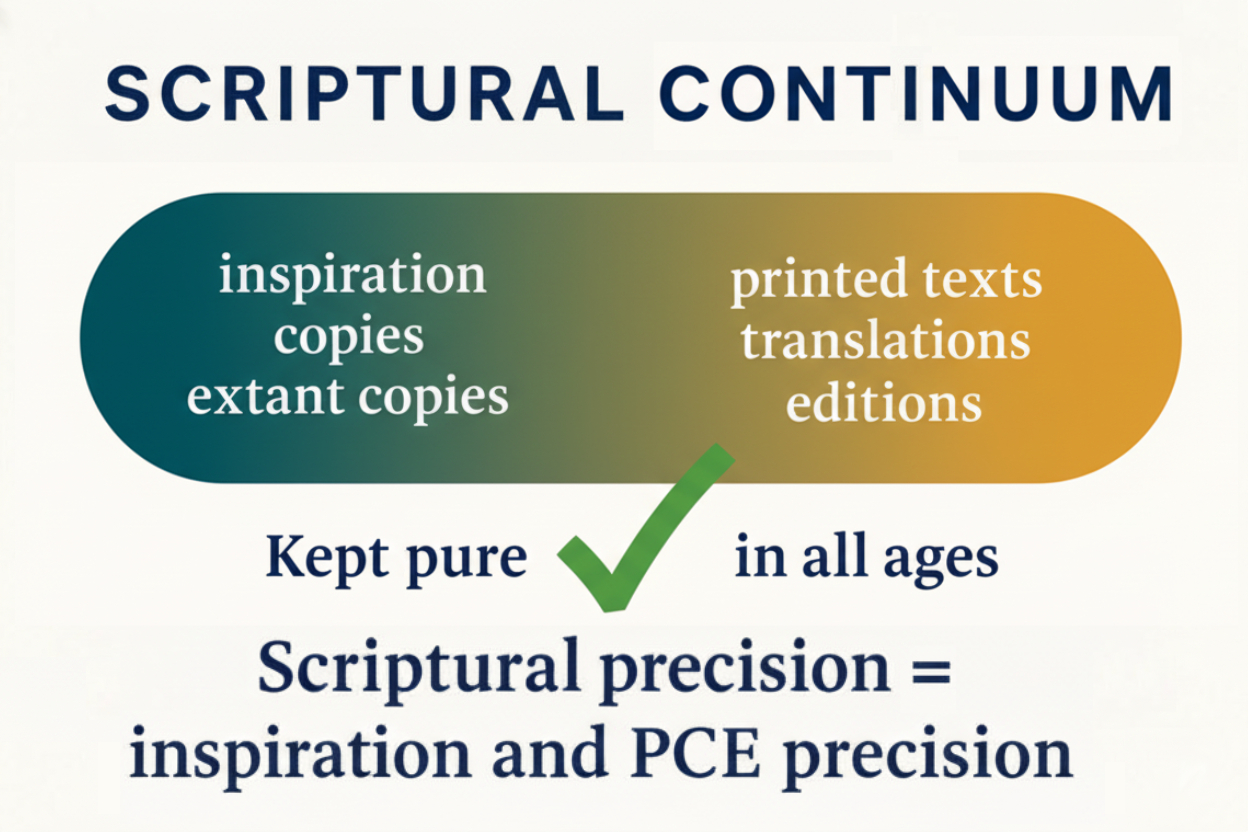
You see, there are seven levels of the Scripture and its form.

First, the Scripture exists in the mind of God, which is also called Theistic Conceptual Realism. It’s a fat load of good being there alone, but because it is revealed in this time of creation first in Heaven and then on Earth for us through the process of inspiration, it is good.

So the second form is that it exists in a perfect form written in Heaven. We can prove this from many passages too, such as Psalm 40:7; 119:89, Daniel 10:21 and Hebrews 8:5; 9:19, 23.

The third form is the Scripture itself. Scripture having all the attributes we ascribe to it, such as inerrancy, infallibility, inspiration etc.

So now, taking this third form, we can argue three things:

  1. That a copy of the Scripture is the word of God,
  2. That a copy of the Scripture is the word of God to the people who use it as the word of God, and
  3. That a copy of the Scripture is the word of God in as much as it is faithful and substantively so.

Therefore on this basis the Greek copies of the Scripture in Constantinople, and even the Latin Vulgate was the word of God.

Now we know that there are Textual variations and translation issues in the Vulgate, so we know that the Vulgate does not match “verbatim” what would exist in Heaven or in the mind of God, but we do know it is accepted in general.

(In fact, the ESV contains the word of God where it matches the KJB, though the ESV be corrupt and the corruption have rendered it practically unusable to a person who has an awakened conscience on these matters.)

The next level, the fourth level, is that of the Text. We can argue for purity of Text. This means a perfect Version, this means a perfect set of Readings. We now point to the King James Bible as being this exactly, as it being the final form of the Received Text.

The next level, the fifth, is that of the translation. We can argue for the purity of the translation. That means a perfect translation, not just a good one like Tyndale or Geneva. We can argue that God’s words have come into English properly and exactly. We can say that the King James Bible is the best translation in the world.

The next level, the sixth, is that of the Edition. One Edition of the King James Bible is better than the others, because of accuracy, because of getting the orthography right. We can argue for a progress in this matter from 1611 to the 20th century. We can see how far advanced the work of Dr Blayney was in 1769.

When I said that Dr Blayney did well, that he had a moral obligation to fix typos and to standardise and improve the English, did you know that Bryan Ross and his friends laughed me to scorn. I cannot understand their attitude at all except to understand it spiritually. I shall not render evil for evil for this, but show that in the love of God, God has given Pastor Ross a fine gift of the benefit of the 1769 work, something good.

Now there are a series of editions of the King James Bible, and editors have worked to fix typographical errors, standardise the spelling and grammar, etc., and there are seven major Editions, which are editions of significant editorial importance, they are the folio Editions of 1611, 1611 again, 1613, 1629, 1638, 1769 and the Pure Cambridge Edition (which is not a folio but exists in a series of various printings). The PCE therefore presents the word of God exactly with proper editing in English.

This brings us to the seventh level, which is the Pure Cambridge Edition, but specifically, a copy-edited form of it, a resolved, exactly correct copy. I didn’t invent the Pure Cambridge Edition, I didn’t make a computer file copy of it based on some sort of “pentecostal experience” or “supernatural guidance”, I did it in line with Providence, and I used a believing textual analytical method. The setting and setting forth of the PCE as a resolved and acknowledgeable perfect textual form therefore presents the word of God exactly correctly to the letter.

Now Ross has quite wrongly said that I say that my holding to the Pure Cambridge Edition (level 6) invalidates every manuscript and copy and Bible (level 3), every Bible version (level 4) and every translation (level 5) and every other edition of the King James Bible. This is so blatantly wrong, and yet he has built his entire attack on me on this silly and false syllogism.

It should be obvious that every edition of the KJB has the same version and translation, and therefore how could I be casting them out on that ground? The fact is that I personally only strive to use the PCE of the KJB for the reason of love of accuracy and wanting to ensure reliance on the exactness of the very presentation of truth.

And so, at the last, we have, before the end of the world, a very perfect, precise and exact knowledge of the very words of God to the very details and possible grasping of the very nuance of meaning, by having a perfect form of the PCE, which in itself answers here below to that which is above in Heaven.

Semantics required for conceptual accuracy 

The fundamental foundation of my belief system, and of the argument for the KJB and the PCE, is that worlds are framed by the word of God, and that the “word of God” is made up of words, and words have meanings. Therefore, exactness of meaning is rooted in exactness of words.

(This is, I am sure, what the rabbis thought too, after their own fashion. My own theological belief, being Word and Spirit, is built directly upon Word of Faith theology, and this emphasis on words as “containers” is central. The Puritan Calvinist, being primarily a legalist, also shares the centrality of God’s law being communicated by words, that words have meaning, because the law is words of meaning. And so, language is a kind of presuppositional framework that exists, it comes from the mind of God, and it enters creation, which is why we call our Saviour by the title Word. The modernists, in their foolishness, have called Him Logos, but I say that we must dominate the Platonic understanding and plunder their words and use words in a Christian way, and not subject Christianity to Platonism.)

Words matter. Things cannot exist except words describe them, and the perfect form of the things exist because they exist in the mind of God, therefore, Theistic Conceptual Realism (the ideas that God knows) dominates Nominalism (mere words). Meaning requires words, just as God’s ideas were expressed by the divine utterance and reverberance in creation, And God said!

Bryan Ross is so far from these mysteries, floundering about with his six different spellings of a word, that he cannot detect that perfection is come.

He cannot accept that the very truth is communicated precisely by jots and tittles which are necessary for conveying the exact sense of the Scripture.

He accuses me of believing in “verbatim identicality”, yet I do not believe in such a thing, but I do believe in the perfect Scripture in Heaven being the progenitor of perfection that is here now in the whole world, and that its force is of full effect in its operation in the Earth.

I can point to scripture reference after scripture reference of promises, prophecies and implications that we should have the Bible perfectly and exactly before the end of the world.

Of course, any edition of the King James Bible which, at the point where it is varying from the PCE, is at that point not giving the “exact sense”. 

Doctrine, statutes, precepts, the very nature of our religion, is based upon the legal nature of covenant agreements and written testaments. Righteousness is measured by the very exact “every last whit” of the law.

The specific and exact state, word order and lettering of Scripture has an effect on nuance, concept and meaning. Therefore, the very letters of the King James Bible are important, because life and death can depend upon them.

Ross intentionally misreads me as though a world of meaning exists in a letter “w” sitting by itself on a piece of paper made by the calligrapher’s art. Ross writes, “Whole doctrines in the Bible do not hang on letters; they hang on Bible verses in context”. This is exaggerated nonsense about a single letter hung with doctrines. But in that a letter changes doctrine, in a verse, in context, that is evident: “Now to Abraham and his seed were the promises made. He saith not, And to seeds, as of many; but as of one, And to thy seed, which is Christ.” (Galatians 3:16).

So, a letter does make a difference. When we look at editorial variations, we would not be so foolish as to not correct typographical errors, and we would be not so foolish as to insist that “I will pour out my spirit upon all flesh” (in Joel 2:28) is identical or else meaninglessly distinct to “I will pour out of my Spirit upon all flesh” (in Acts 2:17). Every word matters, every capital letter matters, even dots matter.

I cannot believe that Ross would stoop so low as to use such a willfully “on the spectrum” style of gullible reasoning to accuse me by saying, “The way doctrines are derived in the Bible is not by looking at a single letter or word in a single verse.” As we can see here, I am using a variety of letters making words and typing out a response here which you can read and which makes sense. I am not striking the letter “L” over and again on my keyboard as if one letter is going to do anything by itself. I mean, how does it edify anyone if I really was doing what Ross suggests and I was abasing myself before the letter “L” and insisting it, in some sort of new religious cult-like way, was some angular power to whack his lambda?

Surely Ross knows he is being dishonest. Surely he knows I am not saying that some mere letter on a page in the Bible itself is full of doctrines. Surely he knows what the nuance of “Glistering Truths” shows.

Ross can easily observe that I actually teach that the “neesings” of the leviathan is full of meaning that is not merely the same as someone sneezing. Now, I know how Ross will run to the Oxford English Dictionary, and claim with umpteen examples that “neesing” was a 17th century form of “sneezing”. I can imagine Ross right now pumping AI for info, that neesing is just an old and archaic spelling for sneezing. But he has missed the point: the Bible trumps the dictionary, and adhering to the divine trumps mere human reasoning.

We approach Scripture with a believing sense of wonder, we don’t impose fake criteria by sullying Bible words with the tyranny of subjective opinion and dictionary dictatorships. Dictionaries are tools, they are servants, they exist downstream from the Providential supply of words and their meanings. We should not be so foolish as people like Mark Ward who petulantly proclaim that usage determines meaning. Divine usage, not human usage, determines meaning.

Let us humble ourselves gladly to then find out what “ensamples” means rather than just say it must be the same as “examples”. To ignore or conflate them would be anti-intellectualism or vain deceit.

Ross also makes a weird accusation that I did not get my views on the PCE by comparing Bible verses. I assume he means the comparing of Scripture with Scripture, and I assume he is meaning a doctrine about there being a perfect exact standard of God’s words. Well then, Pastor Ross can be assured that the entire doctrine of the PCE is based upon Scripture. I also appeal to Providential and internal arguments, but the entire argument is built upon Scripture, it is itself a scriptural doctrine. I’ll be happy to give him an extensive list of Bible verses, but I know already what he will say. He will find it incompatible to interpret the Scripture that way, because I know the problem actually lays in how he interprets Scripture. He’s demonstrated that with how he rejects the teaching of Matthew 5:18.

In fact, Ross came up with his “verbal equivalence” by just trying to explain (wrongly) why New Testament quotes of the Old Testament are not identical. Other than that wresting, his views and his rejection of the PCE are nothing really to do with Scripture.

And so we arrive at the nonsense position of Ross, as if that “alway” and “always” are the same word spelt two different ways. It’s very easy to prove in all kinds of ways that these are two different words with different meanings. Ross has committed himself in writing that they are not different, that they don’t present a different sense. His position is forced to accommodate the places where editions which vary the spelling, orthography, wording or made typos and to uphold them (those places that differ) as equal to what the PCE has now. (Obviously, Bryan Ross accepts the PCE is an edition, but he deliberately tries to deny its specialness.)

Answering Ross’ accusations 

Ross wrote accusingly of me, “He developed his position on the PCE through private interpretation (his Pentecostalism & Historicist interpretation of Revelation) to determine what he thinks the reality of the printed text should be, rather than what the actual reality was.”

This is loaded with wrong and false accusations.

I did not argue for the Pure Cambridge Edition based on private interpretation at all, it is based upon open analysis, providence and tradition.

The accusation that I used some sort of “Pentecostal” experiences to determine the PCE is just completely made up, and I have rejected this ridiculous accusation many times.

I also did not use the Historicist interpretation of Revelation to develop my position on the PCE. In fact, I did not understand Historicism very much when first studying about the PCE. I have written on multiple occasions about how I came to understand about the PCE, and Ross can easily correct himself by reading my several accounts.

It was later that I found in Historicist writings that they pointed to the King James Bible in how they interpreted Revelation 10. In general, I did not initially build or understand the case about the PCE as based on Historicist prophecy.

It is strange that Ross refers to the “reality” of the Pure Cambridge Edition. What is his “reality”? That we cannot get exactness in editing? I’d sure like to know how Ross proposes to have an exactly correct printing of the King James Bible. The history of editing from 1611 to 1769 is obvious, but why doesn’t Ross be more clear in recognising the improvement in the printed history?

Things are heading somewhere, editing has not been for no reason. It staggers belief that Ross would be fighting so hard to reject a post-1769 standard edition. Is he denying that God would want to get a correctly edited KJB Edition for the Body of Christ?

I also can’t understand how he doesn’t recognise that words mean something, his reluctance to get exactness, and his trying to just make “throughly” and “thoroughly” the same. If KJBOs didn’t make an academically rigorous case for the distinction in meanings then why not make an academically proposition to understand why there are detectable differences (according to God’s academia, not the worldly peer-reviewed mafia).

Apparently he doesn’t understand how constitutions and the courts work. Words are full of meaning, but if words can just be just smudged because they seem similar, then I think Ross would be the most sloppy lawyer in the world.

In all of this, Ross’ attacks have done one thing, and that is make me explain more, and I expect it all is more of an encouragement for believers to:
* stick with the reputable Pure Cambridge Edition
* understand and stay with the “glistering truths”
* align with Divine Providence

Conclusion

Pastor Ross may continue in the same denial he seems to hold to but never articulate: that the Scripture cannot have an ultimate final, exact form on Earth. He needs to see that all things move with purpose instead of “verbal equivalence” of general ideas, of approximation, which avoids admitting that God’s Word is communicated in words, not in loose impressions. And because he rejects exactness in the written form, he cannot penetrate a standard beyond conceptual boundaries.

But creation itself testifies otherwise. The sun shines as one light. So too with Scripture. Many copies may vary, many translations may obscure, but the light of truth itself has a penetrating form. Not because man contrived it, but “So shall my word be that goeth forth out of my mouth: it shall not return unto me void, but it shall accomplish that which I please, and it shall prosper in the thing whereto I sent it.” (Isaiah 55:11).

Heaven and Earth follow patterns. The tabernacle below reflected the pattern above; the law given had a heavenly origin; the Scripture is both divine in source and earthly in manifestation. This correspondence is what God designs in perfection and brings to completion in history. Ross seems to be ignorant of this principle, though it be through the whole Bible.

I stand for that God’s Word existed eternally in His mind,
was written perfectly in Heaven,
was given and used throughout all ages as Scripture on Earth,
was gathered through the Received Text,
translated exactly into English for the world,
edited providentially into a standard Edition,
and resolved in a stable and exact form.

This is not private interpretation, it is not whimsical opinion, but the belief in a precise God with an actual set of words telling exactly what we need to know. We can enter into every exact nuance of doctrine by knowing we have every jot and tittle in its right order.

Answering allegations made by Bryan Ross

By MATTHEW VERSCHUUR, author of Glistering Truths.

OVERVIEW

I was unaware, until late November 2025, that Bryan Ross had written a book in 2017 which contains a number of attacks and misrepresentations of my position.

His booklet, “The King James Bible in America”, is designed to be an attack on the idea of there being a pure edition of the King James Bible (KJB), and an attack on the idea that we can have the KJB letter perfect.

One can only conclude that Pastor Ross, who does make some good and interesting points in some of what he talks about, is misunderstanding or else being intellectually dishonest on these issues.

I suspect he is so wrong on this topic because he has a flawed interpretation methodology (i.e. some influence of modernist hermeneutics, such as in how he reads Matthew 5:18), and because he is not approaching divine providence in history as interventionist but rather merely examining things with some degree of Enlightenment reasoning (e.g. variations are observable therefore there is not final perfection) and most especially because he is not adhering to a worldview that says that manifestation on Earth is to reflect perfection in Heaven (thereby denying a perfect knowledge of fixed words of God on Earth as being able to match a heavenly prototype).

Bryan Ross wants to argue that “alway” and “always”, “stablish” and “establish”, “ensample” and “example” and “throughly” and “thoroughly” are not distinct, deliberate words, with some element of specific meaning that makes them unique to their counterpart similar wordform.

At the outset, I want to make it clear that these words can be quite similar, in appearance and in usage, but there is still something specific, distinct and particular about them. We cannot just broadbrush and replace all instances of one word with another. They are not just merely variant spellings, archaic forms or variations of orthography of no consequence. The fact that these words have been listed distinctly in dictionaries, and were not edited to be replaced by Dr Blayney (1769) or in the Pure Cambridge Edition (PCE) shows that indeed there is every reason to retain them.

Pastor Ross can argue that some words might come from the same etymological root word, or that at times historically usage appeared somewhat interchangeable, but I think this does not counter the peculiar “glistering truth” nature of these words. I suggest that there may be other reasons why there was some looseness, and am inclined to hypothesise that less educated compositors and especially American printers have been less exact. We see how much a spirit of wanting to change the King James Bible has manifested in America, including the stupendous amount of changes made by the American Bible Society and also in more recent editions, which thankfully propriety, market forces and diligent Christians have rejected.

I wonder whether Pastor Ross is arguing that God cannot, will not or has not provided the King James Bible with distinctions, even shades of meaning, in accurate printing. I cannot understand how Pastor Ross would be siding against accuracy, exactness, fixedness or certainty to allow the ideas of those who wish to modernise, simplify and deny precision.

I will now give a survey of some of the issues in his book.

MIXED DEFINITIONS

On page 1, Pastor Ross begins with a false accusation against my view that I claim that “modern printings of the KJB, do not possess the ‘pure word of God’”, and that believers “need to purchase a copy of the King James text which is devoid of these changes in order to possess an uncorrupted copy of God’s word in English.”

This accusation is wrong because he is (deliberately) confounding the purity or perfection of a version or a translation with the totally separate idea of the correctness of editing or of printing. These are entirely separate concepts. Version is not translation, and editing and printing are their own things.

As such, if I say that the King James Bible is the Word of God in English, then I cannot be denying the KJB’s version-readings and its translation. I must be accepting that version and translation even if it was printed by Clarendon at Oxford.

On one side, I think that the Word of God is best presented in a typographically accurate form of the KJB, on the other hand, I accept the Scripture as being true, such as when Paul wrote it, before English even existed.

PUTTING WORDS IN MY MOUTH

On page 7, Pastor Ross says that we assert that, “‘throughly’ was of entirely different meaning than ‘thoroughly’.” This is incorrect. That word “entirely” is his embellishment. In fact, I could be prepared to concede that in some cases the different meanings are so close, as to constitute a 99% similarity. But they are, I am sure, still different.

He goes on to discuss me and my book, Glistering Truths. (Note that over the years I have done some minor work on this book, not to change its central thesis, but just normal editing.)

Bryan Ross wants to reject my idea that every letter in the Pure Cambridge Edition of the King James Bible is exactly correct. He says, “Brother Verschuur maintains implicitly if not explicitly that any Bible that changes the spelling of ‘always’ to ‘always’ or ‘ensample’ to ‘example’ is a ‘corrupted’ Bible and not capable of expressing the exact sense of scripture. So unless one possesses a particular printing (circa 1900) from a particular press (Cambridge University Press) they do not possess the pure word of God, according to Bible Protector.”

This is false and absurd. This is not my position at all. It almost seems as if Pastor Ross is deliberately misrepresenting, for he is certainly mistaking, my position.

The King James Bible has both a correct, pure and perfect version/text/readings and translation. The King James Bible has gone through many valid historical editions, which exhibit both printing mistakes and editing. I certainly do not call such editions as “corrupted”. While obviously a printing mistake is not right, by implication “impure”, I am not attributing some moral evil to this, which is what detractors to my position are falsely accusing me of.

(I could illustrate it as having a shirt with a loose thread or a tiny hole in it. It’s my preference for absolutely correct typesetting, like you would rather not wear a shirt with a tiny food splotch on it.)

We all know that editing has happened and that there have been some adjustments in orthography, but such things have been within the parameters of the normal, natural printing and presswork of the history of the King James Bible, and to correct and to standardise spelling and grammar have all been commendable trends.

Since I know that the Word of God was there in the writings of Paul, or in Latin, or in foreign Reformation translations, or in old Protestant English Bible translations, I must steadfastly refuse Pastor Ross’ blatantly false accusation that I am saying that if it is not Pure Cambridge Edition, it is not the Word of God.

The problem arises with modern publishers who want to (despite whatever historical precedents) bring out new Americanised KJB editions — and the problem is not restricted to them, because David Norton also brought out a very modernised edition with all kinds of modernised changes in spelling and grammatical forms — and this is inherently a bad thing. It is changes by stealth, it is an undermining of the idea that we have a tradition which reflects the work of divine providence.

WRONG CRITERIA

On page 12, he writes, “Bible Protector makes no mention of the fact that the same Greek word translated ‘always’ in John 12:8 is elsewhere rendered ‘ever’ six times, ‘always’ five times, and ‘evermore’ two times by the King James Translators. Please also note that no English language resource is given to substantiate the difference between the two words. One is simply asked to take Brother Verschuur’s word for it. ‘Always’ and ‘always’ appear to be another distinction without a difference.”

The first and by far biggest problem here is that Bryan Ross is not judging English, but is imposing from (his view of) the Greek onto English. This is a massive fault, because he is essentially denying the providential distinction in English by the authority of himself or modern scholarship or some external misapplied standard of the so-called Greek.

Pastor Ross also claims that I have given no source for why I stated in my monograph that “alway” is different to “always”. However, here is the basic fact: my monograph is not a deep academic work, but one which is only superficial in nature, inviting much further study. In it I don’t have an extensive bibliography, extensive footnotes or careful examination of various historical dictionaries or lexical sources. I fully expect that lots more study should be done.

However, I am confident, even in my “infant” study, that to approach the Bible, in the providential perspective of what Blayney (1769) and the PCE present, in the distinction of words like “alway” versus “always”, is because there really is some meaning difference. I am sure that further studies will only vindicate this on a much more comprehensive level.

Bryan Ross is asking us to take his word for it that I expect the reader to take my word for it. My view is that as people look into these matters, and if people like Ross’ friend Nathan Kooienga do, if they are going to be honest, I expect based on just a simple faith approach, that “alway” and “always” do have peculiarity, and could not just arbitrarily be made to be just one word only. We know that a modernist approach would do tend to do so, and that they would probably just have “always” at every instance. Either Bryan Ross is dipping is toes into modernistic thinking or at least he is giving them comfort with their way of looking at KJB editing.

ACADEMIC SNOBBERY

On page 19, Pastor Ross says, “Much has been made by King James Bible Believers of the alleged difference between the English words ‘ensample’ and ‘example.’ … Bible Protector, Matthew Verschuur maintains that there is a difference in meaning between these two words … Once again, please note that Brother Verschuur does not reference any English language reference book to support these statements.”

This is slightly laughable in that there are several ways in which to detect a difference, which should be taken in concert, being: King James Bible usage, proper dictionaries and etymological observation.

I also stress that the King James Bible itself is superior to any dictionary.

So my simple examination of the matter could well be a first step, regardless of whether I somehow referenced the Oxford English Dictionary or not. (W. A. Wright’s Bible Word Book is also a source which I note Ross does not mention at all in his work.)

Now, the fact may be that Ross has looked at a bunch of old dictionaries. Generally, I may have looked at the OED, Johnston and Wright’s book. I can even admit sometimes I didn’t look at them that much. Why? Because my monograph is the proposing of an idea rather than the rigorous testing of it. I am inviting such rigorous testing from a believing perspective! And because I started from believing what the Bible actually has, i.e. the word “ensample” being different to “example”, I was able to suggest, even just by observable etymology, that “en-” differs to “ex-”, one being inside (taking it to heart) and one being outside (a pattern to conform to).

I don’t mean that my “off the cuff” definitions I have just given are to be treated as the absolute full definition, but I think that this is far in the right direction, and God is working to clarify these things, because it is His will for us to understand.

Perhaps this is more to the point another issue, about the advancement in knowledge of Christianity. I actually believe God wants us to know and that we can know. Proverbs 1:5, 6 is about us attaining the needful, perhaps hithertofore hidden, knowledge. I see it in many places, including 1 Corinthians chapter 2, etc.

If Pastor Ross wants to cast doubt because I didn’t cite a dictionary, I will counter far more simply that I am starting from believing what has been providentially supplied to us in Blayney and more especially the PCE.

Let me add that despite the variations that appeared from American presses “accidentally”, and worse, deliberately in the middle of the 19th century, and again deliberately from World publishers over two decades ago (after they had printed the PCE when they were aligned with Collins), I will note the irony, that is, providence, that has Ross and his Scofield-loving friends using copies which do get these words like “stablish”, “alway”, “ensample” and “throughly” correct.

STUDYING IT OUT

Bryan Ross goes to some length to attempt to discredit the idea that “example” and “ensample” have distinctions in meaning. Yet, upon reading the King James Bible, the distinction is apparent and applicable at every place.

If I am proposing a hypothesis, and it works, it is a theory. And as a theory, we should be able to get to (by collaboration and proper believing study) a fact.

We will not, as Pastor Ross wrongly does, try to use the Greek to change the English meaning. Instead, we can look at 1 Corinthians 10, and see whether the distinctiveness between “en-” and “ex-” holds ground.

In verse 6, we see that the happenings to Israel in the wilderness are examples, which means patterns to conform to, of things which are an external warning to us, by example. It is not of the nature of a born again Christian to lust, though one might submit to the alien invasion of lust, but the warning is clear. We cannot “internalise” the punishment against lusters because Christ in us is not a luster. Therefore, we look AT the Old Testament, and treat the stories of the Israelites of old as examples.

But then, in verse 11, we are told that the things that happened to Israel are for our teaching, our learning, and therefore, we do internalise knowledge, we are admonished, we take it to heart, they are ensamples!

We are told not to do as the Israelites did wrong, as though we could, and therefore we internalise the admonition, it is the result of learning we received from understanding the teaching of the Scripture.

I can only suggest that Bryan Ross is deliberately trying not to see or discern the difference between “example” and “ensample” in 1 Corinthians 10.

DICTIONARY POWER

Then, on page 22, Pastor Ross goes on to criticise the distinction between “stablish” and “establish”, which can be shown from the Oxford English Dictionary.

The problem that Bryan Ross has is how he selectively interprets the OED to try to make it have “stablish” and “establish” as interchangeable or the same thing. He writes on page 31, “It is obvious that the supposed difference in meaning does not arise from the words themselves since the OED indicates the words are equivalents. What is evidently occurring is that each zealous defender of the KJB has pre-decided that ‘stablish’ and ‘establish’ have different meanings. Since neither the OED nor other dictionaries support such a distinction, each KJB defender has had to manufacture a supposed difference in meaning which does not exist. Thus, one observes that they invent different meanings. The fact that they invent different meanings is proof the supposed distinction between stablish and establish is not real, but contrived.”

In fact, Bryan Ross has started out with the assumption that the words are really just the same, and interpreted the dictionary according to his bias. (There would be common roots in the etymology.) But instead of seeing a difference, Pastor Ross wants to make it interchangeable. He does so, not on the basis of proper merit, but on his assertion that people are apparently making up meanings and that some people had different meanings. (This is like saying because someone was wrong, therefore my view is right.)

Ross wants to take the smudging road that differences are really just the same thing. (Sounds like the same argument NKJV supporters use when saying that they accept both the NKJV and the KJV… but then always say something is wrong in the KJV. In this case, Ross is saying, by implication, something is wrong with having “stablish” when he thinks it really just is “establish”).

Ross claims, “A host of English language resources stretching all the way back to early 17th century, when the translation work on the KJB was being conducted, report that the words are equivalent in meaning.”

That is a mistaken thought. First, because the words are listed separately. And second, because at least some dictionaries, good ones, identify something different about each word.

Here’s a quote from the OED which shows that the words were not merely synonyms: “From the 16th c. there seems to have been a tendency to confine the use of the form stablish to the uses in which the relation of meaning to stable adj. Is apparent, i.e. where the notion is rather ‘to strengthen or support (something existing)’ than ‘to found or set up’. The modern currency of the word is pure literary, and reminiscent of the Bible or Prayer Book.”

The point here is not whether the OED is right, but it is touching on the important point that there already existed in the minds of people centuries ago a difference.

The 1604 Table Alphabetical shows that stablished means “sure, confirmed, one made strong”, while establish means, “confirm, make strong”. In this case, this work does not give identical definitions, though obviously there is a lot of crossover. I’m not suggesting that we should use some work by one man designed for ladies, to define religious and Bible words as being used by KJB translators, but it does give us valid insight as far as it goes. The point here is that the definitions are NOT strictly synonymous, and also they contradict the reporting in the more thorough OED. Yet all agree on separate lexical entries.

As to the point that I might be starting out with my own view of a difference, and inventing my own arbitrary definitions, I think we have already seen too much from the dictionaries to prove otherwise. Furthermore, I didn’t approach the Bible imposing my view upon it, I found two different words, and wondered why. I didn’t just assume (as apparently Pastor Ross wants us to) that the words are just the same. I followed the hint from Dean Burgon, that every distinct word is distinctly different, that every distinct word is exactly correct at its place. I then humbly began to learn why it was so, without just denying or trying to explain away the difference.

(Bryan Ross saw all these differences in 19th century American Bibles, and seems to have concluded quite wrongly that there was no hand of God in these matters altogether. He has pushed very hard to make a case against there being an editorial standard, skirting far too closely toward the thinking of David Norton.)

DISTINCTION VERSUS AMERICAN FUZZINESS

On page 32, Pastor Ross writes, “Not only will this problem not go away for the standard editions of the KJB between 1611 and 1769; but … the problem is compounded when one considers the printed history of the KJB in the United States. As early as 1792, nearly one hundred years before the publication of the Revised Version (1881), American Bible publishers were already ‘Americanizing’ the spelling of words in King James Bibles printed in the United States. If one is going to persist in the belief that KJBs exhibiting these spelling changes are ‘corruptions’ then they must also conclude that generations of unwitting American Christians who used these Bibles did not possess the pure word of God.”

We know full well that there were orthographic, spelling and grammatical works taking place in editions of the King James Bible from 1611 to 1769, especially in 1769. We know that in America, it obviously went a bit haywire doing this.

It’s not a “problem” if we know that the issue has been resolved. It’s not a “problem” if we know that the 1769 Edition and the Cambridge tradition leading to the Pure Cambridge Edition kept in place a proper usage of these various word forms.

It’s not a problem that if we examine closely the usage, in the editorial form we have now, that we can see how “ensample” differs to “example”.

Was the distinction between these two words clear in 1611? I think so, but I also think that the conceptual clarity, especially as we see through other kinds of examples of grammatical standardisation, really becomes a notable phenomenon more and more in time.

We could find some case where people, even the translators, had written the word in the other form. That’s true of any of the kinds of editing Blayney did, even where “you” or “ye” have been changed somewhere. This is no problem.

We can fairly assert that the translators’ intention was to communicate the ideas as we are now able to discern them, through acknowledging distinctness. Of course, we can certainly argue in a retrospective sense that since we have these distinctions fixed and known, thanks to Blayney and the PCE, that we have knowledge of God’s providentially intended distinctness in words.

REALLY PUSHING AGAINST THE GOADS

Pastor Ross dials up the rhetoric, asking on page 61, “Do we really want to say that generations of American Christians possessed ‘corrupt’ King James Bibles because they did not come from an Oxford or Cambridge University Press? Is it our position that in order to possess the ‘pure word of God’ in English one must possess a particular printing, from a particular press, produced on a particular continent?”

This is an absurd set of questions, because we know the King James Bible is good, regardless of the “disparity” or “interference” or “lack of precision” in American printings. I have a London BFBS printing from about 1806 or so, and it is fraught with bad typography. Bad typography or historical looseness in American editions do not invalidate the Scripture, but they are issues thankfully that people today can address and have the answer to, being accurately printed editions.

The Cambridge press has traditionally been the best, and people should read my books on the subject from my website to see how good Cambridge has been. However, Cambridge has also made mistakes and done the wrong thing. The Revised Version was wrong. The Concord Edition was not a good step. And changing the PCE in places as has been done silently (e.g. at Acts 11:12) has been a bad thing. But I am not saying that KJBs which spell “Hemath” as “Hammath” must be cast into the fire. Ironically, there are plenty of Pure Cambridge Edition copies that have made this change, and yet I myself have used them. Of course, it should be “Hemath” at 1 Chronicles 2:55, and thankfully we have been able to resolve even these questions. Therefore, if someone is using a 1917 Scofield Bible, except if he was doing it out of rebellion, they still have the KJB. I am rather just encouraging conformity to the PCE in a positive sense.

I suspect that Bryan Ross does not like that which God’s providence has favoured and wishes for a libertarian approach, which might just allow him to fashion something else. For why is it that he has to react so strongly to the set and particular orthography, spelling and grammar of Dr Blayney and the PCE? Is he really just moved against the PCE, is he really just motivated to reject it?

THE REALITY

The distinctions of “throughly,” “ensample,” “stablish” and “alway” existed pre-1769. Dr Blayney and the PCE preserved and standardised these distinctions rather than inventing them. The retention of these, largely stable from 1611, and certainly stable from 1769, shows editorial recognition of meaningful distinctions.

The work of the editors was not arbitrary. Orthographic choices were meaningful, reflecting nuance, register or function. Editors did not standardise or erase “stablish” or “ensample” or the rest because they understood they were functionally distinct.

Early lexicons and glossaries are not technical, and therefore should not be over-invested with authority. Johnston and particularly the OED are about usage patterns and the record of usage, and from this, we can infer they are reporting a record of semantic distinctions with these words.

Definitions of course have become more clear to us, but that doesn’t mean they were not existing in the past. It’s just that these days we have precise orthography, stable editing and of course a universal means (the internet) to communicate and understand that words like “alway” really are special and particular.

Overlapping definitions of words does not invalidate specificity.

1611 compositor errors, historical orthographic variation or US printing inconsistencies do not erase distinctions.

The record of normal, standard and proper KJB editions, especially from Cambridge, are a witness to stabilisation, not wild, random, erratic orthographic, spelling and word variations, which means that meaning was stable and preexists any issue about apparent changes in orthography in places, which kind of editorial work is consistent particularly with Dr Parris and Thomas Paris’ and Dr Blayney’s editing.

I have engaged in a methodology of studying the editions and the words, and the editorial weight is with the consistency of the Pure Cambridge Edition. We can safely say that 1769 and PCE editorial decisions present the intended distinctions in English usage, as to the differences between the words, and the English language standardisation has served to help clarify distinctions that may have been historically more blurred.

Therefore, Pastor Ross’ objection that the KJB words are more chaotic, or less distinct, or exist in some level of editorial, semantic and conceptual uncertainty is a position which is antithetical to both reality and to the revelation of divine providence.

CONCLUSION

If Ross is right, he must explain why “alway”, “ensample”, “stablish” and “throughly” display remarkable stability across centuries of KJB printing.

If no meaningful distinction in meaning existed, and these words are just synonymous pairs, we would expect far greater instability, especially in the fluid orthographic environment of the 1600s and early 1700s. But we see general stability.

If these words were really just synonymous, the printers and editors would have had every reason to standardise or modernise them long ago, yet these words resisted elimination. Such survival does not reflect random orthographic drift or mere accident, but a continuity far more consistent with providential preservation of distinctions.

Surely the only answer is that these words exist precisely because they are providentially placed, and because their theological meaning and nuance matters.

ADDITIONAL NOTES: In the recent few months before writing this article, I made a few cheeky but harmless memes about Bryan Ross. His accusations I have addressed to which he has committed to writing are far worse than anything I’ve said. I want to be careful to treat him as a brother, because for all the differences in our theology, I don’t mind him as a person, and want to only disagree on him on things we have to disagree on, and do so in robust but constructive ways.

The Cambridge Text problem

SUBHEADING: The KJV Store’s pet project, Bryan Ross’ misrepresentation on 1 John 5:8 and why the Trinitarian Bible Society’s text is diverging.

If anyone thinks the 1769 Edition is a standard, they must be made aware that there are ongoing divergences from it.

In fact, there is a problem that there have been divergences made from the proper standard of the Pure Cambridge Edition. This is not good, for where the Body of Christ needs to come to a standard, there are those who are pushing after their own standards.

“Woe unto them that call evil good, and good evil; that put darkness for light, and light for darkness; that put bitter for sweet, and sweet for bitter! Woe unto them that are wise in their own eyes, and prudent in their own sight!” (Isaiah 5:20, 21).

The solution is that we need to come to the standard. That requires humility and that requires aligning with divine providence.

Rejecters of the Pure Cambridge Edition

For whatever reasons, the KJV Store, a company based in the USA, has sided with Cambridge’s current text against the Pure Cambridge Edition with their production of their “Sacred Syntax” edition.

Cambridge’s main edition has been in a state of flux since the 1980s, in important ways, with their small but vexing changes to the Pure Cambridge Edition.

In 1985 they began to wrongly implement the change from “spirit” to “Spirit” at 1 John 5:8. From 1990, Acts 11:12 and Acts 11:28 began to be changed.

These are changes to the Pure Cambridge Edition as opposed to the London-Cambridge Edition which was published in the Emerald and Royal Ruby, which has been the base of the Trinitarian Bible Society printings, which themselves have been further changed.

There are examples of Cambridge Bibles printed in that period with various combinations of changes from “spirit” to “Spirit” at 1 John 5:8, Acts 11:12 and Acts 11:28.

There are those out there who explicitly reject the Pure Cambridge Edition. One of the reasons they do this is to align with the in-flux status of Cambridge University Press.

As it is, Cambridge University Press themselves are still making available material which is Pure Cambridge Edition, such as, through sales of old stock, through their preferred second hand vendor(s), and through some new works like the calligraphic Gospels.

The slippery slope

To be clear, Cambridge’s text has been changing since it printed the PCE from about 1910 to 1999/present.

There’s one change that was made in the PCE printings by Cambridge in the late 1940s, which was to change “Hemath” to “Hammath” or “Hamath” in several places. That’s not a significant issue, in that this change is not historical nor accepted by other publishers.

While it should be “Hemath”, I certainly am using Bibles with “Hammath/Hamath” … because I am not on the spectrum and know that God has outworked to rectify that issue.

(You really can’t be worried that your Bible is missing a dot accidentally, and we have knowledge of what is right now, so all things can be rectified.)

Some years ago, the British arm of the Trinitirian Bible Society announced it was going to change the word “spirit” to “Spirit” in a whole list of places. This wasn’t Cambridge, this was the TBS! By taking this misguided decision, they were pushing against even Cambridge or accepted standards as manifest by Divine Providence.

We must be exceedingly careful if we are to undertake to make some change. I have striven to align with the proper Cambridge tradition and the general witness of post-1769 editions, and I have also been honest and open about what I’ve done, for example, in putting it out there about how I have treated the letter “s” on the small capital word “LORD’s”.

We need to come to a standard, to a unanimity, a uniformity, not continual divergence of every man setting up his own idol, which has been a problem in Protestantism.

Without an anchor, it will be like how Bryan Ross has all these variations in American editions of the KJB, and somehow he is reluctant to come to the standard.

Let us have an excursus with Isaiah 59, because it’s not just the modern version/translation issue we see, but the rebellion in some against the PCE:

BEHOLD, the LORD’s hand is not shortened, that it cannot save; neither his ear heavy, that it cannot hear:

4 None calleth for justice, nor any pleadeth for truth: they trust in vanity, and speak lies; they conceive mischief, and bring forth iniquity.

9 Therefore is judgment far from us, neither doth justice overtake us: we wait for light, but behold obscurity; for brightness, but we walk in darkness.

10 We grope for the wall like the blind, and we grope as if we had no eyes: we stumble at noonday as in the night; we are in desolate places as dead men.

13 In transgressing and lying against the LORD, and departing away from our God, speaking oppression and revolt, conceiving and uttering from the heart words of falsehood.

14 And judgment is turned away backward, and justice standeth afar off: for truth is fallen in the street, and equity cannot enter.

15 Yea, truth faileth; and he that departeth from evil maketh himself a prey: and the LORD saw it, and it displeased him that there was no judgment.

18 According to their deeds, accordingly he will repay, fury to his adversaries, recompence to his enemies; to the islands he will repay recompence.

19 So shall they fear the name of the LORD from the west, and his glory from the rising of the sun. When the enemy shall come in like a flood, the Spirit of the LORD shall lift up a standard against him.

The layout issue

The KJV Store Reader’s Edition Bible with so called “Sacred Syntax” has some non-traditional elements.

I am not against people doing artistic and other representations of Scripture, but going against the verse by verse layout and blocking the text into a continual running paragraph can be a bit disconcerting.

There’s a place for it, I grant, but not as liturgical literature. I know Schuyler likes these new metrical layouts too, and they’ve been around for a while, for example, with Scrivener’s Paragraph Edition.

I personally don’t prefer that layout, but they say it is to make the Bible “like literature”. I think the Bible has to retain it’s superiority to being mere literature, and have no problem with the flow or pattern in the traditional layout.

Having said that, to make a particular work in that style, like Brandon Peterson’s Story of David, is probably a positive example.

But hidden behind these layouts of Psalms or other Books of the Bible like that often is a modernistic spirit, and it does tend to design to undermine the truth of the Scripture itself by implying something against verse and chapter increments.

One also wonders about these ways people make new layouts or new study systems of the Bible. While innovation isn’t evil, sometimes there is a level of gimmickry. Having said that, words of Christ in red has remained popular even though it was really popularised only in the 20th century. And likewise, having prounciation marks on Bible words, something which I really appreciate, was pushed by Henry Redpath at the same time as the words in red was done at Oxford in about 1901.

Why “spirit” lower case matters

Bryan Ross wrongly said that I said that 1 John 5:8 was not about the Holy Ghost. (The tradition from 1629 is that the King James Bible has “spirit” lower case at 1 John 5:8, including in the 1769 Edition.)

I have explained about this over the years, but it’s very clear that “spirit” has a lot to do with the Holy Ghost. So Bryan Ross is wrong.

Here are some examples to consider:

Turn you at my reproof: behold, I will pour out my spirit unto you, I will make known my words unto you.” (Proverbs 1:23).

And yet we also know that the Holy Ghost leads us in truth, in understanding of the Scripture and in things to come.

“And it shall come to pass afterward, that I will pour out my spirit upon all flesh; and your sons and your daughters shall prophesy, your old men shall dream dreams, your young men shall see visions:” (Joel 2:28).

We know that this is “of” the Holy Ghost when we read Acts 2.

“Teach me to do thy will; for thou art my God: thy spirit is good; lead me into the land of uprightness.” (Psalm 143:10).

God’s “spirit” obvious means the way and work of the Holy Ghost, and that in the heart of a man. Thus, when we read Acts 11:12 we surely can see that “spirit” should be correct.

“Now we have received, not the spirit of the world, but the spirit which is of God; that we might know the things that are freely given to us of God.” (1 Cor. 2:12).

It is obvious that this “spirit” is the impartation of knowledge, of being born again and knowing God. That’s very helpful for seeing why 1 John 5:8 should be lower case, since our born again spirit is witnessing to us of God, that we are wrought of God.

(So, anyone who claims that this is some sort of Pentecostal plot to want to have this in lower case at that place, in fact, there is no specific connection to that, except that proper Pentecostalism should have proper doctrine about being born again! Also, I doubt Cambridge was being motivated by Pentecostal doctrine in 1629, nor Blayney in 1769, when they had “spirit” there too. In fact, if anything, modern Pentecostalism has become very anti-tradition, so they would want to change things up.)

“We are of God: he that knoweth God heareth us; he that is not of God heareth not us. Hereby know we the spirit of truth, and the spirit of error.” (1 John 4:6).

The spiritual way of truth is obviously the way the Holy Ghost moves.

Therefore, one might be very bold, and say that the Pure Cambridge Edition is aligned with the spirit of truth.

The letter J is right

The Trinitarian Bible Society released an article saying, quite rightly, that “Jehovah” is the “most accurate pronunciation of the Divine Name”.

However, that’s not quite right. “Jehovah” is not the “most accurate” it is the exact, right and proper pronunciation of God the Father’s name.

But the problem is more deeply rooted. The Trinitarian Bible Society clearly does not believe the King James Bible is the ultimate authority, nor does it seem to think it is right in Psalm 119. In that Psalm, we see the names of Hebrew letters of the Biblical Hebrew alphabet. We see these words rendered in English. We see JOD, HE and VAU. TBS unfortunately has a different view, and essentially rejects that, giving the modernist “Yod and Vav” instead of the Biblical and perfect “JOD and VAU”.

It blatantly obvious that a J is not a Y and a U is not a V. But in modernist Hebrew, changes have been made.

Although they rightly reject “Yahweh” (which is the speculative name of some near eastern mountain or sky deity known also as Yah, or Yahu who is associated with Mount Seir in Edom) the TBS strangely still mutilates Jesus’ name stating, “and the name ‘Yehoshua’ (Jesus)”. Clearly this “Yehoshua” is nonsense, and not a name to be found in the King James Bible at all.

TBS also wrongly states, “‘Jehovah’ as the English form of the Hebrew ‘Yehovah’.” This is nonsense of the highest order, seeing as we have a correct English Bible, and see the word “JOD” in Psalm 119, and yet, instead of accepting the King James Bible’s use of the word “Jehovah” on occasion, they corrupt the lettering and sounding from “J” to “Y”.

Their article on the subject acts like “YHVH” and “YeHoVaH” are entirely legitimate and correct. The problem here is that while they have rejected the false deity “Yahweh”, they still have accepted a perversion on the same of God and on proper Hebrew as presented in the King James Bible in Psalm 119, but substituting letters and sounds.

Now TBS are right to make a case against “Yahweh” but they are doing so from a ground of quicksand since they have already accepted the modernists’ ideas to replace the pure and proper “J” with “Y”.

It is true, however, that at the end of names, the “j” sound becomes an “i”, as the article does rightly state, “Many Old Testament names begin with ‘Jeho-’ … (e.g., Jehoadah, Jehoash, Jehoshaphat) or end with ‘-iah’ (e.g., Amaziah, Jeremiah)”. It’s telling that when actually talking about Bible names suddenly the Tashlan nonsense of “Y” disappears.

Yet as soon as they can do so, they revert to perversions of the name of the Saviour, saying, “The name of God in the Old Testament, Jehovah, is eminently confirmed by the name of our blessed Lord and Saviour Jesus, both in Hebrew (‘Yehoshua’) and in Greek (‘Iesous’), a name that has an absolutely glorious meaning: ‘Jehovah saves’.”

They do rightly show that Yahweh is a pagan deity and not Jehovah, stating, “Given that Jupiter in Latin is ‘Jove’ and the Samaritan ‘V’ are pronounced like a ‘W’, Yahweh could more accurately represent the Samaritan pronunciation of Jupiter (‘Joh-weh’), rather than the Scriptural name for God. This may indicate that the Samaritans identified their deity with Zeus or Jupiter, raising the possibility that Yahweh may reflect a corrupted or paganised form of the name.”

They also rightly show the modern invention of “Yahweh” as being in the hands of the German rationalists, critics and liberals starting from Gesenius.

The solution to the invasion of the names of Baali into the Church is the restoration of the true name of God as listed in the English Bible, the King James Bible.

“For then will I turn to the people a pure language, that they may all call upon the name of the LORD, to serve him with one consent.” (Zephaniah 3:9).

It’s Christianity based on the King James Bible that will bring the Jews and many Christians back to the proper name of God:

EZEKIEL 36:19-23

19 And I scattered them among the heathen, and they were dispersed through the countries: according to their way and according to their doings I judged them.

20 And when they entered unto the heathen, whither they went, they profaned my holy name, when they said to them, These are the people of the LORD, and are gone forth out of his land.

21 But I had pity for mine holy name, which the house of Israel had profaned among the heathen, whither they went.

22 Therefore say unto the house of Israel, Thus saith the Lord GOD; I do not this for your sakes, O house of Israel, but for mine holy name’s sake, which ye have profaned among the heathen, whither ye went.

23 And I will sanctify my great name, which was profaned among the heathen, which ye have profaned in the midst of them; and the heathen shall know that I am the LORD, saith the Lord GOD, when I shall be sanctified in you before their eyes.

Assessing the Chicago Statement on Biblical Hermeneutics

by Matthew Verschuur

While presented as a push-back statement on various modernist and post-modernist positions on Bible interpretation, the pushback from the Chicago Statement on Biblical Hermeneutics is almost like modernist-influenced evangelicals fighting against even more progressive modernist and post-modernist positions.

It should be evident that those making the Statement were already turning away from the King James Bible, and were already beginning to weaken or fray at the edges in their view on the fundamentals. These were people who did believe in creation, in the plagues of Egypt, miracles of Jesus, the virgin birth and the resurrection.

This article evaluates key textual, translation and hermeneutical principles and the assumptions behind them in the Chicago Statement on Biblical Hermeneutics (1978). This article will particularly evaluate elements from Articles XV, XVI, XIX, XXII, and XXIV. It argues that the Statement reflects a capitulation to Enlightenment rationalism, naturalistic textual criticism and modernist translation practices that undermine historic, Spirit-led, ecclesiastical interpretation of the Scriptures. In contrast, the King James Bible as based on the Received Text and a believing Protestant approach is presented as the theologically consistent, providentially preserved and ecclesiologically grounded expression of Scripture for the world.

The modern shift toward the grammatical-historical method and the influence of the modern critical text theory and modern translation basis not only reflects an epistemological departure from the Reformation but also has long entered through the door of subjectivity, human autonomy and a diminished role for divine preservation in the transmission of Holy Writ. Most importantly, it denies the role of the Holy Ghost using the Scripture to speak to every man, “For whatsoever things were written aforetime were written for our learning, that we through patience and comfort of the scriptures might have hope.” (Romans 15:4).

The Chicago Statement on Biblical Hermeneutics was crafted in 1978 to respond to increasing theological liberalism and assault on the inerrancy of Scripture, with a focus on grounded, literal interpretation of Scripture. While its intent is commendable, its underlying framework and a good deal of its presupposition (including in the area of hermeneutics) ironically reflect the very modernist assumptions it sought to oppose. By embedding Enlightenment-born methodologies and promoting critical text theory, the statement effectively undermines the theological foundations of the Reformation and opens Scripture to priestly gatekeeping in the guise of scholarly interpretation. It only served to hasten the slide away from Christians actually relying on interpreting the Authorized Version (King James Bible) as the legitimate and providentially preserved Word of God in their hands.

In many ways the Statement is at war with proper, believing and sound Bible interpretation mythology.

So what is the grammatical-historical sense? This is a problematic approach arising in the 19th century out of the 18th century Enlightenment. In the grammatical part, it puts emphasis onto the original language, rather than to be able to trust the Scripture as has been properly translated, which is what the Westminster Confession of Faith even affirms is the word of God. If Scripture is not in English, and not to be interpreted in English, then it allows much subjectivity, priest-craft and confusion as to the alleged “real” meaning of words and language. Whereas God is actually speaking to the nations, and so we should trust the Scripture in English. Further, in the historical sense, this puts lopsided emphasis on the Bible in its original context, and on the human authorship and “first audience” readership, rather than on the Holy Ghost and on God speaking to believers today. It is deeply ironic that modern-influenced teachers, including the likes of the late John MacArthur, are people today telling us what it was like in Bible times, or how Bible times hearers understood the Bible. This again is priest-craft and can be done with bias-lenses of the modern, anachronistic and infidelity-influenced perspective.

As an aside, the Bible should be read literally, but obviously that should not excludes types, allegories, symbolism, figurative language, spiritual meanings, etc.

Article XVI is likewise troubling in its tethering to modernistic textual critical views which are necessarily set in battle array against the Reformation-era received text.

The endorsement of textual criticism further betrays the statement’s modernist commitments. The elevation of the eclectic critical text as composed from an unstable array of manuscripts using Enlightenment-based principles of internal and external evidence reflects a naturalistic view of Scripture’s preservation. Scholars such as Kurt Aland and Bruce Metzger openly acknowledged that their work operated on scientific, not theological grounds (Aland & Aland, The Text of the New Testament, 1989).

This methodological shift is not merely academic; it has profound theological implications. The Received Text, which underlies the King James Version, reflects the providential preservation of Scripture as it was recognised and utilised by the believing Church across centuries. To abandon this textual foundation in favour of readings found in obscure or recently discovered manuscripts (e.g. Codex Sinaiticus and Codex Vaticanus) is to prioritize archaeological novelty over ecclesial consensus and divine preservation.

Article XIX is damning against the statement, because a Deistic mentality is brought by these very people in how they view the transmission of Scripture, that they see God inspiring the autographs, but put very low and even a cessationist overlay on how the Scripture went from the first century to the Protestants since the 16th century. In other words, they have a completely naturalistic perspective in how the King James Bible came to be.

The Reformation doctrine of providentia specialis (special providence) affirms that the same God who inspired the text also preserved it through the church. The King James Bible, standing upon the Received Text tradition, represents the fruit of centuries of ecclesial usage, liturgical function and divine guidance.

In Article XXII, we find the inconsistency of how evolutionary, modernistic, secular humanistic thinking is allowed to effect their translation, for example, changing Bible words like “dragon” to “jackal”, and in Genesis 1 changing “heaven” to “heavens”, the Spirit “moved” to “hovered”, “firmament” to “expanse”, etc. etc.

Article XXIV is also not consistently followed, for huge emphasis is placed on the influence of modernist thinking in textual studies (e.g. modern critical text, for example Kurt Aland was driven by Enlightenment-based thought), lexicons (e.g. the infidelity of Thayers, BDAG, etc.) and hermeneutics, which is the subject matter at hand, there are huge problems as people like John MacArthur and so on rely on people like Ramm and especially Milton Terry, who himself was based on the work of arch-infidels as Ernesti.

While the Statement may have been noble in intent, it was fundamentally flawed and deeply compromised in execution. Its perpetuation of Enlightenment-based hermeneutics, critical text theory and modern translation ideology undermines the very inerrancy and divine holy write it seeks to defend. In contrast, the King James Bible, standing firmly on the Received Text and translated by spiritual men under the superintendence of providence, remains the most consistent and theologically sound expression of God’s Word in English.

To recover the authority and clarity of Scripture, the Church must return to the theological foundations of the Reformation, reject modernist intrusions into hermeneutics and textual studies, and affirm the King James Bible not merely as a historic artifact, but as the living, sufficient and preserved Word of God.

Most especially, in this time of darkness, believing study must prevail and understanding must increase. We should believe that we can come to right and proper understanding of Scripture, to interest correctly, and this will not be by continuing one step further down the road of the doubt- and human-based methodologies which have crept into the Church.

“A wise man will hear, and will increase learning; and a man of understanding shall attain unto wise counsels: To understand a proverb, and the interpretation; the words of the wise, and their dark sayings.” (Prov. 1:5, 6).

“Turn you at my reproof: behold, I will pour out my spirit unto you, I will make known my words unto you.” (Prov. 1:23).

The nature of modern translation and interpretation

The New Testament of the Bible was written in Greek. (Some people don’t think so, but that’s how far confusion and unbelief have covered this topic.) Anyway, let’s say we are at the time of the Reformation, we have a Latin Bible which has meanings, and Greek, and we want to make a translation to English, so we have to know what the Greek means in order to make a better translation than if we just went from Latin to English.

Say now, you are one of a group of men under the reign of King James I, and you can see various translations having been made into English, you’ve learned Greek in regards to classics and religious literature in Greek, and you know Latin and information from Greek and Latin Church Fathers too.

You are involved in a massive project to make a new translation. Now the question is, do you believe:

  1. You are handling the very words of God in Greek?
  2. God has moved in history to providentially supply you with the knowledge and resources you have?
  3. The others you are working with a believing Christians and you are collaborating and cross checking with them?
  4. You are producing a really good and improved English translation?

The answers of course are yes. So the results, as we know them, are an accurate English Bible which has been accepted and widely used as the standard.

So, then, is the King James Bible’s translation based on human standards, that is, since men made it, is it not therefore limited and subject to error? And further, as a human work, it would then be theoretically possible that other learned men would have come to a different outcome? The answer to this is a resounding no, in that, if we believe in providence, then we are believing that God got the right people to make the right “human” decisions but they were in line with truth. So, essentially, it must be that the King James Bible is what God wanted, but He did not resort to robotic or puppetry “inspiration” to make it happen.

So far we have established the reliability of the King James Bible’s translation, but what happens is that Christian teachers use this for interpretation. The study and principles of interpretation are called hermeneutics, but the practice of interpretation, to actually find out what the Scripture means, is called exegesis.

Since I believe that the King James Bible is precise, accurate and exact to the very nuance, and since I believe that the Holy Ghost is present to lead people into all truth, then I believe we can know how to interpret the Scripture and come to understand what God is communicating to mankind.

I think it is easier to show the modernist and unbelieving techniques, approach and theology as being called “hermeneutics” and “exegesis”, while the believing approach is better called “sound teaching” and “proper doctrine”, etc. We can therefore contrast the fancy scientific words with the practice of good teaching.

You see, something has happened. People departed from a believing view about the Bible and the Holy Ghost. Higher Critics took on the foundational world view of the Enlightenment, and even good Christians like Granville Sharp erred in their approach. This has led to centuries of attacks on the King James Bible and much waywardness in beliefs (including unbelief, shallowness and confusion).

If we fast forward over the years, past the Enlightenment and the French Revolution, we notice something very different about Bible translation and Bible interpretation today.

First, the divine has essentially been kicked out of translation, so the whole approach and methodology is done based on science. Science is good, but science that is absent from the divine is foolish. The science of modern translation can be practiced by an atheist, and in effect, is done by Christians who are really taking deistic assumptions.

(In fact, the whole of how present day Evangelical Bible scholarship works is to only believe that God intervened in history with the making of the autographs of Scripture, and not really in the copying, nor really in the translating and, as we shall see, not really even with the interpreting of Scripture.)

So let us take a blinded person today, who does not recognise that the King James Bible is right, and they are wanting to make their own translation, or to change or adjust the King James Bible in some ways. This could be a person who actually uses the King James Bible, but is wanting to (in their mind) “correct” it.

So this modern translator or modern adjuster gets a lexicon. Specifically, they would get the modernist one which is most respected by them called “BDAG”.

BDAG is based on the idea that all usage of the Greek language is human, that there is no special divine use of Greek by God, that there is no “Biblical Greek”. BDAG instead takes a Greek word, and then supplies all the different ways or meanings that word could have, based on examples of usage. This is called the Empirical approach, because it is looking for real and existing examples of word usage from all manner of literature of history. They have a maxim which is, “Usage determines meaning.” In other words, how Greek words have been used by people outside of the Scripture will determine what the apostles and evangelists were meaning when they wrote with Greek words when writing Scripture.

It should be pretty evident there are a lot of flaws right there: you don’t have to believe in inspiration, and you are making present day documentary evidence (with present day determinations on what meaning was there) the authority to what you would supply in the BDAG under every word entry.

So, BDAG uses the historical-critical method in how it applies meanings to words for translation, it will claim to not start from any theological bias or position, but will try to be neutral and scientific and descriptive only.

Of course, we only have limited data as to how Greek words were used in all of the literature and documentary evidence we have today. And being objective is still a human measure, we cannot be infallibly objective. And further, having a secular bias is still a religious bias, it’s just a bias against religion or the strand of true religion. Thus, the method to compile the BDAG lexicon, that is, a catalogue like a dictionary of meanings, is not based on any tradition (i.e. pre-Enlightenment) and is based on an anachronistic method of trying to suppose what a word meant to an apostle using that word, as determined by a modern, western, critical and secular perspective.

This all can be shown as well by the people who made BDAG, specifically, the founder of BDAG, a German philologist and higher critic named Bauer, who was heavily influenced by the approach that one should view the Bible just like any other text. He was not known to have believing evangelical beliefs.

Another maker of BDAG was Gingrich, a liberal arts teacher, again, connected to higher criticism and not believing evangelicalism. Next also was Arndt, who had higher critical tendencies. Fourth was ecumenist Danker, who embraced historical-critical approaches and maintained theological neutrality.

So now, a modern translator uses BDAG and says, “Words don’t have meanings, they have usages. Words have a range of meanings, and the intended meaning will be determined by context.”

So, they will seek to choose the right meaning for a word, doing complex grammatical analysis. Is the word being used literally, metaphorically, theologically or idiomatically? What is the genre? Is the human author being metaphorical, polemical or pastoral? How does that human author usually use that word? How was this Greek word used in 1st-century Greco-Roman or Jewish literature? Are there are syntax limitations with the grammar that limit or point to a meaning? Is there a parallel passage?

Notice how far in the realm of human intellect is being employed to decide how to translate a word. Given that there are numerous pre-existing English translations, one could derive consensus and also consider theological implications too.

How far in the realm of utter unbelief this foolishness exists in, where the Bible is being treated as a human book, written by humans, translated by humans to be understood by humans. It hardly deserves to be called God’s word, but that is exactly what antichrist appellation they apply to their abdominal workings.

And so modern translations differ and be subjective in their translation. And we have not even come to interpretation.

Consider now a person who says that they accept the King James Bible is a legitimate translation, but perhaps they use their BDAG to move the meaning, or perhaps they are now trying to interpret the King James Bible under the influence of modernist hermeneutics.

You can start from the King James Bible, but misread it. This is because the same false assumptions behind BDAG are also the kinds of false assumptions used in modernistic methods of interpretation. Those modernistic methods have seeped into evangelicalism, confessionalism and Pentecostalism and are even the edges of fundamentalist belief.

If someone wants to argue that some Christians should know Hebrew and Greek to better interpret and understand the King James Bible, then they have been mislead. The very “Greek” to learn is itself a tainted source. Where do you get the “Greek” from? Strongs, Youngs, Thayers and BDAG? Such lexicons are all corrupt in different ways.

If we believingly interpret the English of the King James Bible, we are going to be far better set than taking anything from the “Greek”. Greek itself is not evil or wrong, it’s this whole modernist approach of assigning meaning to Greek words.

Instead of believing what we see in the King James Bible as an accurate translation from Greek, and then interpreting the English, some people are mistakenly thinking that they can go to “the Greek” to better understand what the King James Bible is saying. That approach is a huge mistake. We ought to have a believing respect towards the English itself, and interpret that properly.

It is the Holy Ghost who determines meaning, not mere usage. We can understand God’s meaning from usage, but the meaning is still from God, not from what ancient (or 17th century) minds thought.

Unless we are tapping into the Holy Ghost’s meaning, and understanding from good teachers and good church tradition, we are going to be led astray. Yes, there is bad tradition, there are mistakes from teachers from history, but that is not corrected by the modernist historical-grammatical approach of interpretation, but by proper believing study and understanding.

PROVERBS 1.

5 A wise man will hear, and will increase learning; and a man of understanding shall attain unto wise counsels:

6 To understand a proverb, and the interpretation; the words of the wise, and their dark sayings.

23 Turn you at my reproof: behold, I will pour out my spirit unto you, I will make known my words unto you.

Bryan Ross’ mistaken approach

by Matthew Verschuur

This is a review and refutation of two videos: https://www.youtube.com/watch?v=Y4QsEsEspKs and https://www.youtube.com/watch?v=81OXcdQl62M

THEISTIC REALISM

Theistic Realism (i.e. Theistic Conceptual Realism) argues that truth exists in eternity, in the mind of God, and that everything is conceptually perfect there. This means that thought existed, and of course, when God speaks in Genesis 1, He has language to use. The key component of language is words. Words represent concepts. And since this is God’s use of words, this would be God’s use of exact words to mean exact concepts.

Further, God communicates to man, as He begins to do in Genesis 1 before men exist, yet He speaks and afterwards reveals the record of it, so that we see it by the writing of Moses, which we have this day, and so we can read or hear what God said.

When God spoke, He communicated the exact concepts He was conceiving and used specific words to convey those concepts.

In fact, we can be sure that God knew in eternity all about the creation, fall and salvation of mankind and the “Bible” message He was going to communicate to man to inform them of this salvation.

We also know that in the beginning when God created the heaven and earth in Genesis 1:1, that in Heaven He has a place there which we shall call the Heavenly Sanctuary, and that this has a book. This book is the Book of books, the perfect form, the Holy Scripture.

When we read in 1 John 5:7 (an heavily attacked verse) that God, now manifesting in three Nicaean persons of the Trinity, bare record in Heaven, we can see that this is a legal document, and that they, the members of the Godhead, are bearing record of the Holy Bible, the Book of books, in the sanctuary in Heaven, known in Psalm 40 as the volume of the book.

It is only proper that God revealed the contents of this Book of books in Heaven to believers on Earth. And so, piecemeal by piecemeal, the holy words were written by inspiration, over many centuries by many good men, which revealed below on Earth what was in the perfect form above.

And so, the same God who inspired also preserved textually, which is to say there was actually scattering and gathering. And there was also a preservation of the concepts of Scripture. Not by identical markings on the page, because at some point the Hebrew and Greek were being translated. So there was never this false notion of “verbatim identicality” which Bryan Ross cannot even explain (identical to what?), but there was rather the turning of the same concepts in one language to the concepts in another.

Now there are promises in the Scripture that in time there should be the exact words of God in Earth. Let us consider for a moment the Reformation English translations. Take one like the Tyndale or the Geneva, it was the Scripture, but it wasn’t exact, there are issues in its readings, its translation, etc. but not so much as to not make it the Word of God.

So then, when was the Text settled? It was settled with the King James Bible. And likewise the translation into English.

Now we know that the KJB men were not inspired, but acting in line with providence.

THE PLAIN PERFECTION

The question then arises as to where are the perfect words of God, since the Bible makes continual reference to “words”. Believers have been able to say that they believe that the King James Bible words are right, that they represent that words of the Autographs. But where is this perfect Word? At one time many years ago as I was thinking about these things, I thought maybe it could be the unknown master copy that was sent to the press in 1611, that this was sort of like a perfect form. But it is pretty obvious that the master copy written in pen of the KJB, which might have been a bit messy, certainly did not have standardised spelling, etc. Like the actual Autographs of Scripture, the print master of 1611 is lost because the whole process is ultimately based on the fact that the Scripture in Earth is reflecting that there is a perfect master copy in Heaven.

The fact is, all we see are imperfect copies in the original languages and imperfect former translations. We see the Text and the translation there in the first printing of 1611. But we don’t have perfect printing back then.

When I say perfect, I am not playing games by using the OED to (re)define the meaning, I mean actually perfect, immaculate, spotless, pristine, pure and precisely exact in this context. (The OED is a descriptive dictionary not a prescriptive one.)

We see a trend of editing in the King James Bible over the years, and we see the standardisation of the language, we see the correcting of press errors, we see spelling and grammar being adjusted to a proper format.

All of this shows that it was morally right that Blayney did what was necessary and edited the KJB. When I first interacted with Bryan making this point, he literally mocked me and his friends laughed me to scorn. They did not seem to comprehend that it was morally correct for Blayney to edit as an important work in the line of history of editing the KJB.

I actually don’t know why Ross mocked me for that, but it showed that Ross did not see a line of improvement from 1611 to the 20th century in the editions of the KJB. In a way it seems to me like a kind of anti-authoritarian approach, that they could not have God working in history towards a standard, because Ross wants to allow for all these different editions which differ on various minor spellings and punctuation etc. to be acceptable without having to nail down that God would be working with a specific care for the editing.

In this, Ross does not seem to exemplify the same fear King James Bible supporters (going back to the Puritans) have spoken of when they have referred to trembling before the words and syllables of the Scripture.

“Hear the word of the LORD, ye that tremble at his word; Your brethren that hated you, that cast you out for my name’s sake, said, Let the LORD be glorified: but he shall appear to your joy, and they shall be ashamed.” (Isaiah 66:5).

Ross argues that the KJB can be giving the message of God and that this message can be accepted even if it is altered within parameters. For example, he would view the Geneva as fine, because it is different without “substantively” altering the words. While he seems to think that the KJB words are the best words out of options, he is open to a certain matrix of variation.

This looseness in the moorings of the KJB’s Text and translation is one thing, but it means then that he is loath to say that there is an edition which is exactly right or a standard or presenting the Text and translation in a acceptable fixed way.

It’s like arguing for a kind of libertarianism, to say “free choice of editions”. This doesn’t sit well with me and indicates potentially a small rebellious streak.

Words have meaning. Therefore, like law, words are important. And who wants to undermine the rigidity of the law? The devil himself. Therefore anything undermining the certainty of fixed concepts with precise language is likely to drift in a direction away from God.

THE VERBATIM INDENTICALITY STRAWMAN

Ross is also intellectually unfair in how he labels anyone who doesn’t have a “looseness” of possibilities (within paramaters) approach like him as being someone who is essentially like a Robotic Photocopier Machine adherent. He presents his views as a kind of King James Bible libertarianism while he labels those who believe in the literal Law of God as existing in a rigid fixed form as being promoters of something called “Verbatim Identicality”. What he is trying to say is that those who aren’t like him for the King James Bible must be saying that the KJB is Robotic Photocopier Machine copy of the original Autographs… or something.

If Ross’ enemies are believers in “Verbatim Identicality”, then what are they claiming “Verbatim Identicality” with? Clearly no one credible and normal is claiming that actually.

For example, I claim Conceptual Identity between the KJB, the Originals and the Heavenly Book. But where is Ross’ conceptual standard Bible, since he does not believe in absolute and finite accuracy of punctuation, spelling and so on?

You see, you need, for legal reasons, accuracy of words and punctuation. I am not a maths person, but in the maths universe 20 + 30 + 50 = 100, but it seems like Ross is more into ~20 + ~30 + ~51 = ~100. He genuinely seems to think that there is no strict relationship between words, punctuation, word order etc. that must equal absolute conceptual accuracy. Therefore, God’s words are near enough when it comes to editorial work. He’s okay with the Text and translation of the KJB, but when it comes to actual conceptual accuracy through editing, suddenly he literally cannot tell the difference between “ensample” and “example”.

Dean Burgon said of the KJB translators, “Nay, even when they go on to explain that they have not thought it desirable to insist on invariably expressing ‘the same notion’ by employing ‘the same particular word;’ — (which they illustrate by instancing terms which, in their account, may with advantage be diversely rendered in different places;) — we are still disposed to avow ourselves of their mind.”

Ross will take that the wrong way, that this “freedom” to render means that any option is a live choice. But Burgon makes clear it is the opposite, that in fact there are reasons compelling specificity, that the same original word does not require the same English word is true, but the exact English word to be used is important.

Burgon wrote further of the translators, “Here also however, as already hinted, we are disposed to go along with them. Rhythm, subtle associations of thought, proprieties of diction which are rather to be felt than analysed, — any of such causes may reasonably determine a Translator to reject ‘purpose,’ ‘journey,’ ‘think,’ ‘pain,’ ‘joy,’ — in favour of ‘intent,’ ‘travel,’ ‘suppose,’ ‘ache,’ ‘gladness.’ But then it speedily becomes evident that, at the bottom of all this, there existed in the minds of the Revisionists of 1611 a profound (shall we not rather say a prophetic?) consciousness, that the fate of the English Language itself was bound up with the fate of their Translation. Hence their reluctance to incur the responsibility of tying themselves ‘to an uniformity of phrasing, or to an identity of words.’”

Conceptual accuracy requires the variation of English according to the nuance. And we can apply that on editorial level, it is not open season to say editing can remain in a state of flux, but the opposite, that editing must reflect the very nuance of the concepts, and they are communicated by the very niceties and fine details of English, and that in turn is a mirror to the Heavenly volume of the Book. Therefore, editing must come to a definite form.

THE FAITH WALK

Ross tells a story of how in 2011 he read Norton, and began to question David Raegan’s shallow views, and question KJBO talking points. At least Ross did not reject KJBO like so many others have done in the same circumstances.

I will quickly reiterate part of my own story. Back in the early 2000s I knew there were variations in editions, and I was reading everything I could, and communicated with many of the following: Burgon, Hills, Holland, Riplinger, Ruckman, Waite, Raegan and David Norton before he ever published. (Read more from the following sources: https://www.bibleprotector.com/GUIDE_TO_PCE.pdf , https://www.bibleprotector.com/norris.pdf , https://www.bibleprotector.com/blog/?p=1080 and https://www.bibleprotector.com/VB.pdf ).

I was critical of the “simplicity” in general of the KJBO side already between 2003 and 2007, and could refute all kinds of problems with what people were saying about editions and other KJB argumentation, which I did publicly from 2007. One important thing was that I did not allow the seeds of modernism (i.e. David Norton’s approach) take me away.

Here’s the important point: I did not allow “sight” to dictate how to interpret faith in the promises of the Scripture about the KJB. In fact, I have been very much about the Scriptural argument FOR the KJB rather than KJB being a fight (reaction) against modern versions/translations.

Whereas Bryan Ross began in 2011 from an empirical approach of seeing things that Norton showed and then reacted accordingly. (Sadly, walking slightly by sight rather than by pure faith.)

Thus, I had already strongly understood God’s work in the course of history toward having a perfect Earthly form of the Scripture, whereas Bryan Ross seemed to be trying to accommodate different editions like there was no final certainty and that there was no conceptual absolute perfection in relation to having a standard and correct edition of the KJB. (Norton’s exact position!)

In fact, Ross has in some ways tried to create a “fire storm” to not have a universe where God has not worked towards mankind having access to a copy of Scripture where there are words with punctuation and lettering that communicates exactly knowable meanings, but instead, that God’s message is sort of rolling around like a loose joint in the various editions of the KJB without God actually intending to have finality, perfection (in the blatantly obvious meaning of that word) and exactness of one precise set of words of an edition of the KJB.

Meaning, in fact, is in the mind of God, and this comes to a derivative concept, which is that God has communicated His Word with words with the intent that the world know the truth, and not only so, but be able to know properly, which is to say, that proper interpretation is accessible.

“5 A wise man will hear, and will increase learning; and a man of understanding shall attain unto wise counsels:

“6 To understand a proverb, and the interpretation; the words of the wise, and their dark sayings.

“23 Turn you at my reproof: behold, I will pour out my spirit unto you, I will make known my words unto you.”

(Proverbs 1:5, 6, 23).

Of course, Christians can tap into this spirit of knowing, but to argue otherwise is to argue for not knowing, ignorance and is counter to blessing. This may be illustrated by Ross being unable to tell the difference between “example” and “ensample”.

My point in saying this is that if a person does not take the faith step towards understanding God’s work in history of having a standard edition, it is in this case because there a little bit of the modernist thinking which is blocking clarity. In fact, that lack of clarity is shown in Bryan Ross floundering around about “terms” versus “words”, which idea I have surpassed in addressing in the section Theistic Realism.

MISCELLANEOUS POINTS

Ross goes on to show how Ruckman did not believe that the Autographs and the KJB were letter for letter identical. Of course they are not, but Ruckman wanted to argue that somehow God was intervening to make the KJB better than the Autographs originals beyond how God actually made the KJB better than the original autographs. (While the world now speaks English more and more and we have a full 66 book Bible with a perfect Text, that’s not what can be said about the partial, varying and foreign original manuscripts, nor the elusive and varying TR editions.

Ross mentions the marginal material at Psalm 12, but does not seem to understand that what is in the margins is the rejected “chaff”. In the case of notes beginning with “Heb”, this means an literal rendering but which was considered an incorrect sense by the 1611 translators. Thus, in Psalm 12 the margin gives a different translation than what was in the main rendering. The marginal translation is technically possible but not is equal to what was placed as the main rendering. By which I mean that the margin (centre column) represents something which hypothetically could be valid because the reader was invited to check, but since it was reasonably rejected by the translators, and after of 400 years of public checking, it is confirmed as invalid. As God requires purity and perfection in Text and Translation, so He has not kept a question or allowed a state of (lingering) doubt as to what is correct. Thus, the centre column material should never be regarded as inspired scripture but as providentially rejected and otherwise informative material.

Ross also discusses the area of jots and tittles in Matthew 5:18. I have argued that the idea of the promises and prophecies being fulfilled in history is needful, but also it must have a meaning about the very lettering of the Scripture. There are those who try to tie the promise to the Hebrew language since they say jots and tittles are parts of Hebrew letters. But the words “jot” and “tittle” are English words, and therefore can then apply to English letters. Now Jesus is referring to the promises, and the promises are written, and the written Scripture is made up of words, and words have meaning. Since we have Scripture in English, and it is for the world, then it follows that Jesus can have been prophesying specifically about the King James Bible.

But Ross tries to downplay the promise about having accuracy of letters of Scripture, because he is trying to create a system of non-specificity, where he is not locked to an actual conceptually accurate standard in a written form when it comes to the editorial perfection within the printed and edited presentational history of the King James Bible.

Ross draws his interpretation here from those commentators influenced by modernism, which does not highlight the importance of the accuracy of the letters of Scripture as being requisite parts of words which in turn present exact concepts. (There are plenty of promises where the very exactness of the passage hinges on a letter, as in Galatians 3:20, “Now to Abraham and his seed were the promises made. He saith not, And to seeds, as of many; but as of one, And to thy seed, which is Christ.”)

If Ross believes that the KJB is God’s words in English, then why cannot he extend that God has outworked for a standard edition? The irony is that Ross cannot point to a standard edition (for example when discussing italics) yet has to use some standard edition to compare between today and 1611. He surely knows that it makes sense to have a “point of reference”, but as such, he is reluctant to allow for the precision of an edition. Essentially, he can accept the version of 1611, the translation of 1611 but will not go further and allow for an edition. In doing so he begins to loose the bands that point to the correctness of the KJB, and he begins to accommodate the possibility for something to change within the KJB. This is certainly a danger in his small movement.

In fact, there is a kind of a hint that they do not believe in actual a perfect, exact, final translation, as much as they are content that the KJB merely is good and the best translation.

PSALM 12 AND THE PROCESS OF PURIFICATION

Psalm 12 is a prophetic psalm. Ross specifically argues that Psalm 12:6 is not about any process in history, where it states, “The words of the LORD are pure words: as silver tried in a furnace of earth, purified seven times.”

Ross rightly understands that God’s words are pure, and were pure when David wrote Psalm 12, and at any time in history, so the pure Word of God must have been preserved from King David’s time to 1611. This is true, but he does not go into full detail how.

In fact, people in general point to many varying and incomplete copies so they wonder how could the Word of God be pure from the inspiration of the Autographs until 1611? The answer is very simple: that as long as the Scripture exists and is copied, regardless of minor flaws, and as long as the Scripture existed also in translations, then preservation was the reason why the Scripture existed, and since the Scripture itself is pure (God’s words themselves are pure) then the pure Scripture has endured through history.

Let me explain it using Theological Realism as a presupposition: God has the pure Scripture in His mind in eternity. The Trinity have it in Heaven in Creation (and today). And it is written on Earth by inspiration. The Scripture, wherever it is, and where it is incorrupt in its existence, though in torn, badly written and various copies, it is not the ink and skins which are the important thing, but the “inspiration” in the words themselves, passing down by copies through time.

So then, Scripture is pure. The words exist.

But how is Scripture purified? Well, since inspiration there was a scattering in readings, so there needed to be a gathering of readings, and the TR editions are part of this.

So it is not the purification of the Scripture itself, but rather a purification of how the Scripture is presented or its form, both that the Text went through stages, and we can especially find fulfilment to the prophecy of Revelation 10 in the fact that there were seven major English translations of the Reformation period.

We can count seven times, and that leads us to the King Jame Bible. But it is very important to show the difference between purification of Text and translation and the fact that the Scripture is always ever pure.

This same logic applies to the King James Bible. The King James Bible we can say is pure. But what about typographical errors? What about the unstandardised spelling and grammatical forms of 1611? What about the need for regularisation (including work on italics)?

So then, there is purity and there is a need for purification.

Purification in editing means that in time the KJB came out in better editions, it means that there were important editions with corrections and work to ensure standardisation. So then the end of that process would be a pure edition that doesn’t have typographical errors, has standardised spelling and grammar and proper regularisation.

Sadly Bryan Ross is not at all clear about this. He knows about the work that happened, but he doesn’t seem to perceive the process of improvement is working towards a goal of purity even of the printing and presentation.

In an ironic exchange, he told his interviewer that the mechanism for correcting press errors and editing the King James Bible is through the interaction of the Body of Christ with the KJB. This is a very revealing exposure of Bryan Ross’ mindset, because he must therefore have to accept the editing of the King James Bible, yet, at the same time, he seems to refuse an editorial standard.

CONCLUSION

While Ross was right to not just take a blind view with some sort of redneck KJBO position, at the same time he has not articulated a good enough response. Instead of finding that God has outworked in history towards a pure edition, he has jumped the wrong way in his engaging with “sight”.

“But sanctify the Lord God in your hearts: and be ready always to give an answer to every man that asketh you a reason of the hope that is in you with meekness and fear” (1 Peter 3:15).

The King James Bible is very clear in its words and meanings, in line with Theistic Realism, (e.g. stablish vs. establish.)

I argue for the precise accuracy and necessity of every word, letter and punctuation mark in the Pure Cambridge Edition of the King James Bible, asserting that even seemingly archaic or minor differences carry distinct theological and linguistic weight.

I believe that the language of the King James Bible should be considered as “Biblical English”, distinct yet completely communicable to ordinary English. I believe that the best truths, best Bible and best theology is in English, so according the Scripture prophecies, English should be taught all over the world.

Every jot and tittle in the English of the KJB is necessary for exact meaning. Words that appear interchangeable — such as alway vs. always, flieth vs. fleeth, ensample vs. example— are distinct, with differing nuances and theological implications. Changes such as spelling alterations, punctuation shifts or word replacements alter meaning and undermine doctrinal clarity. Modern revised works and American variant spellings are threats to the unity and doctrinal exactness of Scripture.

The Pure Cambridge Edition of the KJB presents exactly the perfect, divinely preserved English scripture. My monograph Glistering Truths is a meticulous defence of the King James Bible’s linguistic precision, arguing that every specific word, spelling and punctuation in the Pure Cambridge Edition carries divine intentionality and matters for biblical doctrine. Any change, even seemingly minor, is seen as a potential compromise in conveying the truth as God intended.

So I can point to actual words today, just as the Scripture promised, actual letters, jots and tittles, which are correct. Sadly, Bryan Ross cannot identify a word perfect editorial text, he can only identify a Bible version and translation which is conceptually correct, but no edition of that version and translation that is exactly correct in its communication of concepts to the very jot and tittle.

Supporting the PCE against misrepresentations

Bryan Ross and Dan Haifley discussed me (Matthew Verschuur / bibleprotector) in passing in a video.

Their argument for the transmission of the Text from inspiration to the King James Bible (KJB), which includes the Latin as a witness, is correct.

The “Verbal Equivalence” view, which says that God’s law does not seem to have a particular form in Heaven nor on Earth, is a weakened view, because it does not allow for the conceptual accuracy of God’s words, it allows for some conceptual variation, e.g. not detecting the difference between “ensample” and “example”.

The idea of there being standard editing and accurate printing should be common sense. But it is a misrepresentation to say that unless a Bible is standardly edited and perfectly printed it is “wrong”. The Word of God was in Hebrew and Greek, and that’s not even English. The Geneva Version was the Word of God and is a different Text and translation. Early editions of the KJB were badly printed and they are the Word of God. The Oxford Edition has some editorial differences and it is the Word of God.

So it is wrong to say that one person in Australia is saying that only one Edition of one Bible is the Word of God. Ross and Haifley are clearly misrepresenting me.

The whole idea of there being a standard edition of the KJB is so that we have an agreed standard (e.g. for comparing the 1611 to today), have a correct representation of the KJB (conceptually accurate as far as spellings goes) and having a standard for correct typography (the complete elimination of typos).

It has been well established and accepted that Cambridge editing and printing is the best, and also, as people make minute examination, they can see that the Pure Cambridge Edition (PCE) is representing the KJB properly, fully and as a standard. In other words, the PCE was already qualified as a standard before my website appeared in 2007.

In response to false claims, I have never claimed a vision, a dream or any such thing as to why the PCE is best or right. I have consistently stated and shown that I came to understand about it by study and by looking at providences.

It is not some arbitrary standard set up by me, which is what the modernists might imply, nor did I pronounce by some fervent prophetical means, which is what others might wish to say.

It is notable that I have refuted the false claims over and again and yet there is still a propensity for certain people to repeat them. Therefore, it is very bad that someone should go so far as to say again that I had some vision or whatever (the first misrepresentation) that the PCE is the only word (the second misrepresentation). The Bible did not appear on Earth in 2007 nor did I even make the PCE, which dates back to about 1910 or so.

And lots of people have and can look into the PCE, and into the issue, and come to their own view, and the fact that they understand that it is a good thing is of God. It is very wrong to then say that people should not have a standard and exact printing of God’s words because of some misrepresentation about the person who promoted the idea.

But because the PCE itself is verifiable, that is the point. Otherwise people will have to reject the KJB because King James I was not a Baptist or something, which would be a propagandistic approach. And people will then have to say, the KJB is just an arbitrary work, and why should we follow it and not make a new Geneva translation that might be better? In this, I detect the error of the “Verbal Equivalence” spirit which actually can lead away from the KJB itself as a standard.

The way to determine a correct Edition is like the same way to determine a correct Bible translation etc. It is on the basis of examination of the editorial history of the KJB, internal factors of editorial variations, external factors of providences and a reasoned desire for a standard and elimination of typographical errors. Most importantly it is based on Scripture statements.

These are all reasons we would want to make sure we have a correct representation of the King James Bible as based on standards of copy-editing and typographical exactness. If the PCE is not the “best one” then what is? The “Verbal Equivalence” view seems to be against the many Scriptural passages which indicate that God has an exact standard and concepts like (for example) “Shibboleth”, “seeds many”, “ought” and “jot”, i.e. it is consistent with the nature and work of God, and with other actual Scripture promises and prophecies themselves, that we should indeed have precise lettering and proper and full knowledge of the exact concepts of His very words.

I submit that I am not making that up, but that it’s a Biblical doctrine and consistent with the nature of truth. So it is not “aberrant” to have a correct edition, just as Cambridge editors in the 17th century corrected printings, or 18th century editors edited towards standardisation. It is not “leading to a falsification” just as leading 19th century publishers spoke about striving for printing textual purity, or that I put on a website files that printers, publishers, software developers and websites could use as a typographically correct file.

Also, I admit, I’m a traditional Pentecostal and I promote the (Reformed) idea of the actual perfection of God’s law and message, but that shouldn’t be an issue if we are talking about Anglican Cambridge University Press printing an Edition in many of its KJV printings from 1910 up to 1999 that is being taken as the standard; and that this Edition was also printed by the Presbyterian Collins publishers in the same era, and frankly, both Cambridge and Collins were getting quite secular in that period.

But if good Christians, whether Baptist, Calvinist, Pentecostal, etc. are able to recognise and use one Edition as the best and standard one of the KJB, that alone is surely a positive.

By the way, I don’t believe in “Verbatim Identicality” as such as that position is nonsense. I believe we should have exactly on Earth what is in the Heavenly Book (Psalm 40, etc.) and exactly in English what was in the original language Autographs. Yes, the Autographs took time to appear. Yes, the King James Bible took time to appear. So it is that we have the standard Edition of it now, the Pure Cambridge Edition. I unashamedly hope and pray all true Christians are coming to it in agreement. God Bless Bryan and Dan for the many good things they say and do.

[Editorial note: This was first a youtube comment and then a facebook comment, but in that process I was able to correct some spelling and typos in what I typed. What is here is “better” for those reasons, and because this is my “official” blog, obviously this would be the “standard” form of what I wrote.]

ADDITIONALLY, I sent a message as follows:

Dan thanks for letting me correct you if are wrong about me, and sadly, you are quite wrong about me.

I do not claim that only ONE edition of the KJB is the actual Word of God to the exclusion of anything/everything else. I have never claimed, nor believe that, God spoke to me in a vision or some other prophetical way, to confirm or tell me about Pure Cambridge Edition, nor to say it is the only pure Word.

I believe that the Autographs were pure, and all Scripture copies, manuscripts, texts, versions, editions, etc. of Scripture are pure, in that Scripture itself is pure.

Textually, while the Textus Receptus is pure broadly, and that the KJB’s readings are pure specifically.

Translation-wise, while Reformation Protestant translations were pure broadly, the KJB is pure English specifically.

Edition-wise, while Editions of the KJB, in and following the 1769 are pure, the PCE is pure specifically (as an Edition in its own right).

And setting-wise, while Cambridge KJVs with the PCE have been very accurately printed, the files on my websites were thoroughly checked so that there is no errata in the typesetting, and full “critical” standardisation, i.e. jot and tittle kind of purity.

And even after I have insisted for years that the accusation of me drawing on some sort of Pentecostal experience was the means of discovering or confirming the PCE was wrong, you have still repeated that.

You may disagree with things I say, believe or stand for, but I hope you will accept my correcting you regarding this matter.

Thomas Ross’ TRO position

Thomas Ross (of faithsaves.net) is an American cessationist Baptist. However, despite his theological differences to Christian Perfection and Traditional Pentecostalism, he has made some excellent points in defence of the King James Bible. After he made quite a good statement regarding the Scriptural basis of the preservation of the Scripture into English, he then erred into the “original languages only” (Textus Receptus only) doctrine of D. A. Waite, and jeopardised his entire argument. Not unrelatedly, he also elsewhere stated, rather strangely, that “Scripture’s promises of perfect preservation validate that ‘and he went’ is the correct reading in Ruth 3:15.”

TR: I confess that I do not believe that modern Baptist churches should use any other English translation than the Authorized Version, nor do I see any necessity for revising the KJV at any time during my lifetime.

This is the first sign of a problem. Being open to future changes to the King James Bible is to recognise that the King James Bible’s text and translation may not be perfect after all. Changing the KJB is fraught with danger, because even little changes like “alway” to “always” are meaning changes.

It is very important that the conceptual integrity of the KJB be retained, and therefore no changes should be made. English is, in its written form, become fixed. Written English is not changing so as to make the words or parsing and syntax of the KJB unintelligible.

TR: However, I also confess that the promises of preservation are specifically made for Hebrew, Aramaic, and Greek words, not English words (Matthew 5:18), and that there are no specific promises that state that Scripture would be translated without error.

After having argued that Scripture is in English, and that the nature of inspiration is retained through translation and even given verses that show that preservation is implied to come into English, he now states the opposite, as if the real truth is only in the original languages, and that Matthew 5:18 does not include English, and that it is impossible to have a perfect translation.

First, it is a sign of modernist influence when a person says “Aramaic”. They are obviously meaning Syriack, and what became known as Chaldee.

The assertion that only the Scripture is to be preserved in the original languages is never stated in Scripture.

Only one verse is referred to, and that verse, Matthew 5:18, is not a specific positive reference to Hebrew only (and what about Greek?) Jots and tittles are to be found in English. If it is to be argued that only the Scriptures were in Hebrew (the Old Testament) when Jesus spoke this, then it both misses the Gospel implications of promises of the New Testament (e.g. Jesus saying He is coming soon) and, more importantly, is missing the fact that the entire Bible is in Heaven.

The question then is what language or how is the Bible recorded in Heaven? That is, in Matthew 5:18, Jesus is saying he is to fulfil every jot and tittle of the law. That means every promise. Promises are written. The Bible is a legal document. In law, the very words matter. So then, the very truth is recorded in the Heavenly Volume (Codex).

But Jesus would not be ultimately referring to “Scripture” as being in Heaven without it being on Earth. After all Moses made it clear that the commandment was not far and remote, but at hand. Therefore, the implication is that for believers to know the law, and to ingest it inwardly, it must be available. So then, when Jesus is referring to something which by implication must be the ultimate perfect Scripture, should we then disregard that we have a representation of this for the world in the latter/end times in English, made common?

The words “jot and tittle” are English words, words found in the English turn of phrase and in the dictionaries. We can therefore join together the idea that there is a perfect Scripture with the idea that the Scripture exists perfectly in English here and now as a standard.

So then to limit the truth to Hebrew copies is too shallow, when the whole Scripture is perfect in Heaven, and that there is also something which answers that which is above in Heaven by having a perfect Bible for all in English, to the ends of the earth and for the end of the world.

If there is no perfect translation, then how can the King James Bible be upheld by Thomas Ross. He must just think it is good, maybe an excellent translation, but still, he must admit either to error in English or to less light in English, and it is in this thought where there is a great danger. For, why would God bring the Scripture to English and yet have it missing something? Or, why would He bring it to English in sufficiency, but have something better in the disagreeing and various copies in Hebrew?

Again, why would God do so much as to use imperfections of the Hebrew copyists and all this, only to deny that perfection cannot come via translation? So, one human endeavour of creating a Hebrew Masoretic standard is able to achieve perfection, but bringing the same into English just cannot reach it? No, either God is of power to bring it to English for all, or why even bother giving it by inspiration to begin with.

TR: Since no verses of the Bible promise a perfect English translation, I respect the views of brethren who, while receiving the promises of God concerning the preservation of His perfect Hebrew, Aramaic, and Greek words, believe that there are places where the English of the King James Version would be better rendered otherwise.

This is even more dangerous backpeddling, and all to do with his peeve about the word “baptism”. There’s a denomination that uses the word “Baptist” to mean “full immersion”. As a full immersionist myself, why doesn’t Thomas Ross recognise that this is what the Bible is teaching, that he wants to change the King James Bible word from “baptize” to “immerse”? This illustrates that wanting to change the KJB is always fraught with maximal danger. This desire to criticise and tamper with KJB words is highly dangerous, because who knows what of even small changes would result. To change now is to corrupt!

TR: Furthermore, I recognize that there can be more than one accurate way to translate a verse from the original language into the vernacular.

This is another slippery slide backwards. Let us admit that the pre-1611 Protestant English translations were generally accurate and differ to the KJB here and there. But we are for perfection, for exactness, not just mere sufficiency. This desire to allow variations to what has properly been accepted in English as the standard is to tear down the ensign, withdraw and surrender the high position.

TR: Nevertheless, because the people of God who do not know the original languages should have (a justified) confidence that when they hold the King James Bible in their hands, they have God’s very Word in their own language, and because I respect the high confidence that the Head of the church has led His congregations to place in the English of the Authorized Version, and because I have found in my own language study that, time and again, there are excellent reasons for the translation choices in the Authorized Version, I refrain from criticizing the English of the King James Bible, and when it is appropriate in preaching and teaching to mention a different way the text can be translated, I choose to say, “this word (or verse, etc.) could also be translated as” rather than “this word (or verse, etc.) would be better translated as.”

To say that something could be translated another way is to already give ground that the Word of God is not so fully, pleasingly or properly in English, and tears at the very fabric of our Scripture in English. If the KJB is not right, or could have words replaced, then where is the standard? Is the opinion of Thomas Ross now the standard of what could be the Scripture instead of the KJB’s proper and perfect wording in certain places?

And now to an adjoining point.

TR: Scripture’s promises of perfect preservation validate that ‘and he went’ is the correct reading in Ruth 3:15.

The KJB has had, since the second edition of 1611, “she” in all the main and important editions, at Ruth 3:15. All normal Bibles today have “she”. Yet, that subtle spirit of wanting to turn the truth to error is at work, even (sadly) through a brother who otherwise has some great points in favour of our King James Bible, in that he wants to alter the Bible to an error, even by changing a hairsbreadth. Such changes are highly questionable.

I’ve produced a copy of the Pure Cambridge Edition that specifically made that the “S” at the end of “LORD’S” not a small capital but lower case “s”. Not one person to this day has objected about it, and yet, it is probable that Cambridge was printing copies last century with a small capital “S”. However, it looks like they changed to a lower case “s” themselves with the printing of Norton’s Edition. I am making it very clear that this “s” is in line with the editorial history of the KJB, and is not to be taken as a light thing. This is the Word of God, so we must treat it with the highest of respect. (The small “s” is used because the “s” is a contraction for “his”, and the apostrophe was not use in 1611.) [Note that this formatting does not show the small capitals as actual small capitals.]

Editorial clarity (what I have done) is one thing, but what Thomas Ross proposes or will allow is a quite another thing. The “he” in the first edition was a typographical error in 1611, it should have been “she” at Ruth 3:15 all along. It was editorially responsible for editors to have “she”. But once we move away from God’s providence manifested in English, we are on the grounds of other languages, a misguided emphasis on the lack of printing-house quality of 1611 and Thomas Ross’ opinion that he wants to change away from the pure wording.

It is far better to stand for the King James Bible and accept it as God’s provision than to seek to provide loopholes for making alterations to it.