All posts by bibleprotector

Separation of church and state? – part 2

Is there a separation of church and state? Those who advocate for Christians getting involved in politics means they don’t believe in a separation. Yet, strangely, some such lobbyists and organisers say they do believe in the separation of church and state.

Political organiser Dave Pellowe claims that the separation “is only rightly understood as a synonym for religious liberty, not Christian political suppression.” What he is doing is using the wrong terminology, “the separation” to describe the free marketplace, free concourse and neutrality view of the Australian Constitution.

The Australian Constitution is open to religion, religion in politics, politics in religion, just not to making specific laws about establishing a religion, imposing religion, prohibiting religion or religious tests. All of that does not prohibit or disallow religion, nor does it stop any steps to endorse and support a religion, as long as it does not strictly violate Section 116, The Commonwealth shall not make any law for establishing any religion, or for imposing any religious observance, or for prohibiting the free exercise of any religion, and no religious test shall be required as a qualification for any office or public trust under the Commonwealth.

It is disturbing that in his quest to promote religion in politics, Dave Pellowe turns to the most unlikely source, the social agitator and dubious activist, Martin Luther King Jnr, who could hardly be a good representative for the Christian Right.

Pellowe agrees with King, quoting him favourably, “The Church must be reminded that it is not the master or the servant of the State, but rather the conscience of the State. It must be the guide and the critic of the State, and never its tool.”

In the USA there is a strong doctrinal and philosophical doctrine against the dominion of any specific brand of Christianity in the political system. The fact that the Church is demoted from being an authority or having mastery is to pander to the French Infidel approach. That’s the view of the Left too.

Why would Australian Christian lobbyists/activists who are pushing ostensibly for a Right-leaning view draw upon or allow the poison of a Left-leaning ideology?

We must take a much stronger view. One where a more authoritarian Christianity thrives under the liberty of the state. We need to turn back to our direct roots, rather than to the USA, as a starting point.

In Bobrick’s book on the Cromwellian era Puritans, Wide as the Waters Be, he wrote that, “the Church had been looked upon primarily as an instrument for securing, by moral and religious influences, the social and political ends of the State. Under the Commonwealth, the State, in its turn, was regarded primarily as an instrument for securing through its social and political influences the moral and religious ends of the Church. The aim of the Puritan had been to set up a visible kingdom of God upon earth. In the Puritan theory, Englishmen were ‘the Lord’s people’; a people dedicated to Him by a solemn Covenant, and whose end as a nation was to carry out His will. For such an end it was needful that rulers as well as people should be ‘godly men’. Godliness became necessarily the chief qualification for public employment.”

In the Elizabethan, Stuart, Jacobite and British Empire view, the Church was a partner with the state. As with the Eastern Roman Empire, the Church and the Empire were inextricably linked.

In the Puritan view, it was the common faith, which was partner with the state. The common faith manifested as a particular brand of Christianity with tolerance or openness toward a wider practice of various Protestant beliefs.

In the Australian Constitution the Protestant toleration view has moved far to total religious toleration. That no doubt could include Wiccans, Hindus, Muslims, Sikhs and so forth.

If a particular brand of Christianity is truly right and truly empowered of God, then it will prevail. That’s what the Australian Constitution allows. It allows that every member of society and government can all be part of the same religion. As long as no laws are being made specifically to enforce or bar, it could be so.

In order to defeat Infidelity’s leavening of society (and the Left’s long march through the institutions), then Christians have to understand the national implications of its message. No more should Christians fear fake labels put on them like “dominionism”, “Trumpism”, “triumphalism”, “Christian nationalism”, “theocracy”, “fundamentalism” and so forth.

It is estimated that only 10% of the British population were Cromwellians, yet they ruled the day in the 1650s. There is a broad minority which today has “values” in Australia, including Hindus, Catholics, Mormons and Protestant groups. Of that minority, there are a minority of Christian activist types, Evangelicals and Pentecostals, who are trying to take political participation to the next level. Good on them for wanting to participate in democratic processes, of course, but in the big picture such movements are generally weak, talking about “separation”, quoting Martin Luther King Jnr., upholding Bonhoeffer and being obsessed over single social issues.

Let Christians and Christianity get itself right before it does anything too much in the democratic free market of politics. Current Christians are really so chaotic and largely in an identity crisis that to take them as they are and have them make a real change through political activity is undesirable. The Christianity that has the right and the power to become THE Christianity in Australia is not yet openly manifest. Until such a Christianity is birthed, any major reforms through Christians having constructive influence in politics is going to be negligible. People may mean well and do good, but the capacity of rising bad examples is just as real.

A theological revolution around Christ’s enemies being made his footstool is required. Until adherents know how to press into the kingdom and believe in establishing a national church with particular beliefs, then the current blunderbuss of religious conservatism will suffice as a broad front of influence.

Until the coming bishops and the superior Christians are at hand, there is still the need for the ongoing preparations for this day of visitation. As it is, the current system itself would be incapable of producing the King Arthur-like “last” Christians. The answer therefore does not depend upon slick Christian political websites, the talent pool of well funded mega-churches or the online and travelling fame circuit. It is much more that out of the desert the prophets come.

“Gird thy sword upon thy thigh, O most mighty, with thy glory and thy majesty.” (Psalm 45:3).
Separation of church and state? – part 1

In recent times, generic Christian political speakers have been discussing issues around the influence of Marxism in society and how Christians should be more politically engaged and involved in politics.

In the 1840s, the only politics was Catholics versus Protestants. Proto-Victoria’s fledgling political democracy was the battleground around fundamentally religious issues. How far things have fallen!

Margaret Keech runs an organisation promoting Christians being involved in politics. But she says Christian Left or Christian Right doesn’t matter. It doesn’t matter?! Her own partner in her “ministry”, Dave Pellowe, has called fake conservative moderates “Marxists”. There is not much room for the “Left” according to Dave Pellowe.

City on a Hill, an Anglican Church sub-movement which began its Geelong operation in a pub recently promoted a series of political lectures. They took a mixed look at issues like illegal immigration. One of their own leaders was famously fired from a football club for his involvement with City on a Hill, with that leader saying he disagreed with his own church on fundamental issues. This lack of clarity or conviction on standing with the Christian Right is concerning.

Dave Pellowe tries to explain that he believes in the separation of church and state. He’s not the only Christian political activist to claim to believe that. Today that separation is said to mean (by secularists) no spirituality and no religion in politics. That’s the French meaning. But historically in the USA it meant that no single denomination, as in a state church, like the Anglican Church, should be part of the political apparatus.

Pellowe has an Australian-specific definition, because he uses that term to mean something entirely different than how it has been used. He uses it to mean he supports what the Australian Constitution says about religion. However, it is actually misleading to use such terminology to describe an Australian meaning, when the other secular and traditional US meanings are known.

If a Christian in Australia is saying they believe in the separation, it seems to be cover for them to appear to agree with the secularists, or at least to believe what the American Baptists and American founding father’s believed, viz., that no single religion should have total political control.

In fact, we should reject those meanings altogether, and say we reject the separation of church and state.

Pellowe is really meaning that he supports these words from the Australian Constitution, known as Section 116, The Commonwealth shall not make any law for establishing any religion, or for imposing any religious observance, or for prohibiting the free exercise of any religion, and no religious test shall be required as a qualification for any office or public trust under the Commonwealth.

The first notion, of not establishing any religion, is the American doctrine (as opposed to the French secularist doctrine of anti-religion). The second notion, of imposing, seems close to the French view, but is a historical secularist view, which essentially is based upon religious neutrality. The third, on prohibiting, makes that clear. The final corollary that no religious test be required was designed to undo the limitation against Catholics, which was a long time practised method, by certain oaths (not believing in the central Catholic doctrine of transubstantiation), having hindered Catholics from public office.

The Australian traditionally-based religious neutral-secularist approach is one for allowing open grounds to both truth and error.

Dave Pellowe is wrong to use the terminology of separation of church and state because the Australian Constitution allows all, any or no religion, and therefore religion is not separate to the state.

Therefore to espouse a “separation” is to firmly place Christianity as not having its rightful place in Australia. But the constitution does not affirm a separation at all!

What is scramble-brained about those who claim to support separation while promoting religion in politics and talking about politics in church is that there is no separation at all. They should get this word “separation” out of the way, since it is not right, and not mentioned in the Constitution at all in any way in Section 116.

These Christian political lobbyists have a choice. Either they really are promoting Christianity, or they are promoting compromise.

Surely, the real and underlying motives of such Christians in politics is all about making politics Christian? Being honest would go a long way. Who of them will say, “I want Australia to be a Christian nation. Christian from the top to the bottom,” or similar?

If we treated the Australian Constitution as a providential document, and said that the words of 116 ought not be altered, then what does it mean?

First that the Commonwealth does not have to make a law, yet it may be that all the people in political office were in one brand of Christianity, and that the authority of such was placed in bishops, not in laws of some parliament. Second, that outside of Commonwealth laws, the executive power (e.g. the Governor General or the Sovereign) could establish without Parliamentary laws a particular brand of Christianity. Third, that any or all states could establish and make laws, meaning that the State Parliaments with State Governors could establish a particular brand of Christianity.

Blessed is the nation whose God is the LORD; and the people whom he hath chosen for his own inheritance. Psalm 33:12

The Repairer of the Breach

Book by Matthew Verschuur
THE REPAIRER OF THE BREACH, THE RESTORER OF PATHS TO DWELL IN
An application in Historicist millenarianism and Eastern Futurism

This book is freely available!

Is everything going downhill for the end of the world, or is there supposed to be a massive comeback for Christianity?

Is Russia important in the near future, and what impact is it going to have on world events?

Is there one culture which is more linked to Christianity, and is it still connected to the destiny of Christian impact into the future?

Find out! Download this book by Matthew Verschuur:

https://drive.google.com/file/d/1vQghIZNFXm6vz5vEUplirW5leIwLnuPJ/view?usp=sharing

Some other books are also listed here:

http://www.bibleprotector.com/forum/viewforum.php?f=9

Four forces

What is the real reason behind Russia’s conflict with the West?

Is there a new ideology arising in Russia that is preparing to attack true Christianity?

What does the chariot vision in the Bible book of Zechariah have to do with Russia?

Find out more in this advanced Bible prophecy book by Matthew Verschuur.

Download “Four Forces” freely at http://tiny.cc/to3quz

Reviewing Mark Ward’s article, “Borrowing from the KJV Bank and Trust”.

The article “Borrowing from the KJV Bank and Trust” by Mark Ward is full of all kinds of problems. For example, the major thematic framework Ward uses to talk about the King James Bible is by Tolkien’s ring analogy, and not by a Biblical analogy. (The title of the “bank and trust” is mixed metaphor to this theme.) As usual, Ward does what Burgon accused the Infidels in his day of doing, which is, to treat the Bible as just a natural, human book, in this case, Ward views the King James Bible’s existence as being a natural, human phenomenon. He deliberately doesn’t recognise any providences, prophecies or anything else about its coming to be or its future, and in fact mocks the idea of supernaturalism altogether as if that angels sang as the KJB came abroad in some beatific birth. The KJB, in Ward’s view, is rhetorically the product of realpolitik, gritty urban chance and human contrivance. Of course the KJB appeared in a time of opposition — opposition from the Romanists, and opposition from the hyper-Puritans — but that is not to be analogous to the oppositions to modern translations (given that, of course, people will be inclined perhaps to resist something because it is new — but this is an entirely natural argument). And seeing that Ward thinks that things must be won by parley, it seems he is actually advocating a strange doctrine of “victory thorough adversity”, or to paraphrase it according to Heraclitus, “War is the parent of all things, some translations are made commercial successes, and some are critically acclaimed though parley.” Rather, the parley is for the truth of the KJB to stamp out opposition, just as the KJB was said to be able to do to others in 1611, so likewise it would equally best newfangled works of today. Ward then says that the KJB is the LXX of today, as if the KJB, which was the product of much deliberation and many former works, is the same as the LXX which was made hastily as the first ever translation. And so he misuses the analogy, for the KJB translators never thought that their work was just another LXX (unsound, needing much correction, etc.). No, that view is an entirely modern, unhistorical one, as championed by the likes of Mark Ward. Many indications from the KJB’s dedication and preface show that the KJB men thought that their work was right and proper, not needing intermeddling. The major problem is that Ward thinks that the increase of knowledge of these days must therefore require the modern man to leave the KJB behind. This principle of Infidelity is actually rejected in Scripture, “Ever learning, and never able to come to the knowledge of the truth.” (2 Timothy 3:7). For, once having accomplished the pinnacle, no new things can ever exceed it. Mark Ward also ignorantly, and one would almost have to say deceptively, claims that the KJB in most common use today is from 1769. This is simply not the case in any way. In fact, the editions of the KJB in use today derive from editorial work AFTER 1769, so that the standard Oxford edition available today comes from or after Queen Victoria’s time. Also, this wrongly implies that somehow the text and translation of 1611 is different to 1769 or today, which is simply not the case. The most common Cambridge editions today come from the twentieth century. Ultimately, Mark Ward argues for a plurality where the KJB is “tolerated” as one of many translations, and should be recognised (seemingly reluctantly) for its success, dominance and historical place. It is pretty obvious that Mark Ward is making a case not to annihilate the KJB. But since when has that even been an option? Since when has there been a genocidal intent against it? (In this he bewrays the true intention of his side in this “parley”.) He seeks to impose a plurality, as if he is saying, “Oh, you can have the KJB, but as long as you accept all these other translations as well — the KJB is just one of many.” In that view, the KJB cannot be removed but it can be destroyed by being made less special. Mark Ward would do better to apply his skills in the mathom house to the language, philological history and provenance of the modern English Red Book translation, which ironically, has its best text in a single volume as published by HarperCollins.

Defeating little antichrists

There is a hidden reality that the modern world does not acknowledge, yet it is pervasive and important: the spiritual realm.

Even though unseen, the Bible makes it clear that there are angels and devils operating around the place. The Holy Ghost is also present. The world, in its fallen state, is riddled with evil spirits, devils.

In recent times there has been much talk about political dictators, deep state actors and nefarious conspiratorial elements out there in the world.

Rather than looking at some man as a bad person, with a focus on him in the natural, physical realm, really the understanding should be on what evil spirit is behind them which is manifesting out in what the person is doing.

“For we wrestle not against flesh and blood, but against principalities, against powers, against the rulers of the darkness of this world, against spiritual wickedness in high places.” (Ephesians 6:12).

The fight is not merely physical or political, but is first spiritual. If evil spirits are at work (and they are) it is not enough to use propaganda, people power or any other methods of defeating them. Spirits must be confronted with spiritual power.

In Daniel 10 there is a description about how angels were fighting with an evil spirit. As such, the way that warfare against evil is waged should be first understood as spiritual force being applied against spiritual force.

Which is to say, the force of Christ’s power versus the operation of the devil. Christians who are “awake” should not be thinking that the solution to a political “dictator” is some counter political power, but rather is spiritual power against the spiritual evil behind the scenes.

On that basis, things happen. The natural or political will follow what has already happened in the spiritual. (In the Bible, Jesus cursed a fig tree, where the curse effected the roots of the tree, but the tree only appeared withered the next day.)

Whereas those people who rely on things like violence against the police, mass rallies and cut through propaganda are missing out on the first vital step that is going to lead to a proper political solution (not fighting the police in street brawls).

We can see little antichrists today, and little antichrists are fighting Christ and Christianity, so equally solutions against them are going to be by using Christian means, i.e. believing, repentance, prayer, etc.

“And every spirit that confesseth not that Jesus Christ is come in the flesh is not of God: and this is that spirit of antichrist, whereof ye have heard that it should come; and even now already is it in the world.” (1 John 4:3).

“Little children, it is the last time: and as ye have heard that antichrist shall come, even now are there many antichrists; whereby we know that it is the last time.” (1 John 2:18).

The real solution first of all is Christianity. Of course it is wonderful to see things besetting bad leaders, but ultimately until and unless there is a movement to take up Christianity, there is no real solution.

People need to get down on their knees so to speak, and turn to the Almighty, because ultimately it is only divine intervention that is the real power to destroy the tyrant spirit. On that basis, no dictator can continue.

It takes humility and getting things right in people’s lives and in churches, that’s what bowing the knee means. Coming to Christ and accepting Him as the Saviour is the solution.

“FRET not thyself because of evildoers, neither be thou envious against the workers of iniquity. For they shall soon be cut down like the grass, and wither as the green herb.” (Psalm 37:1, 2).

Political action should follow spiritual action. It is not enough to pray, repent or call to God. Once that’s done, then the corresponding actions must follow. We cannot just “pray the dictator away”, but it requires actions that come from the basis of seeing the spiritual victory of the angelic over the demonic.

National Gospel

Matthew Verschuur’s “National Gospel” is available for download: https://drive.google.com/file/d/1777l7qmCWorAcFq5zOEwIajhbjuOlQlK/view?usp=sharing

This short book discusses:

  • What the Gospel is about and how it is currently viewed as primarily individualistic rather than targeting people groups.
  • The implications of the promise to Abraham about nations being blessed. The national focus of the Great Commission. The general Bible promises and prophecies of converting the Gentiles and the heathen. What the Gospel does for a nation.
  • Understanding spiritual Israel, Bible prophecy interpretation, Infidelity and its effect on Roman Catholicism. Overview of the blessing of the latter days before the return of Christ and giving hope that whole nations can still be reached.
  • Considering the stone that strikes the image in Daniel chapter two. Was Thomas Foster right to teach that the stone represents Britain? Has God planned to use certain nations for the Gospel in history?
  • Considering the vision of the Ancient of days and the Son of man in Daniel chapter seven. Are these people symbols representing some work of God in history?
  • The cleansing of the Church and readiness for national changes in light of great international events such as the Gog-led Magog invasion and its results, including for the conversion of the Jewish nation.

All of this and much more packed into a book which is designed for knowledgeable Christians.

Answering David O’Steen

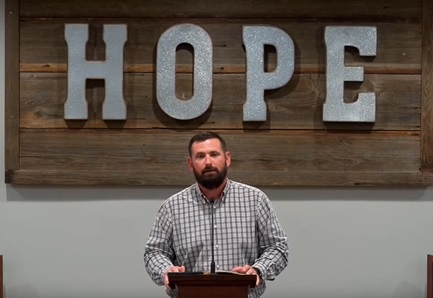
David O’Steen is an American preacher and author at Hope Bible Church in Jackson, Georgia.

Recently he made a video talking about the Pure Cambridge Edition of the King James Bible. Some of his basic facts were generally right, but he made some incorrect statements which we will go through.

David knows that there are typographical errors in the history of the printing of the King James Bible and that spellings have altered since 1611. However, he implies that the Pure Cambridge Edition position is pedantry. His belief is that all variations in editions are concurrently true.

Further, one reason why David is very suspicious of the Pure Cambridge Edition is because I am a Pentecostal from Australia. It is obviously a bitter pill that I am Pentecostal because there is a huge divide between King James Bible only Baptists and Pentecostals in the United States.

Note that I did not invent the Pure Cambridge Edition, it was printed by Cambridge for decades in millions of copies before I was ever born.

David says that whether the word is spelt (or, spelled as they say in the USA), “ancle” or “ankle” it means that same thing. The answer to that is simple. Yes, it does have the same meaning, but we are talking about exactness and God’s use of English, not how we use English in our own usage.

Well of course no doctrinal collapse or whatever is there just because of a “c” or a “k”. That’s not the point, the point is that we should stick with God’s way, not our own heads. We should not diminish ought from the Scripture.

The Pure Cambridge Edition, which arose maybe in the late 1920s, is clearly called “pure” in relation to editorial standards. That is, in relation to typographical accuracy, a deliberate scheme of spelling, etc.

What David wrongly does is conflate the editorial issue with the translation and textual/version issue. There are three levels here: TEXT, TRANSLATION and EDITION. The first two go together: the correct TEXT is the King James Bible, gathered from the TR variants and set forth in 1611 and beyond. The correct English TRANSLATION is the King James Bible which was made in 1611, improving upon the Bishops’, Geneva and other translations. The same TEXT and TRANSLATION have been printed throughout all normal and proper editions. Thus, the Oxford Edition is indeed the pure and correct TEXT and TRANSLATION. However, due to some editorial variations and typographical errors, the Oxford Edition is not quite as pure EDITIONALLY as the PCE is.

David knows that the variations in editions are not intentional corruptions of the King James Bible itself, but have arisen through circumstance, accident, poor editorial decisions, etc. However, editorial variations are still deliberate. Surely the editors at Oxford knew that the Cambridge editions were spelling some words differently and had some tiny variations in wording. But the Oxford people stuck to their tradition. Having said that, the potential for misreading or for error in the detail is therefore possible with an edition that might have typos, misspelled words and worse, editorial changes that are actually wrong. These wrong changes are not going so far as to change the translation or version itself, but still pose impediments as to what is correct, precisely and accurately.

No one should think that a Bible with typos is as good as a Bible with no typos. No, it is proper and godly and orderly to get rid of the typos.

David makes a comment about some young Christian who gets a King James Bible and it happens not to be PCE. Let me say right now that God’s grace is sufficient. I don’t think anyone is (or should be) ripping that Thomas Nelson or whatever out of his hand or calling other editions the work of Satan or whatever. The PCE position is a nuanced one, whereas often a Christian would be so ignorant that he would think that getting an ESV was fine. If the Body of Christ was limited to only King James Bible users or PCE supporters rather than all born again believers today, such a distinction measure at this time would be a damnable heresy. I would to God a Christian read an Oxford KJB rather than the NIV. But there is a better thing than just “any edition” of the KJB.

David then looks at the list of 12 test places of the editions of the King James Bible (the list is on bibleprotector.com). He seems to think that the PCE issue is one where we are saying that there are deliberate and evil corruptions, and that unless you have a PCE, your King James Bible is corrupt. This is clearly NOT what is being said by me on my website or any video I make. Purity is about refinement, not about saying that things less pure are the work of Satan. (The Geneva Version was less pure than the KJB, but the Geneva Version was not the work of Satan.)

David tries to argue that the differences in the tests don’t matter. But they do. Now he rightly says that things to do with the Holy Ghost are not always with a capital “S” on the word “Spirit”.

But then he makes a huge blunder. David says he thinks that I am saying that the word “spirit” (such as in Acts 11:28 or 1 John 5:8) is not something to do with the Holy Ghost. This is simply not true. It is evident that while David has seen that there are variations in these things from 1611 and that the word “spirit” is plenty of times lower case today, he has not understood anything about what I have explained on this issue.

(It is very easy to go online and find the basic information and some semi-negative report about me being a Pentecostal and then just base a flawed conclusion on these points.)

I have quite extensively talked about the “spirit” case issue, including how the Holy Ghost is meant or his work, and why it is precise to use lower case “s” on the word “spirit” on occasions.

The problem is that David is taking a sort of ultra-simplistic approach that basically it doesn’t matter whether it is capital or lower case, because it just must mean the Holy Ghost. But the case difference gives nuance and is entirely deliberate. Editors like Blayney in 1769 knew full well to capitalise deity or that usage should be editorially consistent, yet these learned editors deliberately chose to have the word “spirit” lower case in places, because as we are able to discover today, there is a meaning difference in the case usage.

Laughably, David uses the Donald Waite argument that since Hebrew or Greek did not use the case of letters, therefore it mustn’t be an issue in English either.

By David’s logic, then, whether “god” or “God” doesn’t matter. And “Word” and “word” don’t matter either. Why not then have “dAVID” if letters don’t matter?

And likewise, if spelling is no issue, why not today have “Iesus Christ” or “Sonne of God”?

No, rather, worlds of meaning hang on capital and lower case. Just look at the issue around the word “god” in the story of the fiery furnace.

David brings up examples where one place has “Spirit” or “spirit”, and whether another nearby or parallel passage as the other. These are exact things, and I explain them on my website. The issue is not about fake uniformity, but about what exactly the word “spirit” means as is different to “Spirit”. I discuss this in detail elsewhere, but it seems to me that David completely has ignored this, and instead tried to draw his own negative conclusions about me and reinforce his own belief that variations in editions don’t matter.

David thinks the difference of “spirit” or “Spirit” both being present, somehow must be an “inconsistency”. Not so, but rather precision. I make points about this issue on my website and in youtube videos.

Now, it gets more and more ridiculous with David when he tries to justify the two different wordings. He begins the mental gymnastics by trying to say that both the “or” and “and” readings of Joshua 19:2 are correct.

A quick question should be asked, seeing as God inspired and gave one word, how can it now be two? How is it that now all the “legitimate” variations in editions are all to be accounted as correct and true? No, the whole KJBO argument versus modern versions is that only one set of words is right, so obviously the same must be with editions. Only “and” or “or” can be correct at Joshua 19:2. It is pretty easy to see that the word “or” is correct because Sheba has two names, whereas saying “and” creates a distinction which then messes up the total number of towns listed in that passage.

In another example in Jeremiah 34:16, the PCE says “ye” and the Oxford says “he”. Where each word has a different meaning, and worlds of meaning hang on the grammar or words, to say “ye” is not to say “he”. There is different information conveyed by these word differences. They are not concurrently true.

In another example, David tries to reconcile “flieth” and “fleeth” in Nahum 3:16. But these are two different words. David then gives this crazy explanation that people are saying that the cankerworm could fly. (In fact, the cankerworm does change to a flying insect, e.g. a moth.) He then strains to explain how both could be correct. But once again, seeing as each word has a different meaning, and meaning itself must be precise with God’s words, the “additional information” (basically an “advanced revelation”) that David tries to concoct by adding the “fleeing” to the “flying” is incorrect, since it can and should be only one or the other. (Otherwise would not God have said in Hebrew that the cankerworm flees and flies away?) David says, “the point is the same” … but how can flying and fleeing be the same? He really knows this because he then tellingly says that if you think it is one or the other, write what you think it is in the margin. And now we see that David has come to where the modernists are at: deciding God’s truth for themselves, deciding what variation they would like to choose as their preferred one. He says don’t throw the Bible away because it hasn’t got it the way you think it should be. Maybe stick with the PCE and that’s it after all!

In the example of “further” and “farther”, David clearly has no knowledge from either the dictionary or myself on the clear and distinct meaning of these two words. They are not synonyms. They are not complementary information. No, it has to be one or the other, and the PCE is right with “further” at the place in Matthew. When elsewhere the PCE has “farther” that also is correct in its place.

In the example of “bewray” and “betray”, David knows nothing about these being two completely different words with completely different meanings. But David is wanting to make all variations concurrently correct … is he suggesting maybe that we should get a KJB that has all the variations present, maybe as marginal notes, so that only then we can have the “full” picture?

David rightly says that the 1769 is just as much KJB as the 1611 Edition. Yes, that is my point too. But we are not talking about the VERSION-TEXT or the TRANSLATION, we are talking about eliminating typos, using proper (Biblical) spelling and having editorially resolved what is the right word/spelling in every place.

“But he answered and said, It is written, Man shall not live by bread alone, but by every word that proceedeth out of the mouth of God.” (Matthew 4:4).

Every word means every single word, not all the variations. God’s mouth did not produce variations like, “bewray” AND “betray” at a place. No, God’s word must one or the other.

David falsely says, “Don’t let a Pentecostal from Australia undermine your faith.” This is blatantly wrong! I am encouraging faith in God’s words. Did I ever once go to the USA and tear up Oxford Editions? No, I am about encouraging faith in God’s words, and that we should have and know them.

I have plainly said that the Oxford has the pure and perfect text and translation, because the KJB is the right VERSION and the right TRANSLATION.

But, it is Biblically consistent to have the proper words and their meanings in a proper edition.

“Have not I written to thee excellent things in counsels and knowledge, That I might make thee know the certainty of the words of truth; that thou mightest answer the words of truth to them that send unto thee?” (Proverbs 22:20, 21).

Of course, as David says, no one should be getting hung up. I know some people are like, “This Bible’s printer missed a full stop here” which if taken to an extreme can be unbalanced and sort of so-called mental illness territory. No, the Pure Cambridge Edition is one for the Church, to have a consistent edition, to have precision to the words, a proper tradition, a uniformity in usage.

Any true believer in Christ should be seeing that the common heritage of God’s words is important. The issue being discussed here is not about Pentecostalism or Independent Fundamentalist Dispensationalism, it is about simply whether we believe God’s words and believe that God has provided His words exactly and precisely, and that His providence and power is such as to ensure that we’ve had the King James Bible properly edited over the years and typographical errors resolved. If we know we have something right then it makes it impossible for the devil or anything to change even one jot or tittle in KJB on us.

“And ye shall know the truth, and the truth shall make you free.” (John 8:32).

FURTHER READING:

Information on the Spirit/spirit case issue:

http://www.bibleprotector.com/forum/viewtopic.php?f=8&t=90

David Daniels’ confusion about pure words


INTRODUCTION

David Daniels, from Chick Publications, made a video (8 April 2021) where he discussed the Pure Cambridge Edition of the King James Bible. Daniels has made various good videos and his ministry has been generally helpful. He also wants to stick with the King James Bible, which is laudable.

WHAT IS PURITY?

Daniels begins by asking whether people should throw away their King James Bible if it is not a Pure Cambridge Edition.

My answer is that no one should be throwing out the King James Bible. Of course, we should use the Pure Cambridge Edition.

Would anyone use a book with typographical errors when they have another printing of that same book which doesn’t?

What Daniels does is confuse the purity of the version and translation of the KJB and then apply that standard as if someone is saying that the KJB printed by Oxford or wherever is not a pure version and translation. No, the King James Bible is a pure version and translation in all its normal historical editions.

Typographical errors don’t invalidate the version and translation of the KJB. But you wouldn’t want to use unstandard and bad printing when you have the option for good. The word “pure” in “Pure Cambridge Edition” is talking about correct spelling and typography. It is a different measure or kind of purity than when talking about one version/translation versus another.

WHAT ARE EDITIONS?

Daniels says that the Pure Cambridge Edition is one that matches up to 12 particular verses having particular lettering or spelling. While this is fine for detecting what is a Pure Cambridge Edition, the reality is that there are whole lists of specific differences between current editions. See bibleprotector.com/editions

There are many editions of the King James Bible since 1611, and so on analysis there are many variations is spellings, punctuation and so on. And if you start by comparing the first King James Bible ever printed in 1611 with any other edition, you will always find variations here and there.

None of these are causing the loss of God’s words, but obviously correcting typographical errors and the standardising of the spelling and grammar has been a good thing.

There are a line of corrections from 1611, 1629, 1638 to 1769 and beyond. The Pure Cambridge Edition is an approximately 20th century correction of the Cambridge adaptation of the 1769 editorial corrections (which took place in the 1830s under Thomas Turton).

DO CAPITAL LETTERS MATTER?

Daniels goes on to have a look at some of the examples, particularly around the fact that the Pure Cambridge Edition is getting the word “Spirit” right when it is capital or lower case. A difference in capital or lower case has a difference in meaning.

In fact, in general, changing a word in any document may change some sort of meaning. Not that the actual word of God is changed, but the potential for misunderstanding arising from an editorial inconsistency is the issue.

It is obvious we wouldn’t accept a typo like “Jesus” for “Judas” or vice versa.

Doctrines or doctrinal precision matters, and that is why words, lower case and capital matter.

Saying that the case of letters does not matter, or that because in Greek the Bible was written in all capitals (uncials) or all lower case (minuscules) … the Bible has been translated into English, and clearly capitals do matter.

Would Daniels accept a King James Bible printed without capitals? Would he accept one that always put “god” instead of “God”? I don’t think so.

SOME OTHER EXAMPLES

Daniels is not understanding the differences in words, so when he comes to the examples of “flieth” versus “fleeth”, “further” versus “farther” and “bewray” versus “betray”, he thinks there is no real difference.

But there is. I have written about these before, and information is also in my booklet “Glistering Truths”.

Simply, the word “flieth” means both to flee and to fly away, as the cankerworm turns into a flying insect. Whereas “fleeth” does not have the meaning about the flying insect.

Again, “further” means more far, whereas “farther” simply means a choice out of two options, the nearer and the farther. Correct grammar dictates proper usage.

And as for “bewray” this is a word from Anglo-Saxon meaning to convey inadvertently. Whereas “betray” is from French, and means to trade for. Very evidently these are two different words with two different meanings.

Daniels needs to recognise that distinct words have distinct meanings. To ignore or deny this is simply anti-intellectualism.

IS DANIELS SERIOUS THAT HE WON’T USE AN EDITION CALLED PURE?

Daniels said, rather strangely, that he wouldn’t use an edition called “pure”.

Would he use an edition with no name?

Would he use a mid-twentieth century printed Cambridge KJB?

Conversely, would he use a grossly misprinted edition? What if it was called “The Grossly Misprinted Edition”?

Many Christians who love and use the King James Bible have realised that words and letters do matter, accuracy matters, and there is everything good about everyone using the same edition and knowing that it has every editorial choice right.

CONCLUSION

The answers here address any concerns, clear misconceptions and really explain why it is good to use a particular standard edition of the King James Bible.

Ecclesiastes 12:10, 11

10 The preacher sought to find out acceptable words: and that which was written was upright, even words of truth.

11 The words of the wise are as goads, and as nails fastened by the masters of assemblies, which are given from one shepherd.