THE BIG PICTURE
Bryan Ross and I have been having some remote back and forth.
I want to cut through Bryan Ross’ merry-go-round and directly address a major issue, specifically, that he has barely looked at the Pure Cambridge Edition itself, which was made by Cambridge in the early 20th century, but instead talked about what I have said about the PCE.
So, he claims to be talking about the printed history of the Bible, but instead has got hung up going through my materials, not talking about the PCE itself. It seems that he doesn’t like my views because they differ to his, so he has tried to put them under a microscope.
In doing this, it seems like from the outset he has had an agenda, and little knowledge of what I actually believe. It also seems he has not understood directly what the PCE is.
SOME EXAMPLES
In looking at his notes for his lesson 282 there are problems which come through. He claims to be going through a kind of review of one of my books Vintage Bibles.
On page 2, he mentions how I talk about 1335 day-years from Daniel, but he doesn’t mention Islam.
Another example is where Ross then says, “the PCE’s authority within Verschuur’s system does not arise from the actual printed history”. This is wrong, because the PCE is itself an authoritative Edition as based on the print history and information directly about that.
He continues, “which showed no single, continuous Cambridge textual line”. This too is false. The whole of the foundational study on the PCE has been totally on the Cambridge textual line.
What Ross is trying to do is conflate the information on the PCE with separate other topics on Pentecostalism and Historicism. My approach is the printed history, and then to look at other matters, from a certain theological and Bible prophecy interpretation perspective.
Here are more examples of Ross not actually presenting what is in my book. On pages 3 and 4 Ross presents a different view on Revelation 10 in relation to the sixth trumpet, where his summary doesn’t bear any real resemblance to what I wrote on pages 166 and 167 of my book Vintage Bibles.
Likewise his explanation of the two witnesses contains information not in my book, and differs distinctly to my views while purporting to present them.
On page 9, it seems he is missing the entire context of the Word and Spirit movement, the Church Restitution and so on. He in fact makes out a Postmillennial interpretation which is not what I believe, he says with no explanation, “as the seventh trumpet ushers in the global acknowledgment of Christ’s reign”.
Ross then says that “the PCE position cannot cohere without Historicism”, but in fact the PCE exists objectively. What he is doing now is labelling the Word and Spirit position, with all its theology, as “the PCE position”, which is disingenuous. He doesn’t actually explain or properly understand the Word and Spirit view, and misrepresents aspects in his explanation, because he has the motive of miscasting things to make them look as bad as possible. (The fact that he also casts doubt in ways on the historical objective reality of the PCE is also telling.)
Ross wrongly conflates my positions about theology which I have articulated between 2007 to the present with the PCE itself and the beginning of adhering to it in the early 2000s. Around the years 2000 and 2001 I was basically a Dispensationalist who believed that things were generally getting worse before the Rapture.
This framing by Bryan Ross to make the PCE and my doctrine as identical doesn’t even make sense, seeing that the PCE existed 100 years before the books he has looked at (dated 2013, 2024 and 2025).
Why has Ross avoided other content on my website from 2006, 2014, etc.?
He has clearly just set up his own interpretation, the laboratory creation of a chimera, as a kind of Frankenstein bogeyman that he can set up. That’s why he has invented this idea of “pillars” of my theological view. It’s the creation of a monstrous wickerman woven from straw.
In fact, if he were to read my books, he would find constantly two “pillars”: Word (Puritan-Bible tradition) and Spirit (Holiness-Spirit tradition), and entwined as the Word and Spirit view. Things like creationism, providentialism, historicism and fundamentalism belong to the “Word” tradition.
Further he misunderstands the “heavenly prototype → PCE” is an overarching structure to the “historical process → PCE”, meaning both are concurrently true in one divine oeconomy. But Ross tries to make false dilemmas, like if one then not the other.
BIBLE PROPHECY
We can see that also in how Ross misunderstands the structured multiple fulfilments of Bible prophecy. For example, I believe in Historicism and Futurism, whereas Ross is Futurism against Historicism. He uses his model to view mine, which is not how to fairly present the other person’s view, though can be a valid way for assessing/critiquing.
This leads Ross to misunderstanding the difference between Idealism (Word and Spirit Idealism, also known as Symbolic Word, and based upon the oldest method extant, being the commentary of Victorinus of Pettau) and Historicism. As a proponent of multiple fulfilments of Bible prophecy, I do not, as some may wrongly accuse, think that a prophecy can mean just anything or what the interpreter wishes it to mean.
Ross wrongly calls my using the Idealist method in one place as “incompatible” with the use of Historicism in another.
(In fact, mistakes can happen if one makes an eclectic view and mixes together two modes. Also we are always learning, which is a good thing.)
However, in this case Ross has wrongly understood the situation, there are four ways in which to interpret Revelation 10. They are the late Preterist, the successive repetitions Historicist, the historic premillennialist pre-tribulation rapture Futurism and the Word and Spirit Idealism.
So Ross is wrong to accuse of “a theologically significant contradiction”. Has he not heard of sensus plenior, of dual fulfilment and of multiple fulfilments? These are all positions well known in theological circles, and are found in a vast range of works, e.g. Raymond E. Brown, Desmond Ford, Henry Kett, Halley’s Bible Handbook, Arthur Pink, Augustine of Hippo, Gregory the Great, Gleason Archer, John F. Walvoord, Charles C. Ryrie, G. K. Beale, etc.
Ross goes on to try to define Historicism, but is very vague, in that there are several different frameworks on how the book of Revelation is viewed to be structured. Ross tries to compare my view as “idiosyncratic”, when my view is consistent with Historicism. As to be expected, I have refined it in light of history. But Ross is starting from probably not even understanding the Wikipedia article (with its Seventh Day Adventist biased explanation on the subject), so his assessment is of very little value.
Ross wrongly goes to sources which belittle Historicism, and charges it with one of the major theological crimes of Futurism, namely the self-referential tendency to read things to one’s own day.
Ross seems to imply, quite wrongly, that I am making up the “1967” year date for personal preference reasons, when this date is consistent with the prevailing view of the current evangelical adherents of Historicism.
Ross goes so far to try to make out that my Historicism is “bespoke”, when it is obvious his frame of reference must be the teachings of Seventh Day Adventism. If he used Steve Gregg’s “Four Views” book, he must understand that this book is fairly scant as it is only providing an overview. And if he looked anywhere, he might find Oral Collins’ book. Collins is a modernist who follows the work of E. P. Cachemaille, whereas Gregg’s book looks more at Robert Caringola’s work which follows more A. J. Ferris (and somewhat H. Grattan Guinness) but ultimately E. B. Elliott. I am very familiar with this field of study, whether the recent writings of Joe Haynes or the writings of Joseph Mede. My view is built on the shoulders of giants.
As the KJB translators understood, latter thoughts are greater than the former. Again, as Lord Verulam (Francis Bacon) rightly knew, speaking as a spiritual husbandman, that knowledge is increasing, and we can observe a springing of fulfilments from germinant prophecies.
ANSWERING ROSS’ RANTINGS
I don’t know how many times I’ve shown Ross is wrong in how he manufactures an interpretation.
Like previous times he says that I am one who “adjudicates half of his hallmark PCE ‘tests’ by Pentecostal pneumatology (e.g., ‘Spirit/spirit’ in Matt 4:1; Mark 1:12; Acts 11:12, 28; 1 John 5:8), showing that doctrinal categories—not neutral editorial history—decide the ‘pure’ reading”.
As I have said many times, the tests came before I treated them in doctrinal depth. The tests were not in themselves some places so theologically significant in the differences between KJB readings, but are clearly with some significance. The tests were for identifying an Edition, not for specific study as such. It was therefore several years later, after having a diagnostic framework (a series of test passages to test whether any Bible of any sort is a PCE) that I decided to analyse them theologically, logically, hermeneutically, etc.
Ross is therefore wrong to imply that Pentecostalism led to choosing instances regarding the word(s) “Spirit/spirit” in the tests, when in fact these were things being mentioned by Baptists in their lists of edition differences.
I know Ross wants to doubt my word for it, but indeed there was an amount of material online in the KJBO corners of the internet in 2000/2001.
Ross also wrongly says, “he links the timing and authorization of the PCE to Pentecostal revival”. I did mention twice over the years that it was interesting or even providential that the PCE came about when Pentecostalism was rising. But Ross has blown this out of all proportion.
Ross then says, “That is why his recent denials—‘providentialist not Pentecostalist’—are out of alignment with both his earlier and more recent testimony, where he seeks to deny the impact of Pentecostalism on his framework.”
What Ross is doing now is going “all in” on his false narrative, when I have repeatedly said that:
- The PCE came from Cambridge which was not Pentecostal
- The PCE came about many decades before I was born
- My own identification of the PCE came through textual study, the normal scientific, scholarly method
- The tests to identify the PCE were not Pentecostal-centric, but were mostly drawn from or in line with Baptist sources
- The knowledge that the PCE was right was from a KJBO not Pentecostal perspective
- My comments about Pentecostalism existing or Pentecostal theology in thinking about hermeneutical and editorial-textual-critical method of looking at the rightness of edition readings came later
Ross should ask his friends to instruct him on:
1. Straw Man Fallacy
2. Hasty Generalization
3. Mind Reading / Motive Fallacy
4. Cherry Picking
5. Overinterpretation / Overreading
Ross repeats his now blatant error, saying, “Verschuur’s own framework makes Faith-Pentecostalism a pillar of the position and even uses Pentecostal pneumatology to decide hallmark PCE ‘tests’ (e.g., the capitalization of Spirit/spirit in Matt 4:1; Mark 1:12; Acts 11:12, 28; 1 Jn 5:8), so the edition’s ‘purity’ rests on Pentecostal presuppositions rather than neutral textual criteria.”
Ross should stop bearing false witness.
If pneumatology was a factor, it was a factor common to Baptists who were mentioning the capitalisation of the word(s) “Spirit/spirit”. That discussing was not happening with Pentecostals at all, but Fundamentalist KJBOs.
The purity of the PCE rests on arguments drawn directly from non-Pentecostal KJBOs, TROs and even the modernist desire for consistency.
The desire for editorial purity in KJB editions is a concept going back centuries, for example, see this: https://www.bibleprotector.com/blog/?p=1163
COUNTERING ROSS’ REPEATED ERROR
In Appendix A of his lesson 282 notes, he tries to counter me yet again.
He says, “In reality, I explicitly acknowledged that the twelve items function as identification markers, not doctrinal propositions.”
Well, I have quotes just back where twice the very opposite false witness was given, and now this directly contradicts those lies. Is this a true statement?
But then, Ross writes, “it is beyond dispute that your rationale for half of the twelve PCE diagnostics are grounded in explicitly Pentecostal categories.”
All those theological reasonings I give are later than the making of the tests.
Also, logically, a person who begins studying something, as I did regarding editions in 2000, is starting from very low knowledge, a young internet and relative youth in age. I can expressly say that I was not thinking there is something more vitally Pentecostal about Matthew 4:1 or Mark 1:12 as such, for example.
It is also easy to see, What would a Baptist think? I am sure about 100% of born again Baptists who know anything will understand that the Holy Ghost led Jesus into the wilderness.
How is there anything more exclusively Pentecostal about this Bible story? Were the editors making changes at Cambridge (and maybe Oxford) in regards to Matthew and Mark there Pentecostal?
ROSS GOES FULL RICK NORRIS
Laughably, Ross will not acknowledge that a set of editions from Cambridge represented an Edition, which is now called the Pure Cambridge Edition. He will say that those editions “come close” to the electronic text I published on my website in 2007 (made in 2006). But if my text is harmonising previous editions which are sometimes only varying in one letter in one place, besides the “LORD’s” formatting, then how can it be implied that there is not one Edition which was made in the early 1900s?
Ross, like Norris, wants to make a pedantic point about all the different editions when in fact they clearly conform together, from a common origin, meaning that there is indeed one Edition.
ROSS WRONG ON BIBLE PROPHECY INTERPRETATION
Ross mentions the “Historicist scaffold” and then my mentioning of the angel’s clothes “linen → India paper” which he calls “leaps”. First, this is not a Historicist interpretation. Second, I made it clear it was a tertiary view. And third, the fact remains that India paper was made from flax. Ross’ questioning doesn’t therefore deal with the information as I have presented it. This goes to his willingness to try to make as bad a case as he can, rather than actually do an analysis. As a reviewer he may question things, but now his review is shoddy because it doesn’t even represent my view.
ROSS DOES THE USUAL SCHOLARLY TRICK
Instead of taking the wider view where I have mentioned what Professor Norton said, Ross does the trick of saying that there is “no quotation, no citation, no date, and no context for what Norton supposedly ‘mentioned,’ making the claim entirely hearsay.”
This is what Ross wants to do: he wants to invoke the academic snobbery that I must properly bibliography something in order for it to be admitted as evidence. But because I didn’t, apparently then it can be doubted what I said.
I can only imagine Ross demanding me to produce photo ID to prove whether there really be a Professor Norton at all.
Apparently Ross wants to refuse reading Norton’s book (the very book that converted him towards his new doctrine of “verbal equivalency” as though God speaks as a hydra from many mouths) which in places gives information on the Pure Cambridge Edition.
Also, I know Ross wants to refuse my testimony on correspondence from Professor Norton on the pretended grounds of empiricism, which says, “unless I see the imprint on a sheet, I will not believe”.
He says, “I noted that Norton’s published work does not define or recognize any Cambridge ‘Pure Cambridge Edition’ category (if they did Verschuur would cite them).”
How deceptive. Ross knows that Norton did not use the term “Pure Cambridge Edition” to describe it. That’s like saying that Erasmus did not produce the Textus Receptus because that term came into use a hundred years later.
And as for “citations”, the quotes and info is there in my Guide, Century and Vintage Bibles.
Again, Ross produces his exacting definitions for “copy-editing” but refuses to acknowledge that many editions can represent an Edition. The differences in editions of the Edition are but of that copy-editorial level. Even the formatting of “LORD’s” fits within that.
Again, I explain how the various tests, criticism and differences between various Editions was discussed and listed by Baptists and Fundamentalists in the past. Is this not an objective, investigable fact by engaging the wondrous contraption of analogue use of keyboard typing into a search engine or use of deep thinking AI?
Ross wants to close his eyes, saying my commentary “provides no verifiable evidence—no names, no dates, no sources, and no bibliographic documentation. He merely asserts that ‘Baptists’ made comparison tables, yet none of those alleged materials have ever been produced or shown to contain the exact twelve readings he later canonized as a diagnostic set.”
How Rick Norris of him to throw the words “asserts”, “alleged” and “he later canonized” about.
He says, “no Baptist writer prior to Verschuur ever treated these readings as a unified list, as distinctive, or as edition-defining.”
I assume he means “these sorts of editorial readings”. And Ross would be wrong.
Perhaps Ross can see this mediating historical evidence: https://www.bibleprotector.com/forum/viewtopic.php?t=55
Ross says, “no one before him claimed anything unique or special about this particular set of twelve readings”. This is a pointless statement, as he is conflating the concept of editorial differences with the concept of a diagnostic list. It is not that those 12 readings are “more special” in the sense that he indicates it.
He then says, “no historical or theological tradition recognized them as constituting a distinct Cambridge ‘Pure Cambridge Edition.’ His claim therefore contributes nothing toward establishing documentary or historical grounding for the PCE as he defines it”.
Again, Ross is totally wrong. KJBOs were supporting Cambridge printings.
Also, it seems that Ross seems to deny the reality that there is an Edition now called the PCE.
All those Baptists, Presbyterians, Pentecostals, etc., who used Cameos (Reference and Large Print Text) and Turquoises for decades were indeed using the PCE.
Where did the tradition as held by Gail Riplinger, Laurence Vance and others who use these very editions come from?
Ross has the temerity to deny that Waite, Ruckman and other KJBO and TRO leaders all used Cambridge Bibles.
I corresponded with these people and read their works. How can we deny that Cambridge is not the best? It fits that view that there are KJBOs who use the PCE distinctly.
Why are vintage Cambridge Lectern Bibles being collected by people like facebook user “Scriptorium Bibles”, except that these are considered the best?
It seems like Ross is more a contrarian.
ROSS IS NOT USING LOGIC
In response to my saying that I was not a Historicist when first looking at the editions issue from 2000, Ross says, “his admission suggests that Historicism functions as an after-the-fact justification layered onto a prior commitment to the PCE”.
How telling he should speak of my prior commitment to the PCE, which was on scientific grounds (proper scholarship).
ROSS APPEALS TO IGNORANT SOURCES
Ross really loves the letter from CUP from 2010, because they didn’t know much about the issue.
It is clear that CUP is now an economic-based proposition, which means they would have to weigh up the financial impact it would have on them in what editing they do in the KJB.
Ross appeals to their ignorance as though that is the overarching word of authority. He says, “CUP itself provides no endorsement of a singular, consciously created Cambridge ‘PCE’ setting.”
Ross wants to deny that there is a singular Edition, which is why he uses the word “singular”.
He wants to deny the existence of the PCE which is why he uses the word “conscious”. He does this because he wants to exalt CUP’s lack of awareness in the present as well as their being unaware of the details around the historical editing event in the past which made the PCE.
Of course, how did the myriad of editions and printings in conformity come about through the 20th century? But no, Ross wants to make sure that we think they are not the same. (This is where he is ironically even rejecting his own “verbal equivalency” views.)
Finally Ross wrongly frames the PCE as a “setting” on the premise that one must seek a first copy rather than acknowledge all the evidence of many copies which reflect the origin of the editorial work.
WHAT IS IT ALL ABOUT?
Is Ross trying to say that I use Pentecostal/Word of Faith doctrine, Historicism and KJBO views to talk about the PCE without talking about the focus on its editorial history?
Is he trying to say that there is no Edition throughout the 20th century which is called now the Pure Cambridge Edition, and use that name as a label only for an electronic text made in 2006?
I wonder how much he actually thinks the KJB’s readings and its translation is perfect and exact, because it seems like that’s an issue for him.
I also wonder why Ross never really presents an aggregation of materials from my website, which would be relevant, including my document on Rick Norris and other booklets, etc., see my main index page and this list: https://www.bibleprotector.com/forum/viewforum.php?f=9
And anyone who wishes to understand Mark 10:30 should read this booklet. “But he shall receive an hundredfold now in this time, houses, and brethren, and sisters, and mothers, and children, and lands, with persecutions; and in the world to come eternal life.”
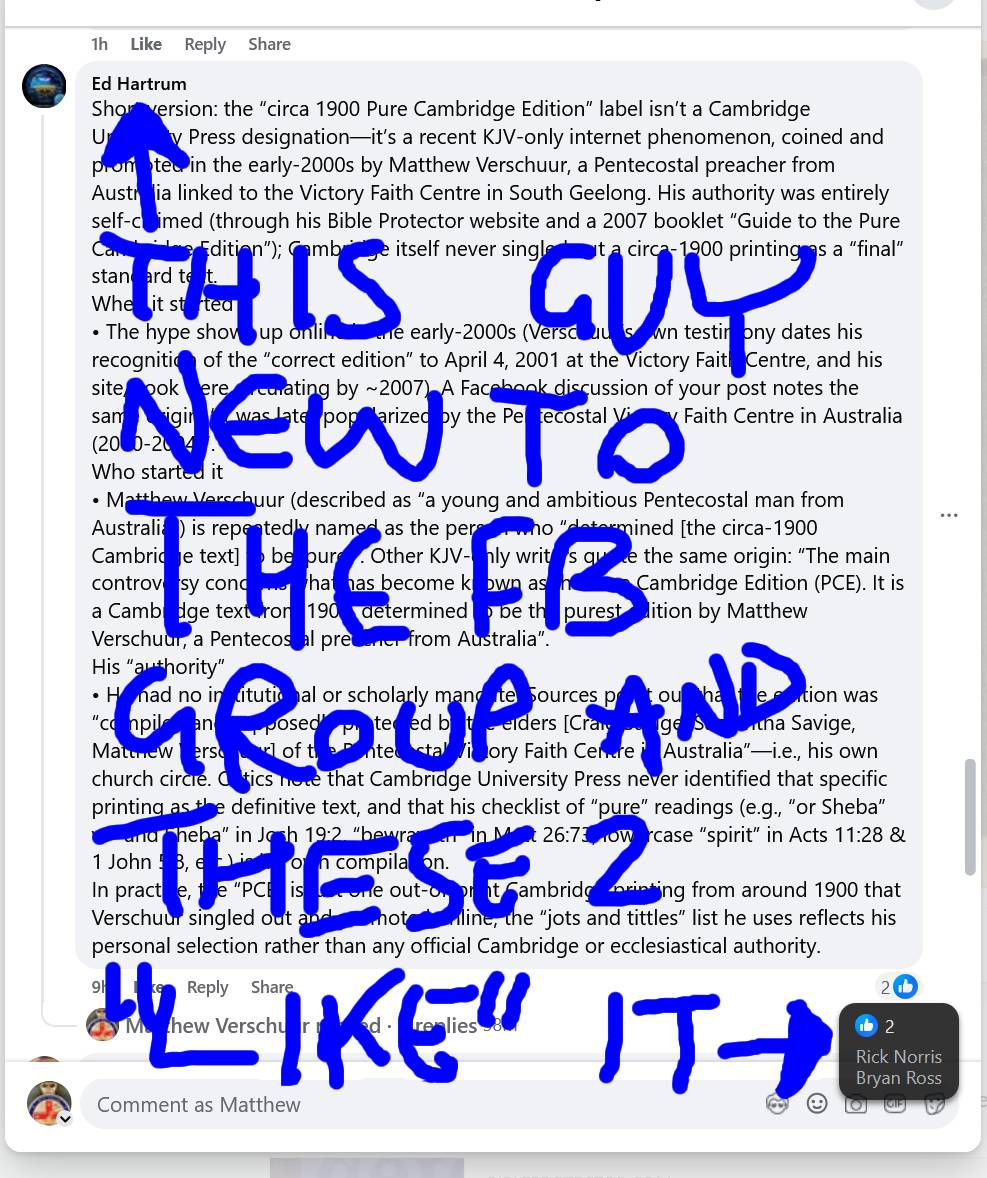
POSTSCRIPT: I suddenly see Ross and Norris together on Facebook, and I ask myself, is this a coincidence?