Time, Gravity and Matter

A Universal-Time Interpretation of Physical Processes

INTRODUCTION

According to the Bible, time is flowing at a universal rate, whether on Earth or in space.

Using a creationist model, it would appear that light was instantaneous in Genesis 1, but that light decay occurred in the universe since the fall of man, and has now stabilised at a fairly constant rate.

It is my intention to present a view of the universe which necessarily rejects Einstein’s unbelieving general relativity, and which builds upon a correct Newtonian view.

We will therefore hypothesise a framework in which time is absolute and universal, flowing at a constant rate from past to future, independent of location, motion or gravitational potential.

We will reject the usual modernistic explanation that time is moving a different rates as one moves up from sea level. Instead, we will suggest that observed discrepancies in clocks, atomic transitions and biological processes are explained not by a relative passage of time but by the physical effect of gravity on matter. Gravity acts as a universal regulator, influencing the rate of atomic, chemical and biological processes.

Light maintains a universal speed, with minor local distortions possible, and historically decayed from near-instantaneous velocity to its present stable value. This model perpetuates a Newtonian understanding of time, aligns with experimental observations such as satellite clock behaviour and freefall phenomena, and avoids conceptual complications associated with relativistic spacetime curvature and time dilation.

We are overthrowing Einsteinian error.

CORE CONCEPTS

Historically, the consensus of Christian societies were built upon the Newtonian view of the universe that recognised time as absolute and uniform, flowing independently of physical events, and three dimensional space as a fixed, consistent framework. Consider Newton’s clockwork universe as operating in this way.

In contrast, Einsteinian relativity introduced a variable-driven, location-dependent concept of time, predicting that clocks in different gravitational potentials or moving at different velocities tick at different rates—a phenomenon commonly referred to as time dilation.

While this relativity seemed to be predictive, particularly in technologies such as GPS, its interpretation relies on the presupposition that time itself is relative. This paper disposes that view to set back truth, that a universal-time framework in which observed clock discrepancies and other relativistic phenomena can be fully explained as physical effects of gravity on matter, rather than variations in the passage of time.

Therefore, gravity itself is sort of like aether, where large planetary and stellar objects cause what could be imagined to be denseness, strength of gravity, and moving away from them, weakness of gravity, and that the strength of gravity holds things in orbit or draws things (e.g. a ball falls to the ground, a comet whizzes toward the sun).

PRINCIPLES

  • Absolute universal time

Time is considered a constant, universal flow, identical across all locations and independent of motion or gravitational potential. The passage of time cannot be accelerated, slowed, or controlled by human devices; it is a fundamental property of the universe.

  • Gravity as a regulator of matter

Gravity is a universal influence acting on all matter with mass. It affects all physical processes proportionally, including:

  • Atomic transitions
  • Nuclear decay
  • Chemical reactions
  • Biological processes, such as neural firing

Clocks do not experience “slower” time in stronger gravitational fields; they tick differently because their internal physical processes are directly influenced by gravity.

  • Light’s decay and current stable universal speed

Light propagates at a universal speed in the current universe. While minor local distortions may occur due to interaction with gravitational fields, its global speed remains consistent. Historical observations suggest that light may have decayed from near-instantaneous speeds in the early universe to the present stable value. This provides a coherent explanation for cosmological observations without requiring time itself to vary.

OBSERVATIONAL EVIDENCE

  • Atomic clocks

Atomic clocks placed at different altitudes or velocities show consistent variations in tick rates. In this model:

  • A clock at sea level ticks at 1 second per standard unit
  • A clock in orbit might tick at say 0.97 seconds per the same standard unit

These differences reflect the physical influence of gravity on the atoms and electrons of the clock, not a change in the passage of time.

  • Freefall and satellites

Clocks in freefall, such as on orbiting satellites, behave as if unaffected by gravity, consistent with the experience of weightlessness. This occurs because the momentum state of freefall alters the manifestation of gravity on physical processes, even though universal gravity continues to act on all matter.

  • Grounded clocks, under constant gravitational acceleration, are affected directly.
  • Freefall clocks exhibit normal behaviour, as observed in orbital satellites.
  • Biological processes

Neurons, metabolic cycles and other biological processes respond proportionally to local gravitational potential. Therefore, a brain at high altitude or in orbit may operate at slightly different rates compared with a brain at sea level, reflecting gravity’s regulation of matter, not a relative flow of time.

  • Light and electromagnetism

While the speed of light remains globally constant:

  • Minor local gravitational interactions can produce observable effects, such as redshift or bending of light, without requiring time itself to be variable. (The universe itself may be expanding since creation, which may also account for redshift.)
  • This ensures causality is preserved and measurement consistency remains intact.

CONCEPTUAL IMPLICATIONS

  • No time dilation

All phenomena traditionally interpreted as time dilation are fully explained as physical effects of gravity on matter. No clock, neuron, or atomic process measures a different universal time; instead, their rates of operation are influenced by gravity.

  • Gravity as a universal regulator

Gravity is not a localised force acting inconsistently; it is a universal regulator that proportionally influences all matter. Because matter cannot be shielded from gravity, all processes are affected in predictable, proportional ways, producing the exact observations attributed to relativistic effects.

  • Simplicity of universal time

By positing universal time, the model eliminates the need for spacetime curvature, relative time metrics, or multiple frames of reference. Observations across locations, altitudes, and velocities are consistent with a single, universal clock regulated only by the physical influence of gravity.

ADVANTAGES OVER RELATIVISTIC MODELS

  • Conceptual simplicity preserves Newtonian absolute time and consistency with the Scripture.
  • Consistency with experimental data: atomic clocks, satellite measurements, freefall phenomena.
  • Predictive differences in clock rates, biological processes, and atomic transitions are fully explained by gravity’s proportional influence on matter.
  • Compatible with a universal light speed. Minor distortions are local and do not contradict measurement standards.

REJECTION OF THE MODERNIST MODEL

It is crucial to emphasise a fundamental distinction often overlooked in conventional physics: predictive agreement does not imply causal truth. Relativity correctly predicts observed variations in clock rates, atomic transitions, and other phenomena. However, interpreting these observations as evidence that time itself flows differently is a metaphysical assumption, not an empirically demonstrated fact.

In the universal-time framework, these same phenomena are fully explained without invoking a mutable time. Gravity acts as a universal regulator of matter, altering the rates of atomic, chemical, and biological processes. The differences observed in clocks or biological functions are not evidence of “time dilation” but rather of gravity’s physical influence on matter. Time itself remains constant, universal and unchanging.

This distinction is more than semantic. It advances understanding by providing a causal account of observed behaviours: whereas relativity treats time variations as a mysterious property of the universe, the universal-time model attributes changes to tangible interactions of matter with gravity — an approach consistent with Newtonian intuition and the observed regularities of the physical world.

In short, phenomena traditionally described as time dilation are not inexplicable “temporal magic”; they are observable manifestations of matter’s response to gravity, all occurring within a single, absolute temporal framework.

CONCLUSION

This approach offers a credible and conceptually coherent alternative to the prevailing Einsteinian framework. By positing a universal-time, gravity-as-regulator model, the universe can be understood in terms of tangible, causal interactions, rather than abstract manipulations of an elusive “flow” of time.

Key principles of this model include:

  • Time itself is constant and universal, independent of motion, location, or gravitational potential.
  • Gravity regulates all matter, proportionally affecting clocks, atomic transitions, chemical reactions, and biological processes. Differences in clock rates or neuronal activity are not evidence of time itself changing, rather, they are the result of matter responding to gravity.
  • Clocks do not control or measure time; they reveal the effects of gravity on the matter within them.
  • Light propagates at a stable universal speed, with only minor local distortions that do not contradict measurement standards.
  • Phenomena traditionally attributed to time dilation are fully explained without invoking relative time or curved spacetime.

By reframing physical phenomena in this way, the model preserves classical Newtonian intuition, aligns with empirical evidence, and avoids the conceptual complexities and metaphysical assumptions inherent in relativity. Whereas Einsteinian relativity interprets observed variations as intrinsic alterations in the flow of time, the universal-time framework attributes them to tangible, causal interactions of matter with gravity, providing a clear and mechanistic understanding.

In this view, the universe operates under absolute time, with gravity as a universal regulator and light as a consistent reference for all physical processes. Observed variations in clocks, biological processes, and atomic transitions are simply manifestations of matter’s response to gravity, all occurring within a single, unchanging temporal framework. This model offers a coherent, causal, and conceptually simpler foundation for understanding the cosmos, preserving both empirical consistency and the intuitive clarity of Newtonian physics.

Promoting orderly Christianity

INTRODUCTION

Liturgy and devotion are two important facets of how a Christian interfaces with God.

Liturgy means the manner of how church (e.g. Sunday public worship) and religious services (weddings, funerals, etc.) are ordered and relates to their content, their use of the Scripture and other elements, particularly scripted elements. Liturgy can also involve the religious content, including Scripture readings, that is used by other organisations, or at other times, for example again weddings and funerals, but also baptisms, child dedications or other services.

Devotion means the manner of family altar, private gatherings and especially personal interaction with the Lord.

While evangelicalism and especially Pentecostalism have largely loosed themselves from the constraints of templates and formulaic prayer, there are still patterns to be found in Word of Faith teachings as regards to model sermons/studies (e.g. the Kenneth Copeland Reference Bible) and model prayers (e.g. prayer of petition, tithing prayer, etc.)

THE NEED FOR COMMONALITY

Different denominations and movements have their own prayer books, hymn books, etc.

The Word of Faith Movement has several books containing prayers, such as, Prayers that Avail Much (original) by Germaine Copeland (not related to Kenneth Copeland), and secondarily material by Lynne Hammond.

It also has been telling that all kinds of Christians have used the Anglican Book of Common Prayer’s wedding ceremony as a tradition. It is this tradition which keeps the use of a wedding ring as a custom for marriage.

Reading the Scripture through the year, in church or personally can be well guided by using the charts of the Book of Common Prayer for daily, Sunday and special day readings. I think this would be good for encouraging the personal reading of Scripture and also having everyone reading/hearing the same thing every day.

Not everything would be useful from the Book of Common Prayer, of course, including Apocrypha readings, but it certainly is a good and common resource to draw upon.

It is also important to understand how the Book of Common Prayer works, in that it has a fixed position of the year and a moveable portion of the year, and that requires switching from one calendar to another so many weeks before Easter, and this continues on until so many weeks after Easter. This is because Easter moves every year.

THE 1662 BOOK OF COMMON PRAYER

The Book of Common Prayer has developed out of the deep Reformation era, and the common form as it stands now is called the 1662. There are also modernised, localised and translated forms of the Book of Common Prayer, but we are not advocating in any direction that way.

The Book of Common Prayer has altered in ways since 1662 but still is called the 1662. It alters in regards to naming the current monarch of England, and also in 1859 some content was removed.

One of the removed elements that is really good, and to be retained on its own, now independent of the Anglican/Episcopal church is the content in regards to the Gunpowder Plot and Landing of William III, http://justus.anglican.org/resources/bcp/1662/nov5.pdf

I have copies of the BCP: a Queen Victoria, Oxford, 1900 and a Queen Elizabeth II, Cambridge, 1954. Older copies can easily be sourced from archive.org, see also here: http://justus.anglican.org/resources/bcp/1662/1662.html

FURTHERANCE

Whereas it is expedient to retain, restore or alter elements of common liturgy and devotion arising from the 1662 Book of Common Prayer, its practice can continue privately or in church services under the concept of a Protestant titular bishoprick of Bethlehem. I discuss related matters here: https://drive.google.com/file/d/1777l7qmCWorAcFq5zOEwIajhbjuOlQlK/view

1 Corinthians 14:33 and 40 states:
33 For God is not the author of confusion, but of peace, as in all churches of the saints.
40 Let all things be done decently and in order.

Order and conformity would mean that we should use the same Bible, a time-honoured and correct one. Only the King James Bible should be the standard and guide. In regards to the question about editions, it is good to have the Pure Cambridge Edition.

The Book of Common Prayer uses the Lord’s Prayer from pre-1611, and likewise the readings of the Scripture can be printed in forms not consistent with the Pure Cambridge Edition, so these can be altered. In the creeds, they can be followed, but “catholick” and “virgin” should be lowercase. Also, as mentioned, the Apocrypha readings are not required.

The Book of Common Prayer should be used as a resource that can be drawn upon, for weddings, words for certain days of the year, especially the 5 November material, and would be an excellent guide for daily readings and Sunday readings, and can be used in church or personally.

In this way we can follow the irenic encouragement for orderly Christianity in line with the Word and Spirit movement.

The Word and Spirit perspective does not conform to any single Protestant stream in total, but to recover and synthesise those doctrinal, devotional and practical strengths which have been preserved in different parts of the Protestant inheritance.

Word and Spirit draws together two streams of King James Only (Pure Cambridge Edition) Fundamentalism and Word of Faith Pentecostalism, but also encompasses vast elements of Multiple fulfilments of Bible Prophecy which includes Historicism (traditional Protestantism), millenarianism (Puritan), higher life entire sanctification Christian perfection (Holiness), creation (Fundamentalism), law and grace (Wesley/Finney and Reformed Evangelicalism), etc.

One also must mention the preference for Redemption Hymnal and a common pool of classic choruses, including those by David Ingles.

CONCLUSION

Having commonality in liturgy and devotion is very helpful in orderly Christianity. The 1662 Book of Common Prayer is a good resource for selective usage. The aim of the Word and Spirit movement is not merely insular but universal, therefore Christians are encouraged to conform to the pattern shown them.

Just as the Pure Cambridge Edition is the common inheritance for all Christians, so right Protestantism should be held to as a matter of common faith.

Translation and editing are two different things

The King James Bible was made in 1611 as a product of translators translating. Then, over the years, as it would be expected copy-editors and editors have done editorial work.

The editorial work has not been to change, edit, fix or corrupt the translation, it has rather been to correct typographical errors, standardise grammar and spelling, regularise elements of the English presentation and the like.

Having said that, some work by American publishers has been dangerous in its direction, such as trying to change a word like “bewray” which has one meaning to the similar looking word “betray” which has quite another.

But in normal editions, from 1611 to the present time, the translation has not been altered. The translation means the words used in English to present what was first written in the original languages.

Early in my “remote” debate with Bryan Ross of early 2026, I found that Ross essentially believes that editing the King James Bible changes the translation of the King James Bible. He tried to backtrack by explaining, through someone, that he meant that you would have to look at the originals in relation to changing the italics.

Ross now says in a document, “I show that one cannot simultaneously affirm a perfectly preserved translation and a uniquely perfect edition without contradiction”. Hence, Ross must believe that the editing in editions changes the translation.

It is interesting that he hides this statement in his final summary of the debate. Earlier, I called him out on this erroneous belief, and he and his friends acted like it was a very bad thing to question this. In fact, the emotion in one of the volatile responses indicated to me at the time the real nature of where this was all at.

I expect that there has been some emotional reaction in relation to the conflict that Ross and his friends have had with other King James Bible people.

It is apparent now that Ross has departed from a proper understanding of the King James Bible, in that he has allowed wrong ideas from the modernist David Norton to cloud his assessment on editions, to the point where he thinks that editorial work within the history of the KJB is really changing the translation.

So let’s properly understand the reality here.

ONE. SCRIPTURE. The Scripture is true, whether in the autographs, original language copies, Textus Receptus editions, foreign translations or in English Reformation translations.

TWO. VERSION. The gathered text of the Scripture, while is present in Textus Receptus editions, is actually finalised, exact and perfect in the King James Bible. These are the readings of the Authorized Version.

THREE. TRANSLATION. The turning of the originals into English has been done since the Reformation, from Tyndale to the King James Bible, but the best and perfectly correct translation is the King James Bible’s translation.

If there are words today that people do not understand or label as “archaic”, this accusation or assessment cannot withstand that the King James Bible’s translation is right, and that its particular word choices are correct.

FOUR. EDITION. The editing of the King James Bible has occurred generally progressively, and is primarily concerned with the correction of typographical errors, standardised grammar and spelling and other regularisation. The best and correct Edition is the Pure Cambridge Edition.

FIVE. SETTING FORTH. Each time a setting or an edition is made of an Edition, it may accidentally have some typographical error of the presswork, or it may contain some copy-editorial level variation in a letter or a hyphen mark. These exceedingly minor issues have been dealt with, in that the Bible Protector website has put out scrupulously correct typographically exact text files of the Pure Cambridge Edition, so that this setting is the derivative exemplary master of them all.

We cannot confuse things in the number four or five category with number three category. They are entirely separate to each other. This is not to deny that there are attacks on the King James Bible’s translation, but these are in some sorts of updated or modernised “new” KJVs, not in normal editions from normal publishers.

Ross states, again, “I show that one cannot simultaneously affirm a perfectly preserved translation and a uniquely perfect edition without contradiction”. The problem is that Ross does not show this at all: he utterly fails to show this, because the King James Bible translation of 1611 is entirely present in current editions, and there is no contradiction at all.

The Pure Cambridge Edition presents exactly and properly the KJB translators’ work. Editing ensures that the intended meaning and translation of the KJB men is presented today.

Countering Bryan Ross’ Closing Remarks

INTRODUCTION

While Bryan Ross claims to have assessed my remarks and teachings, he has had an agenda to specifically attack:

  • The concept of jot and tittle exactness of the King James Bible view
  • Pentecostalism
  • Historicism

He essentially has not in practice followed, “This is what he believes and I will assess it on its own merit”, but said, “This is what I think he believes and why I think it is wrong.” He has not been neutral, but obviously is trying to present my beliefs in as bad a light as he can while claiming to quote me. Hence, his review is not just biased with his own bias but quite misleading in how he wrongly portrays what I believe.

It is also telling that Ross has spent weeks and hours of time talking about and against my position without actually properly assessing the Pure Cambridge Edition of the King James Bible itself.

In fact, he hasn’t addressed the most basic thing of readings of the edition, what changes happened from the 19th to the 20th century or any of that sort of thing, which is what he should have done.

UNFAIR OR DOUBLE STANDARDS

Ross seems to think that the PCE itself is indeed a King James Bible Edition, and that the files on my website are doubtless “good” in the scheme of things. But he can’t afford to admit that for PR purposes, he has to say that he has a “problem” with “authority” and content (e.g. my theology).

Ross has shifted his view as little as possible about the 12 tests, so that he can highlight how I have talked about the meaning of editorial differences, and also now revise his position to explicitly say that he acknowledges (at last) that Pentecostalism did not create the list of 12 tests (because the test verse references obviously came from Baptists/Fundamentalists).

Again, he revises his position that now I do highlight the “high-quality Cambridge tradition”. He still claims that Historicism is being used to make the PCE more than a preference position, when in fact adherence to the PCE doesn’t require Historicism at all.

Ross uses language like a lawyer, he says, “Some Cambridge lines come close to the later PCE profile.” In other words, he cannot admit that the PCE is an editing that took place in the early 20th century, that it was represented by many print copies, and that I made a correct copy of it in electronic file form. He is perpetuating a deception that only my website files are the PCE and he refuses to recognise the approx. 100 years before 2007 of PCEs.

He says that they merely “come close”. He gives himself away because he speaks of things existing before 2007 that “come close” to the standard of 2007 when in fact it’s the opposite way round. He knows they are all the same Edition but accidentally admits he knows it by using the terminology “comes close” when they pre-exist the 2007 copy. In fact, they are all the same Edition, and those editions are followed by the Bible Protector file copy directly. It’s not even “comes close” now when looking retrospectively, it’s the same Edition.

Ross cannot accept that the same Edition being printed in different editions, styles, settings and print runs, which has the same editorial “readings” is really the same Edition. He cannot maintain his fiction because he speaks of “PCE-vs-PCE differences”, meaning he knows they are all the same Edition. But he wants to make a typo or some typographical (copy-editorial level) variation like a hyphen somewhere a major impediment.

How can a few tiny variations, which has been resolved, be an impediment when he knows that the 1611 Edition has a huge amount of orthographical variations to today? Ross invented his own doctrine to allow all kinds of variations to some sort of hazy standard (it is apparent that the original language Scriptures are his standard) and yet he is trying to attack me for copy-editorial standardisation or regularisation of a few absolute minutiae!

He even accuses me of bad sounding things like “presentism” because I resolved a few single type character variations like some hyphens in some printed copies. Isn’t that a good thing, isn’t that what copy-editing and publishers should do, and what any book readers want?

I AM BEING CHARITABLE

Ross says that he can accept the PCE as a preference, which I think is good of him to say. I think that is consistent with reality. I also understand that he would question lots of my beliefs, which as far as that goes, is usual debate. If that’s what is going on, which is a position that Ross does say he is of, then that’s what we will call acceptable debate. We can leave it there. Ross uses the KJB and has good things to say about things, so I know he is not totally wrong or bad. I just think he has misunderstood things and in some ways presented things wrongly or shifted his position without explicitly revealing it. There is some conciliatory tone in what he says, so I welcome that. His own views on topics are not entirely wrong, for example, there are some valid things he says concerning the KJB and its history, there are valid things in his Bible prophecy views, there are valid things he understands in how to assess things. If it wasn’t for all this, I honestly think we would be quite friendly if we were in on the same boat in real life.

ROSS’ FRUSTRATIONS

While it is true we are all growing, and that we can articulate things better in time, I think Ross is wrong in how he perceives and charges me with “retreating” from my “own published claims”.

Ross quotes my materials, but he does so to highlight things that de-contextualise them, or present things without explanation, that frames or mistakenly interprets things in a wrong light.

Ross has a number of times tried to make out that I believe different, opposing or varying things, but I have consistently answered those “attacks” on my logic/teaching.

A classic example is how the word “revelation” is used by him with a different meaning to it is used generally. The word “revelation” could mean Pentecostal dreams and visions, which is what a number of people have tried to claim about me. Of course, that’s a kind of framing because that’s not happened nor what I claim. I have used the word “revelation” meaning essentially “to understand a spiritual concept” which is the normal theological or everyday use of that word.

Now, while I understand we should be aware of how we use terminology, I’m not going to have word police or word mafia tactics used that basically try to stop the proper use of language.

Here are some examples:

Reformed teacher Sproul was very explicit that revelation = God making truth known, not mystical experiences. He wrote, “General revelation provides us with the knowledge that God exists.”

Anti-Pentecostal leader John MacArthur taught that the Spirit gives illumination, not new revelation. He taught that God showed people their sin and revealed their need for Christ. His view was the Spirit applying already-given revelation to the mind.

ROSS’ REFLECTIONS

He writes, “What I am reacting to is not mere disagreement, but a pattern where clear statements are later softened, requalified, or repositioned once their implications are exposed. Instead of saying, ‘Yes, that is my framework and here is why it still stands,’ he now speaks as though the PCE exists independently of the very theological reasoning he used to authorize it in the first place.”

This is in Ross’ mind, and not reflecting reality. He acts like he is exposing me and making me adjust my positions. This is simply not true. It actually is almost hubris for him to think that. I see him misinterpreting what I wrote, or misinterpreting that there is a conflict between various different things I have written.

In this case he gives an example, he speaks as if I am saying that the PCE exists independently of my theological reasoning, as though it didn’t before. The facts are this: the PCE existed for a century. Then I saw that the PCE was the best based on KJBO guidance and using proper studying methodology. Then I produced a typographically accurate form of the PCE as far as typography.

I don’t know if he is deliberately trying to imply it, but he seems to think that the glistering truths view of accepting the correctness of words (which are made of letters) is somehow some sort of self-promotion of an electronic text I made, or something similar. In other words, he keeps reading in motives or some sort of distorted presentation or figure of who I am and what I have done.

It’s like he wants to propagandise that Pentecostal church leaders have done something, when in fact that is his motivation for deliberate negative advertising. Objectively, the PCE exists as it has from the early 20th century, and in many copies of KJBs around the place.

Ross’ distortion falls apart on the fact that at my church people have been and use:

  • Vintage/fairly recent Collins Bibles
  • Vintage Cambridge Bibles
  • CBP Bibles
  • Holman Bibles

All these KJVs are PCE, and many are not identical to the text on my website if you were to look closely at every last place, since there might be a typo in a Large Print Text from Cambridge or whatever.

ROSS TRIES TO DEFEND HIMSELF

Ross writes, “My position … distinguished [1] identification markers from [2] theological rationales, [1] preference from [2] exclusivity, and [1] historical description from [2] prophetic necessity.”

The above has not been executed by Ross consistently at all. In fact, his whole design of looking at the 12 tests (identification markers) has been to allow him to consistently attempt to tarnish them as biased with motives of Pentecostal theology. If that wasn’t the case, why does he consistently bring up the same Pentecostal “accusations” at almost every chance? He has been utilising obvious rhetoric for propaganda purposes.

I agree that his central thesis is preference versus exclusivity, which is really hiding Ross’ own departure from King James Bible Only thinking because his very use of the KJB is now built only as a preference. He is hiding his change of view by going on an attack of my views about believing that the King James Bible words are accurate (glistering truths).

Thirdly, Ross has avoided proper examination in a scholarly sense of the PCE, but rather sought to try to attack it from specious grounds like “Cambridge don’t know about how it was made” and “Verschuur edited to create something brand new in 2006”. Ross delights in repeating information from CUP because it helps him cast doubt on the historicity of the PCE, which is an anti-reality position. And he reframes concepts against his own belief system to make out that the PCE is something invented and manufactured by someone in 2006. This is again anti-reality, propaganda and totally designed.

Further, Ross falsely pits his own interpretation of reality in opposition to his rephrasing and editorialised adjustment of my Historicist views. In other words he is saying it is his science versus my Historicist story telling. This is as false a dichotomy as could be constructed.

Ross keeps on saying that he is “holding” me to what I “actually wrote”, but the fact is he is mis-using quotes, de-contextualising them, creating false dilemmas or false summaries and descriptions leading to false logic and motives in his analysis.

I accept that Ross quotes me, but he marshals the quotes in a rhetorical, propagandistic and frankly deceptive way that mischaracterises matters. I’m not saying that everything he says is wrong, but I am pointing out that he presents quite a different view in ways.

ROSS SUPPRESSES INFORMATION

I don’t deny that Ross has read an amount of my materials. I think he has misunderstood some things, but also missed vital components, for example, in not reading or explaining a range of views and teachings in other books on my website.

It seems to me that he has not looked at the following materials, some of which are highly relevant:

Multiple Fulfilments of Bible Prophecies

The Great Restitution

Straining at Gnats

Throughly/Thoroughly essay

The Good Hand of the Lord Upon Us

The Prefatory Materials of the King James Bible

(And these being less relevant,)

Christendom Revanchism

The Repairer of the Breach

National Gospel

Mystery of the Gospel

A series of monographs

Rightwise

Christian Exceptionalism

Ross lays out his propaganda, stating, “I document internal tensions, redefinitions, and recalibrations precisely because I have read the material closely enough to compare it against itself. Someone who had not read his works would not be able to identify those continuities and shifts.”

Except, every one of these so-called “tensions”, “redefinitions” and “recalibrations” are made up by Ross or don’t exist as he understands them. They are only problems in his mind.

(I am not saying I have tightened or developed views on certain matters, but they are matters which Ross largely doesn’t cover. Some of parts of these topics he doesn’t go into I understand can go outside of the specific scope, such as, elements of Bible prophecy interpretation, italics in the PCE, Word of Faith doctrines, views derived from 17th century Millenarianism, Oliver Cromwell, Church and State matters, Infidelity, the PCE in the Millennium, Church Restitution, False Pentecostalism and Feelings Religion, English language providentialism, etc.)

Ross also ridiculously claims that I am rejecting what he says because apparently I want to “dismiss conclusions” he makes that I “not like”. This has been another of his wrong and perhaps hubris-based views. Further, even though I have pointed directly and multiple times showed him he is getting things wrong, he apparently wants to wave it all away by claiming that I basically haven’t shown him where.

To be clear, I am not accusing Ross of misquoting verbatim, a concept he should understand, I am accusing Ross of how he interprets and how he marshals quotes in a way to suit his own case and interest.

ROSS WANTS TO PLAY A GAME

Both sides of the debate are saying that the other is using a laundry list of “logical fallacies”. It’s an easy thing to do, he claims them for me, I think he does them. The game ends.

I am reminded of how Ross concentrated on what I said of the description of the linen angel in Daniel 10. I said this was a tertiary interpretation only. But Ross used it in a way to make out like I was just making up things, and emphasised his point.

In normal discussions and debates people bring up various information and data. It is an easy retort to question such things. It’s a political, rhetorical manoeuvre. It’s easy to imply that something has no legitimacy if it is not peer reviewed, not an established norm, not cited, not based on papers, studies and documentary evidence.

So, if I said, David Norton said X, Ross will question me. I have provided such information in the books Ross claims to have carefully read, but no, he says, like Rick Norris does, to effect, “You have failed to provide any so-called quote.” When I tell him it’s in my book, or I am presenting from private correspondence, Ross acts like if I didn’t conform to his demands I am suspect. Ross’ attitude in this is wrong.

Again, if CUP doesn’t have records published or information on something, Ross says, “that is assertion” or something, even though my entire two books he claims to have carefully read are full of empirical, scientific and obviously fact and reality based information with sound deductions, interpretations and conclusion (in regards to CUP and their publishing) showing things. But Ross wants to point to CUP who don’t know. In this, he is obviously rejecting what I have provided on the false basis that CUP’s lack of knowledge is more authoritative than all the study I have done. Ross’ attitude in this is wrong.

ROSS EXPLAINS HIS INVESTIGATION

Ross says, “I am asking whether the printed history, by itself, establishes the PCE as a single, consciously created, final Cambridge edition”.

This is a silly question because he already knows that Cambridge did not consciously create a final edition of any sort. Therefore, he is going to use the naturalistic position of Cambridge against the idea that there could be a final edition.

It is clear that while Ross has an ambivalent attitude towards the actual printed Cambridge Bibles, for example, the PCE, he has a specific theological motive to reject that there could be a perfect edition.

In that, he has engaged with my teachings to some degree, and he has done that probably so that he could reject the plain King James Bible Only approach without being explicit that he was doing so.

He has talked about Pentecostalism and other matters, which are his way of poisoning the well, when in fact his real issue, I suspect, is to reject King James Bible Only positions about having the Word of God perfectly.

In other words, he conveniently fought against my theology which he rejects while really wanting to quietly put down the idea that the King James Bible is exact and perfect in itself without need for change.

The end of the Ross debate

INTRODUCTION

Bryan Ross has put out his Lesson 283 video, which puts his concluding case against what he calls the PCE position. In it he conflates the Pure Cambridge Edition (PCE) of the King James Bible (KJB) itself with the teachings of Matthew Verschuur (Bible Protector). There is an objective reality of the PCE, an Edition made by Cambridge in the early 20th century, and printed in many editions throughout, including from Collins. This of course has led to people accepting that the PCE is a standard (by virtue of having an accurate electronic file copy) or at least is a normal Edition to use. On the other hand, from 2007, through the Bible Protector website, there have been teachings on King James Bible Only, Church Restitution, Bible prophecy and Pentecostal-related matters. While the PCE is related to the Word and Spirit movement on the website, obviously the PCE is openly being used by all kinds of people.

It is clear that Bryan Ross seeks to attack the gamut of teachings from Bible Protector because it conflicts with his own. While this blog has outlined a conflict over Pentecostalism and Historicism, the conflict seems also very sharply about King James Bible Only.

Essentially, Ross should be challenged on how much he actually believes that the King James Bible is perfect, precisely exact and right, because it seems that behind his public preference for the KJB and that he thinks it to be the best, he certainly does not view the King James Bible as the very stringent dimensions of written perfection.

REVELATION

The word “revelation” has two relevant meanings, but Ross has not understood this or deliberately tried to fog the distinction in which this word is used.

“Revelation” can be used by cessationists, Reformed people and others as a dirty word, meaning people claiming to be Pentecostals giving prophecies, words in tongues and having visions and dreams and so on.

I very strongly oppose the mistaken or deliberate accusation that is being made that it is by this sort of “revelation” that I came to understand or confirm the Pure Cambridge Edition.

The other use of “revelation” relevant here means to understand something spiritual. For example, when a person understands they need to be born again, this is a revelation. So to discover something spiritual by natural, academic or scholarly study is a revelation.

This second use ties to the usual cessationist and Reformed use of that word where they speak of Scripture being God’s revelation to man. In such a way, to understand the Scripture is itself “revelation”. Again, cessationist and Reformed people will say that it is possible to understand the acts of God in history and broad events (providence), and the existence and nature of God in looking at creation and maybe also even in what people do in their own life and their sense of calling (e.g. becoming a Presbyterian elder or something).

I think Bryan Ross is very remiss to wrongly connect that people understand about the King James Bible and the PCE as though this must be like Pentecostal experiences rather than an act of intellect received from God so to speak.

GLISTERING TRUTHS

Bryan Ross was probably one of these KJBO types that believed the 1611 was right and that this is what we have today with some typos fixed and spellings standardised. He then read David Norton’s book, and not only did he see that there had been proper editing in the KJB (something which he mocked me for when I said that it was morally right for Blayney to have done his work), but then I think seeds of doubt began in Ross’ heart about the specialness of the KJB, and he began to look at it more and more naturalistically.

So because Ross began to doubt the specialness of God’s words in the KJB specifically, he began down a path of just saying that the KJB was good and best and that the word of God can’t be tied to specificity of lettering. (Even though that is the very definition of what “Scripture” means.)

He constructed a view called “verbal equivalency” and began to allow parameters on what is or could be the Word of God without having a specific anchor. It has I think opened him to enter into a kind of middle realm between holding the King James Bible but sort of interface with the modernistic view of modern version/translation ideology.

Ross therefore was especially reactionary against my major concept, i.e. my monograph Glistering Truths, that began to show that the very words and letters of the KJB, specifically in the PCE, are necessary for the very finesse of conceptual accuracy. He has not liked the idea of such rigidly specific perfection of scripture setting connecting to conceptual perfection of ideas. He has broad brushed his idea of general equivalence (to what standard or authority?) in opposition to accuracy to the nuance.

While rightly reacting against the idea that God’s words have been perfectly in one standard copy to the jot and tittle of correctness passed down from 1611 to today, he has gone far into his own reactive view which seems to build upon the modernistic loyalty to the originals.

As such, he has balked and reacted against the idea that God’s words are perfect in Heaven and have, by promises and through providential mechanisms, manifested in an answer to the heavenly sanctuary on Earth. In fact, besides his anti-Pentecostalism and so on, it is probably this idea of having an exact standard, perfect, specific set of lettering of Scripture that has been most offensive to him, and been his primary motivator.

I challenge him as to why, in his heart, he does not wish to conform to an exact expression of God’s law but seeks rather the freedom to have acceptable (to him) variations to God’s message.

ROSS GIVES HIMSELF OVER TO HIS ERRORS

Ross says, “No single historical PCE exists. Early–mid 20th‑century Cambridge/Collins Bibles show family resemblance, not a documented, fixed, final edition. ‘PCE’ is a retrofit label invented by Verschuur himself in the early 2000s, not a contemporaneously attested artifact”.

Ross now blatantly tries to make out that many of the Cambridge and Collins editions through the twentieth century were not the same Edition.

He will say they are not the Pure Cambridge Edition because he might find one letter different, which is Ross being super hypocritical since he claims to be for “verbal equivalency” and against “verbatim identicality” yet he is saying that one print character difference is essentially a major factor.

Even more bizarrely, Ross argues that because people didn’t specifically document about the PCE or about the specificities of setting in recognising the conformity of Cambridge Bibles through the 20th century, that somehow this invalidates reality and history.

Ross goes even further in his foolishness, trying to make out that “The modern ‘PCE’ is an editorial synthesis, not a historically settled edition. What is marketed or circulated today as ‘the PCE’ is a post‑hoc, harmonized profile assembled from multiple non‑identical ‘vintage’ printings. There is no single, contemporaneously published volume that functions as the authoritative standard; the modern PCE derives its uniformity from recent collation and normalization, not from a historically fixed print tradition.”

Such a statement is now utter hypocrisy from a person who is hung up about jots and tittles (a verse, Matthew 5:18, that he has sought to reinterpret to not mean jots and tittles but just the gist), and yet he is saying that the many different printings from Cambridge, even if they differ perhaps in a hyphen or two or something, that these are not the same Edition, even though manifestly they are.

I THINK ROSS REJECTS KING JAMES BIBLE ONLY

Ross attacks the concepts of King James Bible Onlyism by disconnecting exactness of wording from divine preservation. He specifically denies that God could get publishers to have an exactly correct printing of the Bible.

While he knows that King James Bible Onlyists use and uphold Cambridge printing, Ross is unwilling to recognise or allow that God would have worked through history with the Cambridge University Press to bring about accuracy of printing and editing.

Ross rightly sees historical preservation as continuity and sufficiency, but he refuses to recognise there could be any end or conclusion as far as having a world standard copy of Scripture. In other words, Ross is going towards the error of uniformitarianism, which says, what we have seen in the past must continue into the future.

In 2 Peter 3:4, 5 it warns that in fact there are interventions of God in history, there is an “end”. Therefore, it follows there is also an “end” of the “slackness” in which Scripture has been transmitted, and we come to sharpness and certainty.

Proverbs 22:20, 21:

20 Have not I written to thee excellent things in counsels and knowledge,

21 That I might make thee know the certainty of the words of truth; that thou mightest answer the words of truth to them that send unto thee?

Remember, God’s work is perfect (Deut. 32:4) and that God is not just allowing the looseness of naturalistic phenomena to act on His Word so it just drifts on and on with editorial or even version/translation variation without it actually being made known exactly to the world in precision.

Ross is therefore drifting towards compromise with the anti-KJBO and pro-modernist deistic position when he says, “Scripture and history align when preservation is understood as God’s faithful maintenance of His Word in the Church, not a quest for a last, flawless English edition. That framing grounds confidence without manufacturing edition‑finality.”

Already many KJBOs understood that we were more than just 1611 KJB users by accepting that the great work of 1769 has come to us. But as we have understood that each of the publishers have gone a little further from 1769, it is a matter of knowing what is right. The accurate and accepted Cambridge tradition has been established by KJBO leaders. The validity of the PCE to be central there is what is provided as a gift to all, so that God’s words can be known, as it says:

“Ye shall not add unto the word which I command you, neither shall ye diminish ought from it, that ye may keep the commandments of the LORD your God which I command you.” (Deut. 4:2).

“What thing soever I command you, observe to do it: thou shalt not add thereto, nor diminish from it.” (Deut. 12:32).

Editions studies and lists

This is a brief overview for charted lists of edition differences in the King James Bible.

When I began studying the area of edition differences of the KJB in 2000 there weren’t a lot of resources available. The internet was in its infancy, and letters rather than emails were still regularly sent.

My (Matthew Verschuur) website and materials provide lists of differences between editions, such as comparing 1611 to today, and differences between 20th century editions. It’s something I continue to discuss, study and interact with people about.

The earliest example of this, though I didn’t ever see it until later, was a list of spelling differences of words in contemporary editions in William Savage’s Dictionary of the Art of Printing (1839). This list mainly looked at spelling and whether words were hyphenated, joined or separate. You can find this on the main page of bibleprotector.com

The general foundations in edition studies (as we might term it), was the book by Scrivener, called The Authorized Edition. This book was quite obscure at the time, and has been an important source of information. Scrivener wrote this book in line with also making a highly edited edition of the KJB called the Cambridge Paragraph Bible. I obtained a physical copy of Scrivener’s guide from D. A. Waite, but the book is now easily available on archive.org

The next main source was D. A. Waite’s attempt at reading out a 1611 and comparing to a tape recording, and reading along with Cambridge Bible, and listening differences he heard. It wasn’t fully thorough, but it was enough to indicate that Scrivener’s information wasn’t wrong, and that there really were differences between 1611 and today. This document was being sold in the 1990s and early 2000s. My church bought a copy of his booklet.

In response to Waite’s work, was the far more pedantic and comprehensive investigations into editions by Rick Norris. Rick Norris has been a fairly prolific poster online, and has self-published a number of books, listing variations in many edition of the KJB. Norris published his materials after my website went up, and he first mentioned my website online in April 2007, which led me to get involved with the KJB bulletin boards/forums of those days.

When I was first examining the editions issue, one early website was from Touchet Baptist, which had a list of edition differences, including Joshua 19:2, Job 33:4, Jeremiah 34:16, Ezekiel 11:24, Nahum 3:16, Matthew 4:1, Matthew 26:39. It had a major section called “Capital ‘S’ left off the word Spirit affecting the deity of Christ”. I have a print off of this.

Another source document which was published on the Touchet Baptist 1611 website was Peter Ruckman’s Differences in King James Version editions, online in six parts, but originally written in perhaps the 1980s. I have a print off of this. He mentioned variant words in editions.

There was also a web page, which is still online, about being aware of counterfeit KJBs by Nic Kizzah, which listed differences been the Concord Cambridge and other editions.

Also, at that time, Sam Gipp’s Answer Book was around, which used a pamphlet by David Reagan which wrote about the changes in editions of the King James Bible.

Then Prof. David Norton’s book came out called A textual history of the King James Bible, which I bought. This book was designed to give information about Norton’s work to revise Scrivener’s Paragraph Bible, by making a New Cambridge Paragraph Bible. There are actually two editions of the Norton highly altered edition of the KJB.

Because of my website I’ve had interaction with different people looking at editions of the KJB over the years.

Gail Riplinger published a booklet in 2011 called Settings of the KJB, which goes through edition differences, and also mentions the Pure Cambridge Edition.

Laurence M. Vance has written a book in 2025 called The Text of the King James Bible, which has some very good tables of differences between editions. Bryan Ross and his circle of friends have been in interaction with Vance and been looking at editions over the years as well, including the Pure Cambridge Edition. So has Christopher Yetzer, a missionary and facebook user.

Brandon Peterson, author and youtuber, has made a chart comparing various editions and discussed the topic.

There are ongoing discussions of people looking at and listing differences in editions.

What is interesting is that many of the names listed above prefer Cambridge (in one form or another).

Further, in relation to comparing editions, a list was generated at MIT as recorded in an email exchange:

From: <mafetter@ATHENA.MIT.EDU>
Date: Sat, 5 Aug 89 04:42:39 EDT
To: tytso@ATHENA.MIT.EDU
Subject: diffs

This email from 1989 (I have a copy) showed a machine output of differences between two online texts they were comparing, one of which was a PCE text from the old Oxford Text Archive from the 1980s (that text is still available on several websites, was worked on by Robert A. Kraft).

Spelling matters

Someone asked me about the Cambridge, Oxford and London, and older and newer spelling difference of “rasor” versus “razor”. The question is, does it really matter?

If you are going to really believe that every word of God is pure and that jots and tittles really matter, then you will want precision.

So is it really important to have “rasor” and why should we consider the Cambridge spelling to be correct? The answer could be, even if it doesn’t matter (I personally can’t see a doctrine hanging on the spelling of the word), the point that the rest of the Edition that has that spelling is right, we go right along and accept rasor as well.

But for the argument of etymology and propriety. In Middle English, the French influence, it was rasour, so the z spelling is more recent.

Now, if we go one way, we will find really big differences which are important, like between “intreat” and “entreat”.

FORMSENSEDIRECTION
intreatask, pleasetoward will/favour
entreat treat, deal with toward person/condition

But in the other direction, in something which ordinarily wouldn’t matter, we ought to side with the Pure Cambridge Edition of the King James Bible.

By the way, the spelling “ought” not “aught” is not in the Pure Cambridge Edition. The mid-20th century London Edition used the spelling “aught”. If it is all the same one way or the other way, that’s one thing. But the spelling convention in the Bible (coming from 1611) has been “ought”.

“Ye shall not add unto the word which I command you, neither shall ye diminish ought from it, that ye may keep the commandments of the LORD your God which I command you.” (Deut. 4:2).

See that word in bold in that statement.


Not again…

THE BIG PICTURE

Bryan Ross and I have been having some remote back and forth.

I want to cut through Bryan Ross’ merry-go-round and directly address a major issue, specifically, that he has barely looked at the Pure Cambridge Edition itself, which was made by Cambridge in the early 20th century, but instead talked about what I have said about the PCE.

So, he claims to be talking about the printed history of the Bible, but instead has got hung up going through my materials, not talking about the PCE itself. It seems that he doesn’t like my views because they differ to his, so he has tried to put them under a microscope.

In doing this, it seems like from the outset he has had an agenda, and little knowledge of what I actually believe. It also seems he has not understood directly what the PCE is.

SOME EXAMPLES

In looking at his notes for his lesson 282 there are problems which come through. He claims to be going through a kind of review of one of my books Vintage Bibles.

On page 2, he mentions how I talk about 1335 day-years from Daniel, but he doesn’t mention Islam.

Another example is where Ross then says, “the PCE’s authority within Verschuur’s system does not arise from the actual printed history”. This is wrong, because the PCE is itself an authoritative Edition as based on the print history and information directly about that.

He continues, “which showed no single, continuous Cambridge textual line”. This too is false. The whole of the foundational study on the PCE has been totally on the Cambridge textual line.

What Ross is trying to do is conflate the information on the PCE with separate other topics on Pentecostalism and Historicism. My approach is the printed history, and then to look at other matters, from a certain theological and Bible prophecy interpretation perspective.

Here are more examples of Ross not actually presenting what is in my book. On pages 3 and 4 Ross presents a different view on Revelation 10 in relation to the sixth trumpet, where his summary doesn’t bear any real resemblance to what I wrote on pages 166 and 167 of my book Vintage Bibles.

Likewise his explanation of the two witnesses contains information not in my book, and differs distinctly to my views while purporting to present them.

On page 9, it seems he is missing the entire context of the Word and Spirit movement, the Church Restitution and so on. He in fact makes out a Postmillennial interpretation which is not what I believe, he says with no explanation, “as the seventh trumpet ushers in the global acknowledgment of Christ’s reign”.

Ross then says that “the PCE position cannot cohere without Historicism”, but in fact the PCE exists objectively. What he is doing now is labelling the Word and Spirit position, with all its theology, as “the PCE position”, which is disingenuous. He doesn’t actually explain or properly understand the Word and Spirit view, and misrepresents aspects in his explanation, because he has the motive of miscasting things to make them look as bad as possible. (The fact that he also casts doubt in ways on the historical objective reality of the PCE is also telling.)

Ross wrongly conflates my positions about theology which I have articulated between 2007 to the present with the PCE itself and the beginning of adhering to it in the early 2000s. Around the years 2000 and 2001 I was basically a Dispensationalist who believed that things were generally getting worse before the Rapture.

This framing by Bryan Ross to make the PCE and my doctrine as identical doesn’t even make sense, seeing that the PCE existed 100 years before the books he has looked at (dated 2013, 2024 and 2025).

Why has Ross avoided other content on my website from 2006, 2014, etc.?

He has clearly just set up his own interpretation, the laboratory creation of a chimera, as a kind of Frankenstein bogeyman that he can set up. That’s why he has invented this idea of “pillars” of my theological view. It’s the creation of a monstrous wickerman woven from straw.

In fact, if he were to read my books, he would find constantly two “pillars”: Word (Puritan-Bible tradition) and Spirit (Holiness-Spirit tradition), and entwined as the Word and Spirit view. Things like creationism, providentialism, historicism and fundamentalism belong to the “Word” tradition.

Further he misunderstands the “heavenly prototype → PCE” is an overarching structure to the “historical process → PCE”, meaning both are concurrently true in one divine oeconomy. But Ross tries to make false dilemmas, like if one then not the other.

BIBLE PROPHECY

We can see that also in how Ross misunderstands the structured multiple fulfilments of Bible prophecy. For example, I believe in Historicism and Futurism, whereas Ross is Futurism against Historicism. He uses his model to view mine, which is not how to fairly present the other person’s view, though can be a valid way for assessing/critiquing.

This leads Ross to misunderstanding the difference between Idealism (Word and Spirit Idealism, also known as Symbolic Word, and based upon the oldest method extant, being the commentary of Victorinus of Pettau) and Historicism. As a proponent of multiple fulfilments of Bible prophecy, I do not, as some may wrongly accuse, think that a prophecy can mean just anything or what the interpreter wishes it to mean.

Ross wrongly calls my using the Idealist method in one place as “incompatible” with the use of Historicism in another.

(In fact, mistakes can happen if one makes an eclectic view and mixes together two modes. Also we are always learning, which is a good thing.)

However, in this case Ross has wrongly understood the situation, there are four ways in which to interpret Revelation 10. They are the late Preterist, the successive repetitions Historicist, the historic premillennialist pre-tribulation rapture Futurism and the Word and Spirit Idealism.

So Ross is wrong to accuse of “a theologically significant contradiction”. Has he not heard of sensus plenior, of dual fulfilment and of multiple fulfilments? These are all positions well known in theological circles, and are found in a vast range of works, e.g. Raymond E. Brown, Desmond Ford, Henry Kett, Halley’s Bible Handbook, Arthur Pink, Augustine of Hippo, Gregory the Great, Gleason Archer, John F. Walvoord, Charles C. Ryrie, G. K. Beale, etc.

Ross goes on to try to define Historicism, but is very vague, in that there are several different frameworks on how the book of Revelation is viewed to be structured. Ross tries to compare my view as “idiosyncratic”, when my view is consistent with Historicism. As to be expected, I have refined it in light of history. But Ross is starting from probably not even understanding the Wikipedia article (with its Seventh Day Adventist biased explanation on the subject), so his assessment is of very little value.

Ross wrongly goes to sources which belittle Historicism, and charges it with one of the major theological crimes of Futurism, namely the self-referential tendency to read things to one’s own day.

Ross seems to imply, quite wrongly, that I am making up the “1967” year date for personal preference reasons, when this date is consistent with the prevailing view of the current evangelical adherents of Historicism.

Ross goes so far to try to make out that my Historicism is “bespoke”, when it is obvious his frame of reference must be the teachings of Seventh Day Adventism. If he used Steve Gregg’s “Four Views” book, he must understand that this book is fairly scant as it is only providing an overview. And if he looked anywhere, he might find Oral Collins’ book. Collins is a modernist who follows the work of E. P. Cachemaille, whereas Gregg’s book looks more at Robert Caringola’s work which follows more A. J. Ferris (and somewhat H. Grattan Guinness) but ultimately E. B. Elliott. I am very familiar with this field of study, whether the recent writings of Joe Haynes or the writings of Joseph Mede. My view is built on the shoulders of giants.

As the KJB translators understood, latter thoughts are greater than the former. Again, as Lord Verulam (Francis Bacon) rightly knew, speaking as a spiritual husbandman, that knowledge is increasing, and we can observe a springing of fulfilments from germinant prophecies.

ANSWERING ROSS’ RANTINGS

I don’t know how many times I’ve shown Ross is wrong in how he manufactures an interpretation.

Like previous times he says that I am one who “adjudicates half of his hallmark PCE ‘tests’ by Pentecostal pneumatology (e.g., ‘Spirit/spirit’ in Matt 4:1; Mark 1:12; Acts 11:12, 28; 1 John 5:8), showing that doctrinal categories—not neutral editorial history—decide the ‘pure’ reading”.

As I have said many times, the tests came before I treated them in doctrinal depth. The tests were not in themselves some places so theologically significant in the differences between KJB readings, but are clearly with some significance. The tests were for identifying an Edition, not for specific study as such. It was therefore several years later, after having a diagnostic framework (a series of test passages to test whether any Bible of any sort is a PCE) that I decided to analyse them theologically, logically, hermeneutically, etc.

Ross is therefore wrong to imply that Pentecostalism led to choosing instances regarding the word(s) “Spirit/spirit” in the tests, when in fact these were things being mentioned by Baptists in their lists of edition differences.

I know Ross wants to doubt my word for it, but indeed there was an amount of material online in the KJBO corners of the internet in 2000/2001.

Ross also wrongly says, “he links the timing and authorization of the PCE to Pentecostal revival”. I did mention twice over the years that it was interesting or even providential that the PCE came about when Pentecostalism was rising. But Ross has blown this out of all proportion.

Ross then says, “That is why his recent denials—‘providentialist not Pentecostalist’—are out of alignment with both his earlier and more recent testimony, where he seeks to deny the impact of Pentecostalism on his framework.”

What Ross is doing now is going “all in” on his false narrative, when I have repeatedly said that:

  1. The PCE came from Cambridge which was not Pentecostal
  2. The PCE came about many decades before I was born
  3. My own identification of the PCE came through textual study, the normal scientific, scholarly method
  4. The tests to identify the PCE were not Pentecostal-centric, but were mostly drawn from or in line with Baptist sources
  5. The knowledge that the PCE was right was from a KJBO not Pentecostal perspective
  6. My comments about Pentecostalism existing or Pentecostal theology in thinking about hermeneutical and editorial-textual-critical method of looking at the rightness of edition readings came later

Ross should ask his friends to instruct him on:

1. Straw Man Fallacy

2. Hasty Generalization

3. Mind Reading / Motive Fallacy

4. Cherry Picking

5. Overinterpretation / Overreading

Ross repeats his now blatant error, saying, “Verschuur’s own framework makes Faith-Pentecostalism a pillar of the position and even uses Pentecostal pneumatology to decide hallmark PCE ‘tests’ (e.g., the capitalization of Spirit/spirit in Matt 4:1; Mark 1:12; Acts 11:12, 28; 1 Jn 5:8), so the edition’s ‘purity’ rests on Pentecostal presuppositions rather than neutral textual criteria.”

Ross should stop bearing false witness.

If pneumatology was a factor, it was a factor common to Baptists who were mentioning the capitalisation of the word(s) “Spirit/spirit”. That discussing was not happening with Pentecostals at all, but Fundamentalist KJBOs.

The purity of the PCE rests on arguments drawn directly from non-Pentecostal KJBOs, TROs and even the modernist desire for consistency.

The desire for editorial purity in KJB editions is a concept going back centuries, for example, see this: https://www.bibleprotector.com/blog/?p=1163

COUNTERING ROSS’ REPEATED ERROR

In Appendix A of his lesson 282 notes, he tries to counter me yet again.

He says, “In reality, I explicitly acknowledged that the twelve items function as identification markers, not doctrinal propositions.”

Well, I have quotes just back where twice the very opposite false witness was given, and now this directly contradicts those lies. Is this a true statement?

But then, Ross writes, “it is beyond dispute that your rationale for half of the twelve PCE diagnostics are grounded in explicitly Pentecostal categories.”

All those theological reasonings I give are later than the making of the tests.

Also, logically, a person who begins studying something, as I did regarding editions in 2000, is starting from very low knowledge, a young internet and relative youth in age. I can expressly say that I was not thinking there is something more vitally Pentecostal about Matthew 4:1 or Mark 1:12 as such, for example.

It is also easy to see, What would a Baptist think? I am sure about 100% of born again Baptists who know anything will understand that the Holy Ghost led Jesus into the wilderness.

How is there anything more exclusively Pentecostal about this Bible story? Were the editors making changes at Cambridge (and maybe Oxford) in regards to Matthew and Mark there Pentecostal?

ROSS GOES FULL RICK NORRIS

Laughably, Ross will not acknowledge that a set of editions from Cambridge represented an Edition, which is now called the Pure Cambridge Edition. He will say that those editions “come close” to the electronic text I published on my website in 2007 (made in 2006). But if my text is harmonising previous editions which are sometimes only varying in one letter in one place, besides the “LORD’s” formatting, then how can it be implied that there is not one Edition which was made in the early 1900s?

Ross, like Norris, wants to make a pedantic point about all the different editions when in fact they clearly conform together, from a common origin, meaning that there is indeed one Edition.

ROSS WRONG ON BIBLE PROPHECY INTERPRETATION

Ross mentions the “Historicist scaffold” and then my mentioning of the angel’s clothes “linen → India paper” which he calls “leaps”. First, this is not a Historicist interpretation. Second, I made it clear it was a tertiary view. And third, the fact remains that India paper was made from flax. Ross’ questioning doesn’t therefore deal with the information as I have presented it. This goes to his willingness to try to make as bad a case as he can, rather than actually do an analysis. As a reviewer he may question things, but now his review is shoddy because it doesn’t even represent my view.

ROSS DOES THE USUAL SCHOLARLY TRICK

Instead of taking the wider view where I have mentioned what Professor Norton said, Ross does the trick of saying that there is “no quotation, no citation, no date, and no context for what Norton supposedly ‘mentioned,’ making the claim entirely hearsay.”

This is what Ross wants to do: he wants to invoke the academic snobbery that I must properly bibliography something in order for it to be admitted as evidence. But because I didn’t, apparently then it can be doubted what I said.

I can only imagine Ross demanding me to produce photo ID to prove whether there really be a Professor Norton at all.

Apparently Ross wants to refuse reading Norton’s book (the very book that converted him towards his new doctrine of “verbal equivalency” as though God speaks as a hydra from many mouths) which in places gives information on the Pure Cambridge Edition.

Also, I know Ross wants to refuse my testimony on correspondence from Professor Norton on the pretended grounds of empiricism, which says, “unless I see the imprint on a sheet, I will not believe”.

He says, “I noted that Norton’s published work does not define or recognize any Cambridge ‘Pure Cambridge Edition’ category (if they did Verschuur would cite them).”

How deceptive. Ross knows that Norton did not use the term “Pure Cambridge Edition” to describe it. That’s like saying that Erasmus did not produce the Textus Receptus because that term came into use a hundred years later.

And as for “citations”, the quotes and info is there in my Guide, Century and Vintage Bibles.

Again, Ross produces his exacting definitions for “copy-editing” but refuses to acknowledge that many editions can represent an Edition. The differences in editions of the Edition are but of that copy-editorial level. Even the formatting of “LORD’s” fits within that.

Again, I explain how the various tests, criticism and differences between various Editions was discussed and listed by Baptists and Fundamentalists in the past. Is this not an objective, investigable fact by engaging the wondrous contraption of analogue use of keyboard typing into a search engine or use of deep thinking AI?

Ross wants to close his eyes, saying my commentary “provides no verifiable evidence—no names, no dates, no sources, and no bibliographic documentation. He merely asserts that ‘Baptists’ made comparison tables, yet none of those alleged materials have ever been produced or shown to contain the exact twelve readings he later canonized as a diagnostic set.”

How Rick Norris of him to throw the words “asserts”, “alleged” and “he later canonized” about.

He says, “no Baptist writer prior to Verschuur ever treated these readings as a unified list, as distinctive, or as edition-defining.”

I assume he means “these sorts of editorial readings”. And Ross would be wrong.

Perhaps Ross can see this mediating historical evidence: https://www.bibleprotector.com/forum/viewtopic.php?t=55

Ross says, “no one before him claimed anything unique or special about this particular set of twelve readings”. This is a pointless statement, as he is conflating the concept of editorial differences with the concept of a diagnostic list. It is not that those 12 readings are “more special” in the sense that he indicates it.

He then says, “no historical or theological tradition recognized them as constituting a distinct Cambridge ‘Pure Cambridge Edition.’ His claim therefore contributes nothing toward establishing documentary or historical grounding for the PCE as he defines it”.

Again, Ross is totally wrong. KJBOs were supporting Cambridge printings.

Also, it seems that Ross seems to deny the reality that there is an Edition now called the PCE.

All those Baptists, Presbyterians, Pentecostals, etc., who used Cameos (Reference and Large Print Text) and Turquoises for decades were indeed using the PCE.

Where did the tradition as held by Gail Riplinger, Laurence Vance and others who use these very editions come from?

Ross has the temerity to deny that Waite, Ruckman and other KJBO and TRO leaders all used Cambridge Bibles.

I corresponded with these people and read their works. How can we deny that Cambridge is not the best? It fits that view that there are KJBOs who use the PCE distinctly.

Why are vintage Cambridge Lectern Bibles being collected by people like facebook user “Scriptorium Bibles”, except that these are considered the best?

It seems like Ross is more a contrarian.

ROSS IS NOT USING LOGIC

In response to my saying that I was not a Historicist when first looking at the editions issue from 2000, Ross says, “his admission suggests that Historicism functions as an after-the-fact justification layered onto a prior commitment to the PCE”.

How telling he should speak of my prior commitment to the PCE, which was on scientific grounds (proper scholarship).

ROSS APPEALS TO IGNORANT SOURCES

Ross really loves the letter from CUP from 2010, because they didn’t know much about the issue.

It is clear that CUP is now an economic-based proposition, which means they would have to weigh up the financial impact it would have on them in what editing they do in the KJB.

Ross appeals to their ignorance as though that is the overarching word of authority. He says, “CUP itself provides no endorsement of a singular, consciously created Cambridge ‘PCE’ setting.”

Ross wants to deny that there is a singular Edition, which is why he uses the word “singular”.

He wants to deny the existence of the PCE which is why he uses the word “conscious”. He does this because he wants to exalt CUP’s lack of awareness in the present as well as their being unaware of the details around the historical editing event in the past which made the PCE.

Of course, how did the myriad of editions and printings in conformity come about through the 20th century? But no, Ross wants to make sure that we think they are not the same. (This is where he is ironically even rejecting his own “verbal equivalency” views.)

Finally Ross wrongly frames the PCE as a “setting” on the premise that one must seek a first copy rather than acknowledge all the evidence of many copies which reflect the origin of the editorial work.

WHAT IS IT ALL ABOUT?

Is Ross trying to say that I use Pentecostal/Word of Faith doctrine, Historicism and KJBO views to talk about the PCE without talking about the focus on its editorial history?

Is he trying to say that there is no Edition throughout the 20th century which is called now the Pure Cambridge Edition, and use that name as a label only for an electronic text made in 2006?

I wonder how much he actually thinks the KJB’s readings and its translation is perfect and exact, because it seems like that’s an issue for him.

I also wonder why Ross never really presents an aggregation of materials from my website, which would be relevant, including my document on Rick Norris and other booklets, etc., see my main index page and this list: https://www.bibleprotector.com/forum/viewforum.php?f=9

And anyone who wishes to understand Mark 10:30 should read this booklet. “But he shall receive an hundredfold now in this time, houses, and brethren, and sisters, and mothers, and children, and lands, with persecutions; and in the world to come eternal life.”

POSTSCRIPT: I suddenly see Ross and Norris together on Facebook, and I ask myself, is this a coincidence?

James White v. Doug Levesque

KJV Only Disaster Debate James White v. Doug Levesque

The video: https://www.youtube.com/watch?v=a0tVo994M1A

OVERVIEW

Back in 2025 a debate took place, hosted by Apologia Studios (which seems to be on White’s side). The alleged topic was “is the King James Bible the best translation?” On one side, a snide, vicious James White just clamped it, while on the other side, Doug Levesque was somewhere like a Jack Moorman. He was irrelevant, overwhelmed, vacillating on the KJB and had no counter to James White’s deceptive and strident rhetoric.

One of the problems is that James White has an arrogance which makes him naturally speak down to and sometimes even try to discipline Doug Levesque. On the other side, Doug Levesque repeated cliched phrases like he’d carefully read the works of amateur scholar Donald Waite.

The video has had quite a few views on youtube, and it has resurfaced on another channel, so I have set out some comments to help the KJB side, especially because random observers like youtube user f308gtb1977 think that the KJB position has no viability.

BEFORE STARTING

The problem is the context or ground in which the debate is taking place. It is already the ground of the modernists, and the champion modernist White already dominates the battlefield. He defies the warbands of the Lord, and out comes Levesque, who is chopped up in short order. He’s brave, he’s not a fool, but he was defeated from the outset.

As I say, the first problem is the ground and context. It would seem, by all appearances, that the host and place of the debate was not pro-King James Bible. It also seems that Levesque started from defensive positions like trying to distance himself from extremism (e.g. Ruckmanism) and the idea that the KJB is perfect. (I know Levesque means well but I hope he has retired from the debate circuit.)

So, how to defeat James White? Well, it is by using Scripture to fight against Infidelity. It is actually a spiritual fight.

Infidelity is at the core of White’s system, so you have to strike it, his presuppositions and premises.

Therefore, to begin, more time needs to be spent on opening statements, and less in the cross. This is purely a strategic choice, but much time needs to be dedicated to attacking the sludge on which White’s position is built, while at the same time also establishing the bedrock, with correct base ideas, of a proper KJBO position.

Standing up and giving “conclusive” rather than constructed statements will not do. It’s very easy to use “conclusive” logic and say, “God has favoured the KJB, it is right; your modern ‘bibles’ are part of the demise and sliding of Laodicea; the Scripture is pure and represents faithfully the original and heavenly master.”

Just saying that kind of stuff would exemplify where the debate really is: James White would just say, “that’s just your subjective opinion”. That’s what it means to deal with people who have bowed to the idol of Infidelity: they apply the same naturalistic framework they hold onto the KJB supporters as though we are living in an absolutely naturalistic universe. In that view, everyone is having subjective experiences and there is doubt placed on the overarching consistency of thought derived the Spirit of God.

In reality, to confront James White, you have to approach him as being a Deist.

Deism says that while God intervened in history to inspire Scripture, God pulled back, and natural forces have been at work, and modern science will be making as best as possible (by use of empiricism, reason and so on) translations that improve upon the KJB.

Therefore you have to argue for a God who is more immanent, more interventionary and more actively superintending (over) His word through time. You have to argue for divine intentionality, that providence is immediate, observable, real and powerful.

In other words, that we are living in a supernaturalistic universe not the naturalistic one of Infidel imagination.

Did God intend that the King James Bible rise to be the world Bible? Yes. And own it. Own the progress of the English-speaking peoples, the power of English-speaking Christianity, the very design and path of the English language.

So while James White technically may be a brother in Christ, he is at the far edges of the periphery, as his own position is a short hop from doubting infallibility of Scripture. White is unconsciously ready to doubt infallibility in two ways. First by either being unsure what does or does not belong to Scripture. And second, by climbing to some new position articulating what is Scripture today (differing in word and meaning to the KJB).

Alongside this is a methodology of interpretation that has two major problems. The first is doctrinal error, which is a general problem. The second problem is having a hermeneutical framework which starts from erroneous foundations and leads to erroneous exegesis.

LEVESQUE’S OPENING STATEMENT

Levesque begins like he is having a fireside chat, and runs through a series of tropes about the King James Bible. His manner is simple, folksy, well-meaning, earnest and endearing.

White watches like a predatory beast.

Levesque quickly distances himself from extremist views on the KJB. He starts from a position of wavering and weakness. He also misquotes a major statement from the KJB translators, which should have been emphasised in its proper form: “that out of the Original Sacred Tongues, together with comparing of the labours, both in our own, and other foreign Languages, of many worthy men who went before us, there should be one more exact Translation of the holy Scriptures into the English Tongue.”

These great men of God call their Bible one more and exact (or else, one and more exact). This sounds like a far more muscular, dominant empowered form of Christianity with a perfect Bible, and not a work with questions. Sadly Levesque does not take this view, but is timid in his defence, saying elsewhere that the KJB is “99% pure”. He has basically waved his white underwear flag to the other side right there.

Levesque talks about the two Alexandrian codices, about Tischendorf and about the infamous Westcott and Hort. He frames the last two as new agers who needed a different, perverted Bible. And along with some other accusations against the modern versions and some unconscious facial movement, Levesque makes the kind of case that might work best at a King James Bible only Sunday School.

While that kind of thing might appeal to an older, smiling Church audience, it would do little to destroy White’s rhetoric.

Now I agree Westcott and Hort were not good, but it is largely irrelevant to emphasise them, and Westcott for one was not a totally evil scholar. It’s like how James White might be able to do some good work fighting Mormons, despite his flaws. Also, it’s much better to not make out as if Westcott and Hort were active deceivers so much as they were acting consistently with the same Infidel spirit which James White is influenced by.

It’s more likely that White is himself deceived, and because of pride and other entryways for evil in his background, he uses techniques which I would say are not him actually consciously lying. I would suggest, rather, that because White has a partial foundation of Infidelity, that he is in the flow of the spirit of error, and is therefore going to be speaking lies as if that is reality, because that is what he actually believes.

This leads back to the erroneous texts or readings and other problems which manifest in modern “bibles”. Today’s wrong readings are unlikely based on deliberate human choices for evil. They are wrong because of the underlying philosophy that they are based upon. Such as the reasoning around the so called age of readings, basis on empiricism, groupthink, scholarly elitism, monetary interests and various other wrong assumptions which lead them astray to produce works of error.

Different elements of this same underlying erroneous spirit manifests through the “science” by which all their practice is done, including textual criticism. Their philosophic way leads them to error, which manifests in how they judge readings, measure the method of translation and evaluate meaning by their hermeneutical framework.

Levesque did not even address the issue: is the KJB a better translation? He didn’t even address translation, he really addressed textual issues. James White did, at least, but he also went off into textual issues.

WHITE’S OPENING STATEMENT

James White doesn’t bother to lay out that his foundation is based upon the spirit of error, that he is following the way of Infidelity or explaining any such thing. He begins like that is the settled science, and now everything is going to be viewed from that ground. He assumes his audience is already in the Deistic universe, so he begins on a mountain of assumption.

That’s why his first statement is about the translators of the KJB, and how he reinterprets their words in the light of modernism, claiming them to be the same as the modernists. White says that the KJB men never said that their work was final.

In fact the KJB translators did make a number of statements along this way, and to show how wrong White is, I will mention two places.

First this one from The Translators to the Reader:

“For by this means it cometh to pass, that whatsoever is sound already, … the same will shine as gold more brightly, being rubbed and polished; also, if any thing be halting, or superfluous, or not so agreeable to the original, the same may be corrected, and the truth set in place.”

And again, “It is a grievous thing (or dangerous) to neglect a great fair, and to seek to make markets afterwards: … but a blessed thing it is, and will bring us to everlasting blessedness in the end, when God speaketh unto us, to hearken; when he setteth his word before us, to read it; when he stretcheth out his hand and calleth, to answer, Here am I, here we are to do thy will, O God.”

James White wants to neglect the fair of the proper manifestation and knowledge of the very Word of God by making his own thing, and is then not humbly recognising what is given of God. White admits this because he himself opens the door to more discoveries in Greek, and like a false prophet, speaks on behalf of the KJB translators as if they would be open to this too.

But what are these new “discoveries”? It comes back to the underlying philosophy. Data and interpretation of data. James White is not really talking about new data, he is talking actually about how the modernists interpret the data.

New data does come to light from time to time, but it is how that information is viewed.

Essentially, in a scientific approach, evidence is the interpretation of the data that fits your narrative. That’s exactly what evolutionists do. In this case, modern Biblical Studies (or, modern Bibliology), approaches the entire science as though God doesn’t functionally have anything to do with it, and that men are doing their best to reconstruct deistically what was given in the original inspiration.

White is very succinct in communicating his information. I also don’t think he’s there to educate the KJBOs, but to speak to his own modernist constituency, to tell them exactly what they ought to know.

Thus, an intellectually curious Reformed person, upon listening to White, would be instructed not in Scripture but in the doctrinaire of modernist philosophy, of which White is proficient.

White barely needs to explain it: God inspired, then lifted His hand, and now we today are using our minds to work out “what did Paul or David originally write?”

White is very clear in his communication skill. Having laid out the idea of progressive humanist knowledge (a modernist concept in opposition to divine knowledge kept by tradition), he slights the idea that the KJB is right because it is over 400 years old.

Yes, modernism means new or current or contemporary. Old is bad, apparently. We’ve seen false Pentecostalism throw off godly traditions so as to be worldly and carnal, and the entire of Infidelity acts like it is a new thing: new science, new thought, progress, more information, maturity of humanity. Infidelity has offered a false millennium of the international rules-based order to replace submission to the divine law, and allowed every man to determine his own path and press into sin in place of submission to the commands of Christ. Human rights have trumped divine order, godly fear and responsibilities. Devil-effected people are given medication, rich nations are punished punitively for destroying the earth and white people are being made to bow down. Evolution, wokeness, modernism, communism, humanism, atheism, abortion, euthanasia, etc., are all part of the one and self-same kingdom of darkness. James White is a champion of that side’s view of the Bible from a religious perspective (rather than a pure atheistic-critical-unbelieving perspective of liberal theology and higher criticism).

The problem then is that there is Modernism, which is rank unbelief, and then there are Christians who have been much compromised, which is modernism (with a lower case m). James White is a modernist.

So the philosophy of modernism is that error prevails, and because error prevails, the way to counter it is through human effort and human thought. Specifically, new discoveries and new statements are needed.

That’s why they are always updating their critical apparatuses and lexicons. That’s why new translations come out. We are apparently living in a perversion of a Heraclitean universe where there is no constant, no touchstone, no absolute, no certainty, no unchanging God, no timeless Scripture and no standard. And as well, consumer culture creates the conditions for the Joneses always needing to spend big on new translations, especially in premium bindings.

James White’s view, which is that of modernism, is that we need all the data, all the facts, and the compounding of learning, to be able to “come to” a better Bible. He wrongly makes out as if the KJB men were of that same mindset.

The reality is that God spoke to people by whatever Bible reached them. Accordingly, since the Reformation, God has been reaching the world with:

  1. The Textus Receptus
  2. Vernacular translations, and
  3. The KJB.

James White wants to reject this because in his naturalistic view, the only way to know better what the Bible really originally said is to find old copies in the same language as what it was first written in. He effectively belittles a small church in 15th century Byzantine where they are singing from the copy they have, because it is a recent copy. He effectively belittles a little congregation in 17th century Yorkshire because they are using a translation made by Anglicans from the TR which itself is allegedly only based on a handful of Erasmusian representative typical manuscripts.

Apparently God just hasn’t been able to get through. Error apparently has been prevailing everywhere. Translation apparently has suffered, and hermeneutics has to jump the chasms of time and culture. How poorly we must be served if we rely on God actually getting the KJB to us perfectly.

That’s why we need James White’s people to help do the best they can. They can’t get to the very truth, but they can get it to acceptable percentages.

But rather than counter this who self-defeating error, Levesque later denies that the KJB is perfect.

What actually happened was that there was a gathering of the text in history, and by transmission the inspired words have not been lost. We have the KJB, it was built on a proper method that drew back from the past. Between Erasmus and 1611 was almost 100 years of checking and developing the TR. Unsurprisingly, White doesn’t mention that fact.

Laughably, James White thinks he has the approach that can counter the atheists and Tahrifists. As though slightly less unbelief is the way to answer the Infidels, when in fact it is the believing view with the King James Bible that preaches truth and counters to spirit of error.

WHITE’S OPENING ON TRANSLATION EXAMPLES

White brings up examples the same as what an atheist would bring up, in questioning the translational accuracy of the KJB.

The debate was supposed to be about this topic, so points for White for getting to it. Straight away, I must say that White is obviously very skilled at propaganda and rhetoric. This is something which can be learned, but examining his tricks could help educate students of theological debate.

White then says that most people are using the “Blayney Revision”. He doesn’t explain this is an editorial work in the English, of course, but he says this to make out like people are using a different text and translation to 1611. This is the implication, not the actual assertion. It’s also factually incorrect that anyone would be using a Blayney 1769 as people are mainly using contemporary editions like the Pure Cambridge Edition, post-PCE, Concord, Oxford, Scofield Oxford, some Thomas Nelson variation and so on.

White makes it clear that there are points where he thinks the KJB is a bad translation. Never let it be said that the modernists are not against the KJV or just criticising KJBO. They are against the KJB itself.

His first example is Acts 5:30, where it reads “The God of our fathers raised up Jesus, whom ye slew and hanged on a tree.”

There’s no need to go to the Greek or to Tyndale or anything like that. We will read this as Scripture in our mother tongue, as God speaking to mankind in English.

The verse follows this sequence: resurrection and the killing and crucifying. James White makes out, mocking with a straight face, that this is saying that Jesus was killed and then hanged on a tree. He then claims that the translators were slaves to Latin and that Greek linguistic understanding has since advanced.

Of course, the reality is that James White is using a rhetorical device typical of neurodivergent people who read hyper-literally.

It is actually clear that the hanging on a tree (being crucified) is a subset of the killing, and that the killing happened already when the Jews demanded it from the Roman governor and he acquiesced to their cry. We know that’s when the Jews killed Jesus because they weren’t the ones who literally nailed Jesus to the cross, they killed Jesus by having the Romans then carry out the execution.

As for James White thinking we are living in a paradise of advanced knowledge, the reality is that all kinds of knowledge has increased. Yes, data has increased. But my knowledge and my interpretation is the opposite of James White’s. I think that all the new ideas that come from modernism are just an endless splurt of more unbelief, whereas I think there is no reason to find anything from “the Greek” that is going to compel any change in the Bible, and further, the Bible is actually clear anyway, which makes White’s entire attack of no effect, and frankly, is crazy to change clarity.

James White then says if we say that the KJB’s translation is perfect, then we must believe in “double inspiration”. This is because in Infidelity and modernism (notice my use of “and” there rather like the Acts 5 example), entropy prevails, perfection is impossible. In that person’s thinking, to have a perfect translation would mean either the translators were inspired or some other overtly supernaturalistic act happened to overcome the laws of deistic nature.

The proper view is that creation was made by God, events are happening by the knowledge of God. And that the KJB is perfect is the outcome of a cause and effect as set in motion by God, who provides to the right place at the right time the right things. If God feeds the sparrows then He certainly can get His word to people, and if that, then He can outwork a full recovery of His word in English in 1611. That’s because nature and creation are subject to the law of God.

I’m surprised that James White, whose Calvinism should help him understand about God’s sovereignty, has bowed to the Moloch of modernism rather than the common sense aspects of what is called Calvinism. (Unlike Calvin or White, I believe in free will and believe in human agency to choose to align to provided divine perfectibility, i.e. Wesley/Finney).

White mocks the idea of the KJB translators getting it right saying they got it absolutely right the first time… but what about Tyndale to the Bishops’ Bible, what about all the to-ing and fro-ing in the translation committee process? No, White is presenting a naturalistic view.

White then goes on to Romans 9:5. He tries say that the KJB is not clearly saying that Christ is divine. What White is doing is reading the sentence like someone on the spectrum, instead of seeing the punctuation marks as giving ancillary points. White wants to argue about what is, in his mind, an obvious use of English or not.

Basically, the real reason for White’s attempt to make Romans 9:5 hazy is because he is looking at Greek and the modernist way of translating it. But the reality is that the English that normal people, everyone, understands, is clear.

Next White mentions Titus 2:13. Now, some background. Titus 2:13 is clear and Trinitarian. This is because of the perspicuity of Scripture, accuracy of translation and propriety of English usage.

But back in 1798 a man named Granville Sharp, a good man, had a big fault. He attacked the KJB translation because he wanted to correct God’s communication and make it even more explicitly Trinitarian.

That was a mistake. He invented a set of rules to apply to a number of verses, each rule being required to make his system work, that is to say, set up his “deception”. In wanting to be so stridently overtly more than what God said, he turned the truth to error. He was not wrong to love the idea of the Trinity but he was wrong to try to attack the KJB’s translation and cast doubt on its accuracy.

But this is grist for James White’s mill. He smiles knowing he is harpooning the KJB.

And just to be clear, when White says the Greek means this or that, what he is doing is arguing in a kind of magic realm, where he can control the Greek or let it flow to some place. We know it is magic because he then explains with English words what the so-called Greek says or means. These new ideas differ from the KJB, which means it is a different method with different results or meanings to the KJB,

White should actually speak honestly and say, the KJB says X, but my modernist philosophy says Y. Infidelity is always going to fight the truth: actually it fights the Holy Ghost, saying that we cannot know or have perfection, even though the Holy Ghost is here to show us the truth.

WHITE CAN’T HELP BUT TO GET ONTO TEXTUAL ISSUES

Then White goes on to textual issues, which is another subject altogether. He gives a mocking laugh, “ha ha ha”, showing he obviously really believes the KJB to be inferior.

White brings up Revelation 16:5, which he says is a conjectural emendation by Beza, that is, that Beza made something up in the 16th century. This is the problem that we see where people go to the Greek and accept the modernist way of using the Greek.

Now if there was an early corruption in the copying of Scripture, and if the right pattern can be seen elsewhere in the Book of Revelation, then it wouldn’t be wrong for Beza to correct the reading.

White pronounces (as a false prophet) that all Christians always did not have Revelation 16:5 like we have it now (how does he know?). He thinks it was invented by Beza, and that Beza was wrong.

This comes down to a question. Are we constrained to “manuscript tradition”? A person like James White, who is tied to materiality, is of course going to reject the KJB way of reading Revelation 16:5.

There are pieces of information out there which, when using James White’s own empirical system, give clues, such as hints from Beatus of Liébana in an 8th century commentary, and from Papyrus 47. Of course, in this case James White rejects the rational method (under God) used by Beza for the near unanimity of a different reading.

It’s almost like White wants to chose whatever option is the most against the KJB.

Finally, James White says that Erasmus accidentally inserted a bit of a commentary into the text when constructing Revelation 21 in his New Instrument (a Greek text with a new Latin translation, now considered the first Textus Receptus edition).

The verse in question is Revelation 21:24, and this becomes White’s biggest weapon to bludgeon the KJB. Apparently Stephanus, Beza and all the translators didn’t know that Erasmus made a mistake. White even claims he has a copy of the very copy that has this “erroneous” reading which Erasmus used.

It’s telling that White is almost bursting out laughing telling his story. But it is, of course just that, his own story.

But now the facts. It was the end of Revelation 22 that Erasmus had to source from other places, not Revelation 21. And the reading that White says Erasmus got from a commentary actually appears in other Scripture manuscripts that are older than Erasmus’ time.

Just on human choice, it would be better to side with Erasmus, Beza and the KJB men than to side with White. At least the former men were reverent in their desire to conform to truth, whereas White has no loyalty to higher truth but to the philosophy of modernism which is actually in flux.

But White beat Levesque with this idea and smashed him out of the oval/park.

MY CONCLUSION

Having gone this far, I won’t travel further. But it was sad to see Doug Levesque floundering about, not able to answer James White, nor effectively counter attack him.

White could easily attack all the low hanging fruit conspiracy theory stuff and say he didn’t even follow Westcott and Hort. Now, he doesn’t actively follow them, that’s true, but certainly they pioneered much, and are in the same belief system as White, namely, that of modernism rather than divinely supplied tradition.

Levesque had good things to say, but basically was conceding to James White when shouldn’t have.

And James White was also very condescending, talking down to Doug and trying to police him on the debate rules.

Quite frankly, Levesque was nearly as bad as Haifley who tried to debate Mark Ward, who is not quite as hard (nosed) as James White.

In this debate, it isn’t just about all the changes that happen in the modern critical text, and how White’s own preferences will differ, but how many translation and meaning differences will White present as his preference in comparison to the meaning and concepts presented in the KJB?

We believe that providentially the KJB is from God. As for White, he is just a strident mouthpiece against God’s glorious truth. The rightness of the KJB is consistent with itself. There are no errors in the KJB.

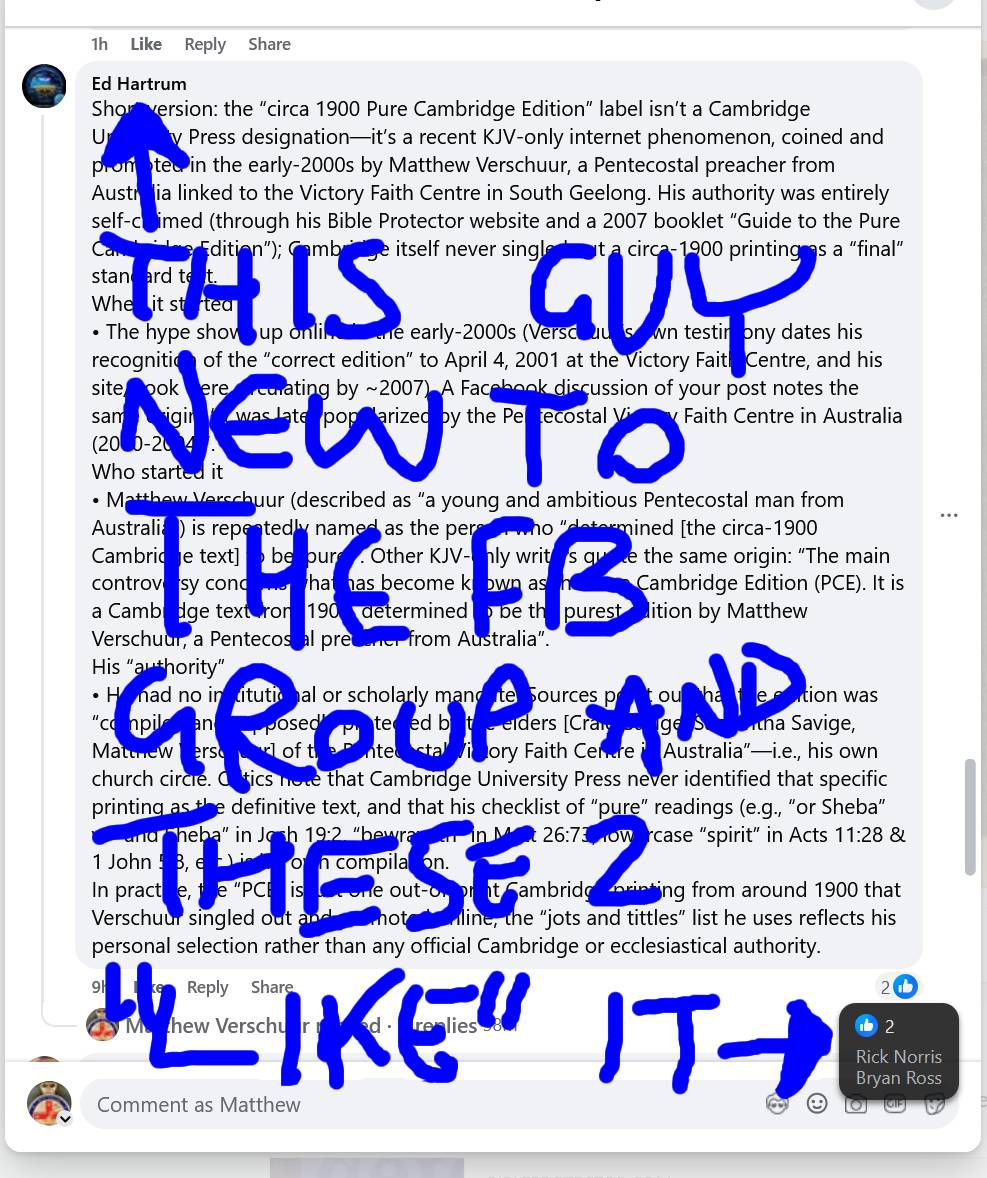
Bryan Ross’ debate continues

WHAT HAS BEEN HAPPENING

Pastor Bryan Ross has continued to maintain his position in how he wishes to be critical, in his lesson notes, number 281, on my position. At this point of writing, we are now some way along in an ongoing back and forth (see previous entries on this blog).

In assessing Bryan Ross’ demeanour, he seems to be most upset about my Pentecostalism. I should point out, however, that I am actually a Word and Spirit Christian, which movement is really a mixture of Word of Faith doctrine and takes an equal measure of Fundamentalist, Reformed and Puritan information (most especially in regards to the King James Bible).

I am sure that Pastor Ross does not ascertain how many different views there are that are labelled “Pentecostal”, nor the difference between “Word of Faith” and “Word and Spirit”. I expect also that he doesn’t grasp this because his own views are cessationist, and because it is common and easy for Baptists to view Pentecostals as all the same, when in fact there are wide differences between them.

It seems very evident that Ross appears to want to frame the Pure Cambridge Edition of the King James Bible as having some Pentecostal specificity, whereas the reality is that this is an Edition edited by Cambridge in the circa early 1900s.

ROSS PUTS UP UNFAIR BARRIERS

It’s an easy tactic for people who want to use an appearance of scholarship that they say, “you didn’t back that point with verifiable facts”, like not citing sources or something. It’s a trick done by people like Rick Norris too, who act like they can’t accept something because they want to act like information has no credibility.

The question at hand is whether Cambridge did edit the King James Bible to make a particular Edition which has been printed many times and can be identified.

We live in objective reality, and even Professor Norton has mentioned a few things, but somehow, Ross will deny or question because no information has been extracted from any archival or written record. We have the empirical textual evidence while no archival information has been forthcoming. Ross cannot blame me for CUP’s poor institutional memory.

Ross seems to fluctuate on this point because he tries to make every individual edition, each with its little errata or whatever, as different to every other. And while there are editions, there is also an Edition, which is the same editorial text which those editions are following.

It is strange that Ross apparently cannot tell the difference between Cambridge King James Bibles printed in the 20th century, that there is a clear conformity to an Edition in a whole raft of printings throughout that century. That is to say, that if we had a matrix of particular editorial readings, we would find a whole lot of editions matching together, agreeing completely on their editorial form, and “substantively” in their own presswork.

ROSS’ ONGOING CONFUSION ABOUT THE IDENTIFICATION LIST

When we (the Elders of Victory Faith Centre) were looking at the editions of the KJB, I came up with a series of test passages that could be used to identify this Edition. This was happening in about 2001. The identifying of the PCE was in making sure that a Bible being tested matched all the readings.

So this could be considered as a short matrix of measurement to see whatever Bible you were looking at, whether at a shop or you owned, was matching the PCE or not.

The basis of this was several articles by King James Bible only people who talked about publishers making changes, or differences in meaning in modernised or other editions of the KJB. Further, people at that time, who were prominent in the KJBO movement, did say that they preferred Cambridge over Oxford, and reference was usually made to Joshua 19:2, etc.

I personally was only wondering about the difference between “Spirit” and “spirit” in 1 John 5:8. Everything else was fine, and all the differences were on a meaning and historical basis (e.g. going to 1611 or what was proper, etc.) At that time people would even say “Savior” is erroneous, you have to have “Saviour” because it has seven letters.

Because in comparing editions, one of the areas people were looking at was the word “Spirit”, that was obviously an issue. Note, this was nothing to do with Pentecostalism. There was some theological aspect, but that was more in passing and simplified. For example, unlearned people, if they were shown a KJV verse that had “spirit”, they might automatically think it should be changed to “Spirit” because that’s “proper”.

So, the tests were just the product of looking at editions, and they were not driven by any focus on Pentecostalism, as those discussing the issues were Baptists.

Now, when I understood that 1 John 5:8 was lower case in many old editions, and that the word “spirit” appeared elsewhere lower case in all normal KJV editions, I then tried to think how 1 John 5:8 could be right.

As a particular kind of Pentecostal, I certainly could see how it could be lower case. But that was me thinking now in line with my theology, but my theology was a broad evangelical one that includes sanctification doctrine, etc. I saw how 1 John 5:8 could match in with that.

Now Bryan Ross has tried to make it some sort of narrow Pentecostal choice that 1 John 5:8 was accepted as lower case “spirit”, but it was, as I say, me looking at it as a Pentecostal Christian with evangelical doctrine.

Bryan Ross has tried to read in Pentecostalism to the fact that six of the 12 tests to identify the PCE are to do with the word “Spirit” or “spirit”. But that obviously was not the case.

A few years later, when I was actually using the tests specifically to give historical, logical and theological reasons for why one was right and one not so good, I obviously argued as a person having Pentecostal doctrine, but that is only part of what is to be taken as my view.

What Pentecostal doctrine would be involved in Joshua 19:2?

And as I have had to constantly say to Bryan Ross, who seems to be stuck in a rut, we are talking about pneumatology and Trinitarian doctrine (in relation to Matthew 4:1) so the whole matter cannot be “Pentecostal” as he seems to obsessively imply.

EDITIONS WHICH MATCH SOME OF THE TESTS

There are various editions which may, even historically, match some or many of the 12 diagnostic readings. That is to be expected for various reasons. Ross seems to not understand this, or keeps on trying to make a non-point about it.

Yes, there are editions that might match some tests, because to have those readings or editorial choices in those places are good. The PCE is measurable and identifiable because it matches all the tests.

The tests are not places where Cambridge made changes when they made the PCE. That’s not what the tests are for. If you want to know about changes, just look at the Victorian Cambridge readings and compare them to the PCE.

THE CUP LETTER

I do not want to get bogged down in trivialities, but it is apparent Ross wants to milk all he can by brandishing about a CUP letter from 2010. That letter shows that CUP knew very little about their own print history, but it seems apparent that Ross is gleeful at their ignorant statements which he is repeating as if “facts” from the lion’s mouth.

CUP wrote, “Some new Cambridge editions were originated during the 1920s and 1930s, apparently using as their pattern copy a version that (nearly) accords with your expectations.”

So, a manager at CUP in 2010 writes that some of their current editions are close to being PCE (they are post-PCE), and doesn’t seem to realise that there were many printings of the PCE and of near-PCEs (doctored Victorian editions) between 1910 and 1985 (and later).

Cambridge were talking about editions from the 1920s and 1930s that they had at hand which they knew, in 2010, were differing in 1 John 5:8, and perhaps Acts 11:12 and/or verse 28. It appears as if Ross is making out as if CUP was saying that their editions in the 1920s and 1930s did not match the PCE. This is blatantly wrong, and I am questioning why Ross did not explain the situation clearly about what CUP actually said.

The reason why Ross wants to misinterpret, I think, is because he wants to say that no printed Bible from Cambridge is a PCE. I think he wants to deliberately not acknowledge that an Edition is a set of editorial readings, but instead he wants to take individual printings and use some minutiae in any copy (no doubt like a missing full stop somewhere that the printing plates didn’t ink properly) and say that this constitutes an edition that is separate. Thus he fabricates his main argument that basically the PCE first appeared on the Bible Protector website in 2007.

Ross goes on to make his summary of CUP’s letter, saying, “inconsistencies in Bible Protector’s identifier lists”. Again Ross is not representing the reality of the situation. While he is communicating a mistaken view by CUP, he does not clarify with his own understanding that CUP were equating the 12 test places (a diagnostic matrix) as the same as a list of specific editorial differences between common editions. This was wrong of them to do, because they were confusing a list of diagnostic markers with a list of editorial differences. It is telling that Ross doesn’t clarify to explain that, rather, it appears he wants to magnify in CUP’s quizzing onto my work. He is employing a tactic of casting doubt by proxy, a technique much used by Rick Norris.

Now in case Ross is ignorant, I will explain: the 12 tests are tests for any edition where the 12 tests must align as based upon specific points in the PCE, where the PCE will have all 12, and only having all 12 is a pass. Besides this, I did a comprehensive (but not completely exhaustive) comparison between London, Oxford and the Victorian Cambridge editions, so that what changes from a Victorian Cambridge to the PCE could be known, what were the main differences between Oxford and Cambridge, and what wrong changes had been made in the Concord and modern Cambridge editions.

Ross says that the CUP letter, “is a documented non-endorsement of a singular, consciously created, Cambridge-recognized ‘PCE’ edition”. But of course, that’s Ross’ wishful thinking, the actual evidence of printed Bibles shows the opposite of his view, but I guess he just wants to be ignorant or not to accept the actual facts.

ROSS STILL TRYING TO WIN POINTS ON THE TESTS

Bryan Ross has made a lot more about Pentecostalism and the 12 tests than what really exists.

Ross has repeatedly tried to make a case that I used Pentecostalism to make the 12 tests, or some of them at least, and/or that they were for doctrinal reasons (i.e. Pentecostal).

He says, “I find myself compelled to clarify why such a claim cannot bear doctrinal or methodological weight.” I will explain it again. At that time KJBOs were looking at differences in editions, and the case of the word “spirit” was one of the issues mentioned, e.g. in Genesis 1:2, etc. Now obviously there is a certain level of doctrinal bearing in this, but the reality is that the discussions around Joshua 19:2 and Jeremiah 34:16 etc. at the time were around that Cambridge was right, and that it matched 1611 and these sorts of things.

While some theological study or element was broadly involved, things like old editions and so on were also a factor. The 12 tests were not selected on specifically weighty grounds, they were in fact a set of verses to test editions with.

A year or two or three later, I then decided to use these important test markers to really study them out, to create a hermeneutical approach for studying editorial differences. My own Guide the PCE is my real time demonstration and study of these.

Ross says, “When one examines your published Guide, it is beyond dispute that your rationale for half of the twelve PCE diagnostics are grounded in explicitly Pentecostal categories”. This is Ross’ “paranoia” or “obsession”. He sees the word “Spirit” or “spirit” and that’s what he thinks. A Pentecostal conspiracy.

Here are many facts:

  1. The difference between “Spirit” and “spirit” as far as the text of the KJB has not been an explicit Pentecostal doctrine at all.
  2. The selecting of the test passages was on empirical, comparative grounds, not with some special loyalty to Pentecostalism.
  3. How could that be the case anyway, since the readings include some from 1611, those from 1629, in 1769, and in Victorian Cambridge editions, as also passing through the hands of the PCE editor in the early 1900s with no change.
  4. I wrote the drafts of my guide from late 2002 through several years, and it was only in this process that I began to really look deeply at “proving” with theological reasons why the PCE was right by showing a method of editorial-testing hermeneutics, which I demonstrated on the 12 tests to furnish the reader with examples. Since I am Pentecostal, I gave reasoning from my theological perspective.
  5. The word “Spirit” being capital in the Bible and the doctrine of pneumatology are not specifically Pentecostal: they are also Baptist doctrines.
  6. King James Bible only people were writing about the case on the word “Spirit”/”spirit” in various places before I wrote my book.

Yes, it is a fact that King James Bible onlyists were mentioning the word “Spirit” in various places, even to this day one of those articles can be easily found online.

ROSS ASKS ANOTHER QUESTION ON THE 12 TESTS

I heard Bryan Ross make a good question, if it was serious, he asked to the effect, if the tests didn’t come from doctrine explicitly, then why are they important. My answer is that they came from a mixture of KJBO doctrine, examination of historical editorial renderings and logic/common sense. In other words, it is clearly providential.

Here’s exactly what I did, I looked at 1 John 5:8 in my “modern” Cambridge KJV, it was “Spirit”. I then looked at a bunch of old KJVs. They had “spirit”. Then I thought about why could it be “spirit”, what was the meaning distinction. It is an evangelical doctrine, if you look at verse 9 it says about having a witness or knowing. Okay, I’m a Pentecostal who believes evangelical doctrine. Then it makes sense to me.

Also, 12 tests relating to the word “spirit” or “Spirit” case is one about faithfulness to the 1769 tradition, nothing to do with something changing there to “make” the PCE. Well, except that Matthew 4:1 and Mark 1:12 were changed, but that already existed in some other contemporary editions.

ROSS TRYING TO MIX UP ABOUT COPY-EDITING

The PCE was made in the early 1900s it seems. That Edition was printed in many editions. Each of those different editions of the PCE, while agreeing on an editorial level, may have typos or differ at some minor point on a copy-editorial level.

I took representative editions of the PCE, did copy-editing and made an exactly correct electronic text.

The PCE file on my website is not a new Edition because the editing that produced that Edition happened some time around the start of the 20th century.

I hope I am being very clear to explain that an Edition is a set of editorial choices, and many editions of an Edition can exist. So, we have one edition, a text file, which represents and is a typographically correct copy of the Pure Cambridge Edition, but it is one edition, just like there were many printed vintage Bibles.

Ross overstrains this issue by using the word “non-identical”. He is trying to cast doubt on the Edition by looking at differences of an exceedingly minor nature in editions. So if one copy has “and” while another has “And”, he is saying that they are “non-identical”, which of course is technically true, but he is using it in a way to make it seem like the idea is “totally different” when the actual difference is not editorially significant, only significant in a copy-editing sense, where it was identified and dealt with.

Of course, words and letters are important, but the reason why Ross wants to major on these minors is because he is trying to frame the issue in light of his own created enemy category called “verbatim identicality”. I am of course not pigeon-holed in his false dilemma categories.

These minor copy-editing matters can be easily resolved, and that is what happened to create an exemplary form or copy of the Pure Cambridge Edition. This is what you can access through my Bible Protector website.

AGAIN ABOUT THE TESTS

It is interesting how that Ross thinks always according to the worst assumption. For example, he accused me of making the 12 tests to include 6 secret rejoinders to promote Pentecostal doctrine.

This of course is wrong.

I said that my deeper studies into those areas were made later than finding markers to identify the PCE out of a selection of other editions.

He then responded, and I summarise for clarity, If (Pentecostal) doctrinal commitments were not the reason for choosing the 12 tests, then why have them at all, wouldn’t they just be arbitrary?

I have already answered above, but I will again.

At that time, KJBO materials were producing some comparison tables or commenting on things in editions where they were upholding one and not another. In those tables were multiple entries for the word “Spirit”. These people were Baptists. There were several websites. Only one still exists today.

That’s how the tests were made: they came from the background of people mentioning these sorts of things for doctrinal reasons, they came from me looking at old editions and they came in the context of rejecting Americanised spelling/editing editions too.

While I obviously had a sense of the importance or agreement to the PCE’s correctness in these tests, I later decided to use these tests to really give a meaningful case for the correctness of the PCE, which was much more comprehensive. That was the in depth examination in my Guide to the PCE.

Ross just can’t help himself, he wants to criticise when I looked into these test areas. He says, “Here are the exact spots where you claim you had already settled the ‘correct’ PCE readings before bringing Pentecostal theology into it (i.e., text first, theology later)”.

Notice how he wrongly casts the tests as “correct PCE readings” when all readings in the PCE are correct and these things were just diagnostic tests to identify that a copy of the KJB is the PCE rather than being any other edition.

I then later used the tests as examples of why they would be correct. It’s not that these 12 places are particularly more correct or in themselves something vital, but because they represent a set of editorial readings.

They are not primarily about positive editorial changes being made, but are actually more the opposite, to counter the negative or alternative form. Yes, the other rendering would be “less pure” on an Edition level.

Do I need to say that the KJB’s translation and version-readings are pure, and that this is a different measure of purity?

If I say my collation or representation is “more pure” if measuring typographic accuracy than other editions, but I hope Bryan Ross does not just want to make out something bad.

Here’s a table:

The Scripture is more pure than other writings.

The KJB’s version is more pure than any TR or version.

The KJB’s translation is more pure than any other English Bible.

The PCE is a more pure Edition than any other Edition/edition.

Bible Protector’s text file and collation of the PCE is more pure than any other text file or representation.

So, the Pure Cambridge Edition is identifiable through a consistent set of editorial readings present in numerous Cambridge printings from the early twentieth century onward. The evidence of Cambridge printings shows that a stable editorial text existed in the early twentieth century. The identification tests were developed as a practical way of recognising that Edition among all settings or texts of the King James Bible.

ONE FINAL POINT

Ross is simply wrong when he says, “the PCE’s authority, in Verschuur’s system, depends not on evidence from the printing record but on the acceptance of his overarching Historicist, theological, and symbolic framework.”

Not only was I not a Historicist when I first knew about the PCE, but it is very evident that the entire argument is from the printing record. So Ross’ interpretation of the objective reality is wrong and his perspective leads him to frame my position incorrectly.

And a general thought: “There is therefore now no condemnation to them which are in Christ Jesus, who walk not after the flesh, but after the Spirit.” (Rom. 8:1).

POSTSCRIPT

Ross has gone quiet on his Cushing argument, where he said several weeks before that an 1829 edition from America “proves that readings Verschuur wants existed before 1900” and that the editor, Cushing, “had no Pentecostal affiliation, yet one edition from the early nineteenth century had most of Bible Protector’s desired readings. It shows that Bible Protector must arbitrarily pick and choose readings to make his PCE argument work.” Because this entire argument has collapsed since the 12 tests are not some especially favourable readings for Pentecostalism or for any other special doctrinal necessity. Ross’ entire reason for mentioning Cushing was on a wrong premise. Ross also wrongly states that the 12 readings are somehow arbitrary, but that makes no sense, and now, after reading this blog post, I am sure Ross will have even less reason to mention anything along these lines since the 12 tests were formed from lists created and discussed by Baptists, and sometimes from examples like ones they were mentioning.

The time frame was about the year 2001/2002.

Joshua 19:2 – explicitly mentioned by leading KJBOs and anti-KJBOs

2 Chronicles 33:19 – explicitly mentioned by leading KJBOs and anti-KJBOs

Job 33:4 – this or similar in a list discussion by some KJBOs

Jeremiah 34:16 – explicitly mentioned by leading KJBOs and anti-KJBOs

Ezekiel 11:24 – this or similar in a list discussion by some KJBOs

Nahum 3:16 – explicitly mentioned by leading KJBOs and anti-KJBOs

Matthew 4:1 – this or similar in a list discussion by some KJBOs

Matthew 26:39 – this potentially mentioned in a discussion against Americanisations by some KJBOs

Matthew 26:73 – this mentioned in a discussion against Americanisations by some KJBOs

Mark 1:12 – this or similar in a list discussion by some KJBOs

Acts 11:28 – this as a result of KJBO discussions about the word “Spirit”/”spirit”, where the lower case was found because the Elders of Victory Faith Centre went through and checked various instances of the word “Spirit”/”spirit”

1 John 5:8 – this as a result of KJBO discussions about the word “Spirit”/”spirit”, where the lower case was found because the Elders of Victory Faith Centre went through and checked various instances of the word “Spirit”/”spirit”, and this instance was found

By now it should be evident that Bryan Ross’ claim that Pentecostal dreams, visions, prophecies of “words” or whatever were not employed in this.

It should be further evident that the “pillar” that Ross has constructed about Pentecostalism being integral to the adherence of the PCE is wrong.

And further, Ross’ claims of some confluence of the Pentecostal movement arising in the early 1900s and the coming of the PCE as some fulfilment of Historicist prophecy has largely been an entire false narrative woven together by Ross that has come to nothing.

One only hopes he doesn’t accuse of numeretics on the 12 test references, or of favouring the book of Matthew three times, or something similar.